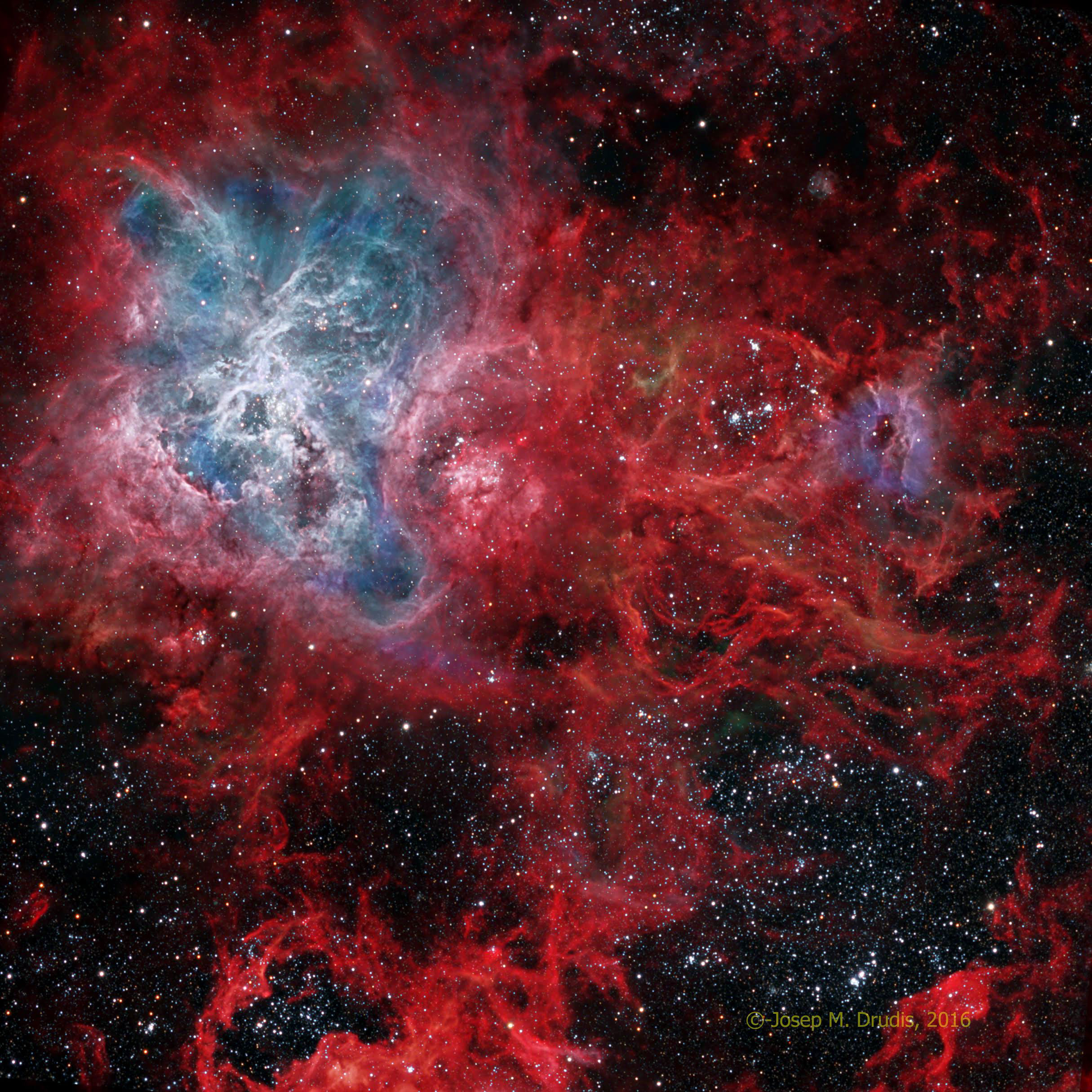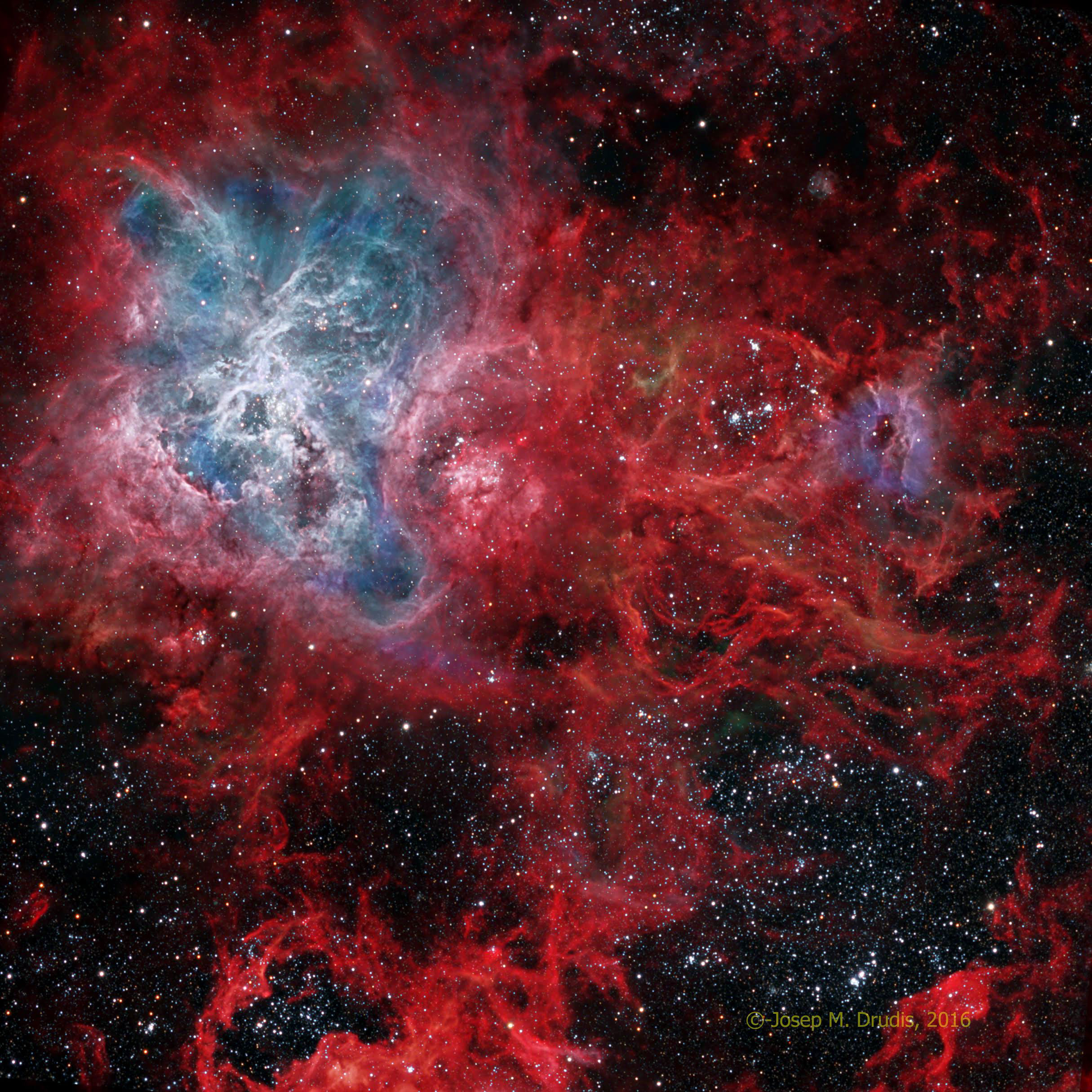
It is the largest and most complex star forming region in the entire galactic neighborhood. Located in the Large Magellanic Cloud, a small satellite galaxy orbiting our Milky Way galaxy, the region's spidery appearance is responsible for its popular name, the Tarantula nebula. This tarantula, however, is about 1,000 light-years across. Were it placed at the distance of Milky Way's Orion Nebula, only 1,500 light-years distant and the nearest stellar nursery to Earth, it would appear to cover about 30 degrees (60 full moons) on the sky. Intriguing details of the nebula are visible in the featured image shown in colors emitted predominantly by hydrogen and oxygen. The spindly arms of the Tarantula nebula surround NGC 2070, a star cluster that contains some of the brightest, most massive stars known, visible in blue in the image center. Since massive stars live fast and die young, it is not so surprising that the cosmic Tarantula also lies near the site of the closest recent supernova.
Es la región más grande y compleja de formación estelar en toda la vecindad galáctica. Ubicada en la Nube Magallánica Grande, una pequeña galaxia satélite que orbita nuestra galaxia Vía Láctea, la región tiene una apariencia arácnida que da lugar a su nombre popular, nebulosa Tarántula. Sin embargo, esta tarántula tiene un tamaño de aproximadamente 1.000 años luz. Si se colocara a la distancia de la nebulosa de Orión en la Vía Láctea, que se encuentra a 1.500 años luz de distancia y es la región estelar más cercana a la Tierra, ocuparía aproximadamente 30 grados (60 lunas llenas) en el cielo. Detalles interesantes de la nebulosa son visibles en la imagen destacada, mostrada en colores emitidos principalmente por el hidrógeno y el oxígeno. Los brazos delgados de la nebulosa Tarántula rodean a NGC 2070, un cúmulo estelar que contiene algunas de las estrellas más brillantes y masivas conocidas, visibles en color azul en el centro de la imagen. Dado que las estrellas masivas viven rápido y mueren jóvenes, no es sorprendente que la tarántula cósmica también esté cerca del lugar de la supernova más reciente cercana.