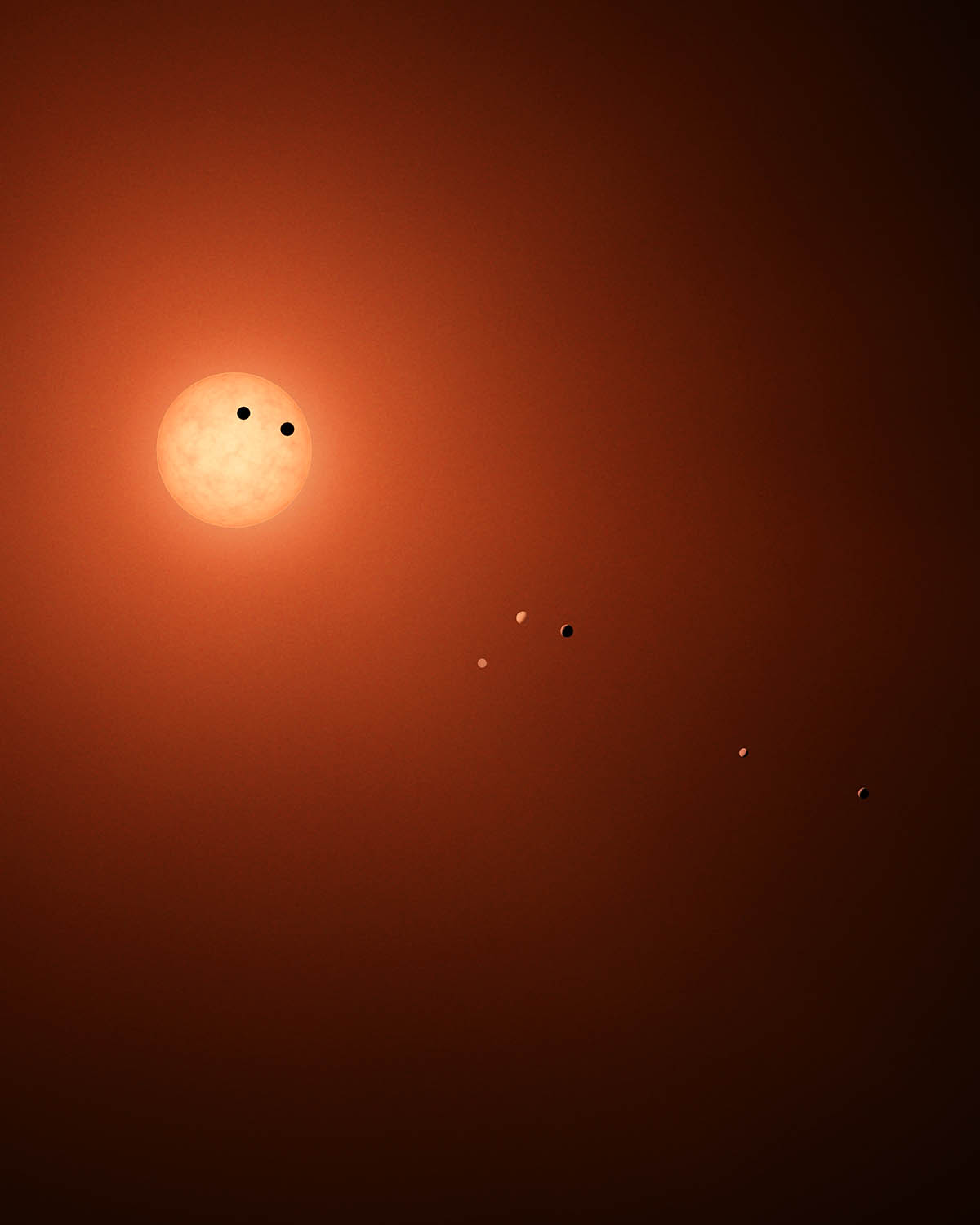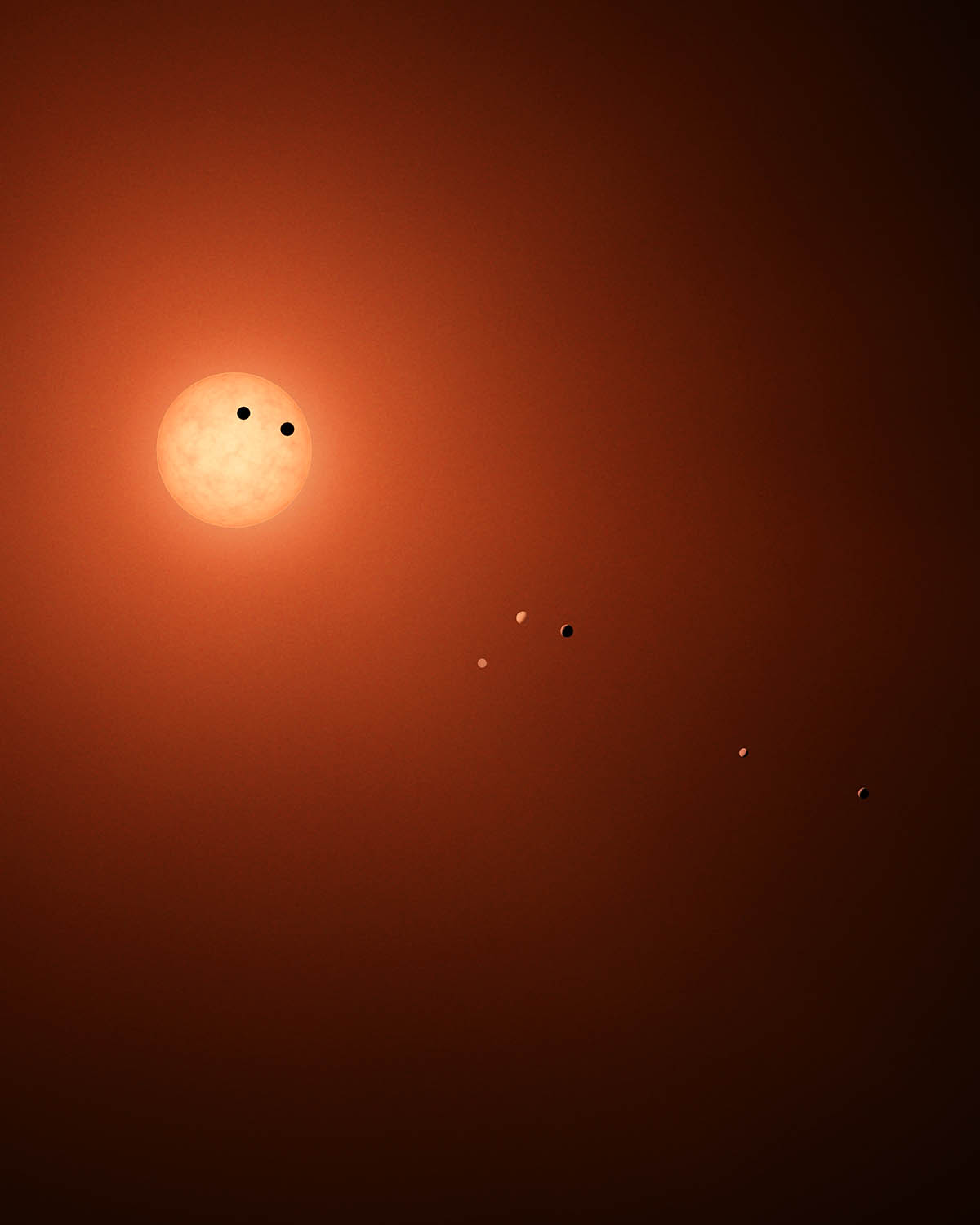
Seven worlds orbit the ultracool dwarf star TRAPPIST-1, a mere 40 light-years away. In May 2016 astronomers using the Transiting Planets and Planetesimals Small Telescope (TRAPPIST) announced the discovery of three planets in the TRAPPIST-1 system. Just announced, additional confirmations and discoveries by the Spitzer Space Telescope and supporting ESO ground-based telescopes have increased the number of known planets to seven. The TRAPPIST-1 planets are likely all rocky and similar in size to Earth, the largest treasure trove of terrestrial planets ever detected around a single star. Because they orbit very close to their faint, tiny star they could also have regions where surface temperatures allow for the presence of liquid water, a key ingredient for life. Their tantalizing proximity to Earth makes them prime candidates for future telescopic explorations of the atmospheres of potentially habitable planets. All seven worlds appear in this artist's illustration, an imagined view from a fictionally powerful telescope near planet Earth. Planet sizes and relative positions are drawn to scale for the Spitzer observations. The system's inner planets are transiting their dim, red, nearly Jupiter-sized parent star.
Siete mundos orbitan la estrella enana ultracool TRAPPIST-1, a tan solo 40 años luz de distancia. En mayo de 2016, los astrónomos que utilizaron el Telescopio Pequeño de Planetas Transitorios y Planetesimales (TRAPPIST) anunciaron el descubrimiento de tres planetas en el sistema TRAPPIST-1. Recientemente, confirmaciones adicionales y nuevos descubrimientos realizados por el Telescopio Espacial Spitzer y telescopios terrestres de la ESO han aumentado el número de planetas conocidos hasta siete. Los planetas de TRAPPIST-1 probablemente son todos rocosos y similares en tamaño a la Tierra, constituyendo el mayor hallazgo de planetas terrestres detectados hasta ahora alrededor de una sola estrella. Debido a que orbitan muy cerca de su estrella tenue y diminuta, podrían tener regiones donde las temperaturas superficiales permiten la presencia de agua líquida, un ingrediente clave para la vida. Su atractiva proximidad a la Tierra los convierte en candidatos ideales para futuras exploraciones telescópicas de las atmósferas de planetas potencialmente habitables. Los siete mundos aparecen en esta ilustración artística, una visión imaginada desde un telescopio ficticio poderoso cercano a la Tierra. Los tamaños y posiciones relativas de los planetas están dibujados a escala según las observaciones del Spitzer. Los planetas interiores del sistema están transitando su estrella madre tenue, roja y casi del tamaño de Júpiter.