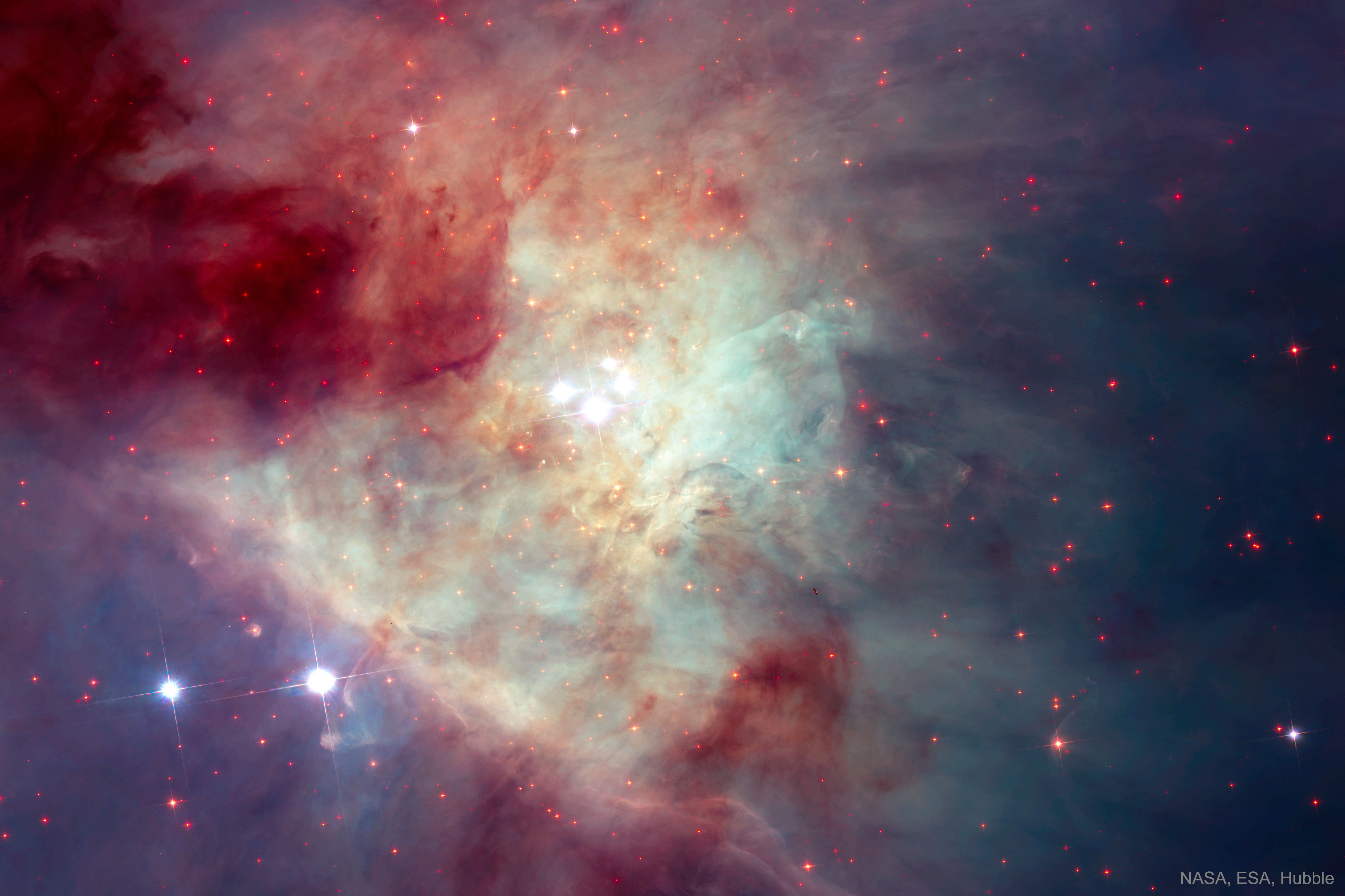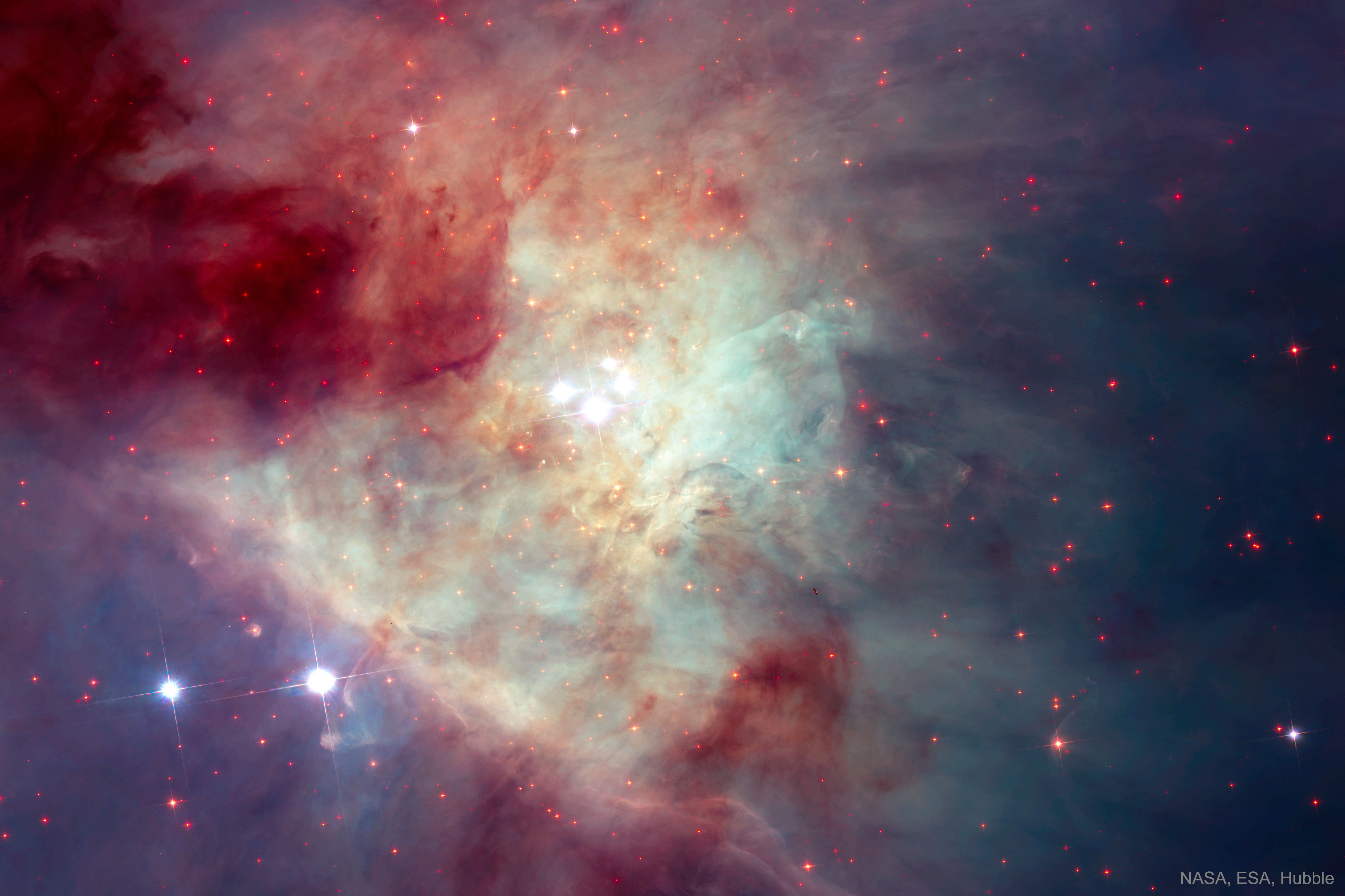
Start with the constellation of Orion. Below Orion's belt is a fuzzy area known as the Great Nebula of Orion. In this nebula is a bright star cluster known as the Trapezium, marked by four bright stars near the image center. The newly born stars in the Trapezium and surrounding regions show the Orion Nebula to be one of the most active areas of star formation to be found in our area of the Galaxy. In Orion, supernova explosions and close interactions between stars have created rogue planets and stars that rapidly move through space. Some of these fast stars have been found by comparing different images of this region taken by the Hubble Space Telescope many years apart. Many of the stars in the featured image, taken in visible and near-infrared light, appear unusually red because they are seen through dust that scatters away much of their blue light.
Comience con la constelación de Orión. Debajo de la cintura de Orión se encuentra un área difusa conocida como la Gran Nebulosa de Orión. En esta nebulosa se encuentra un brillante cúmulo estelar conocido como el Trapecio, marcado por cuatro estrellas brillantes cerca del centro de la imagen. Las nuevas estrellas en el Trapecio y en las regiones circundantes muestran que la Nebulosa de Orión es una de las áreas más activas de formación estelar en nuestra región de la Galaxia. En Orión, explosiones de supernovas e interacciones cercanas entre estrellas han creado planetas errantes y estrellas que se mueven rápidamente a través del espacio. Algunas de estas estrellas rápidas han sido encontradas comparando imágenes diferentes de esta región tomadas por el Telescopio Espacial Hubble en años distintos. Muchas de las estrellas en la imagen destacada, tomada en luz visible y infrarroja cercana, aparecen inusualmente rojas porque se ven a través del polvo que dispersa gran parte de su luz azul.