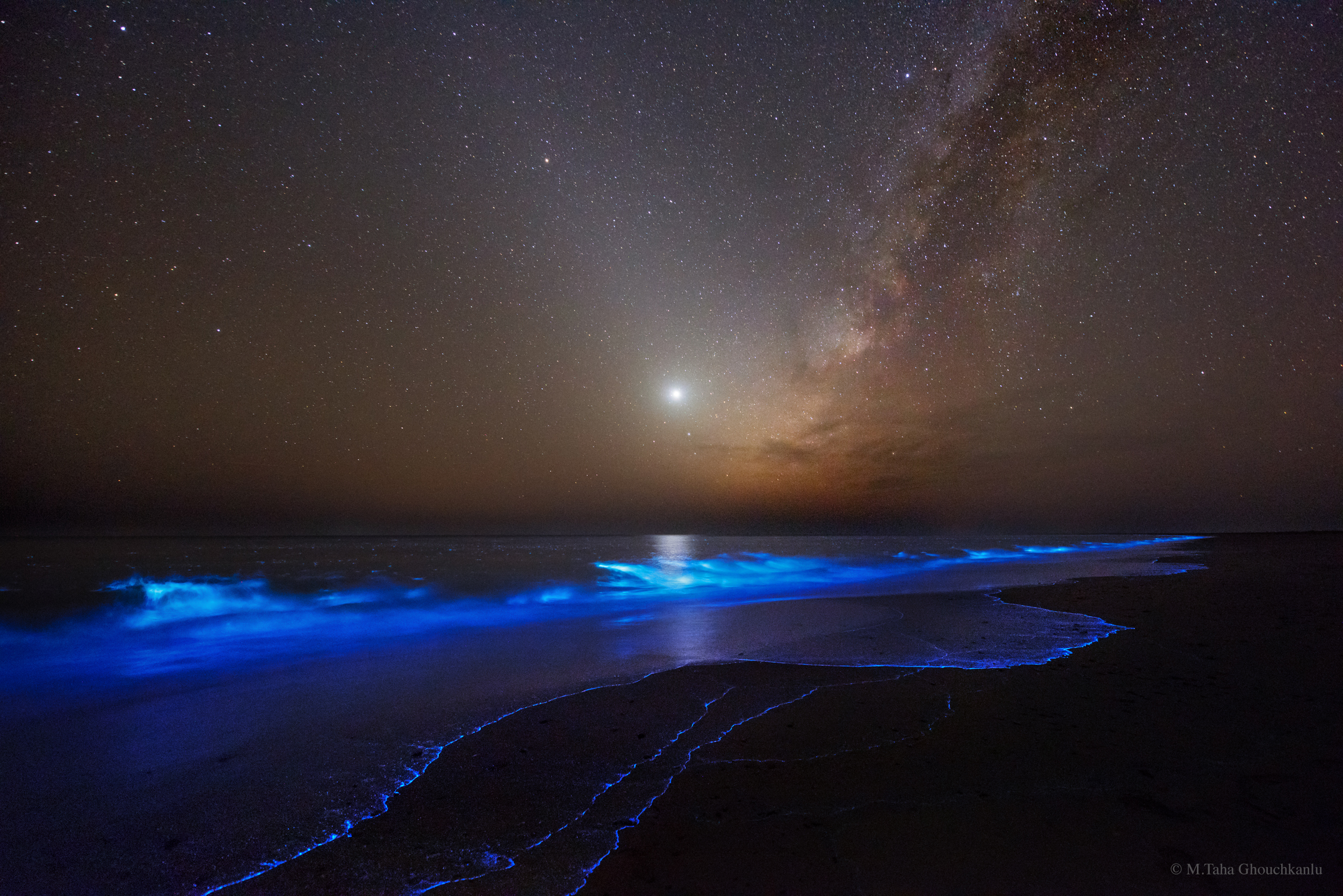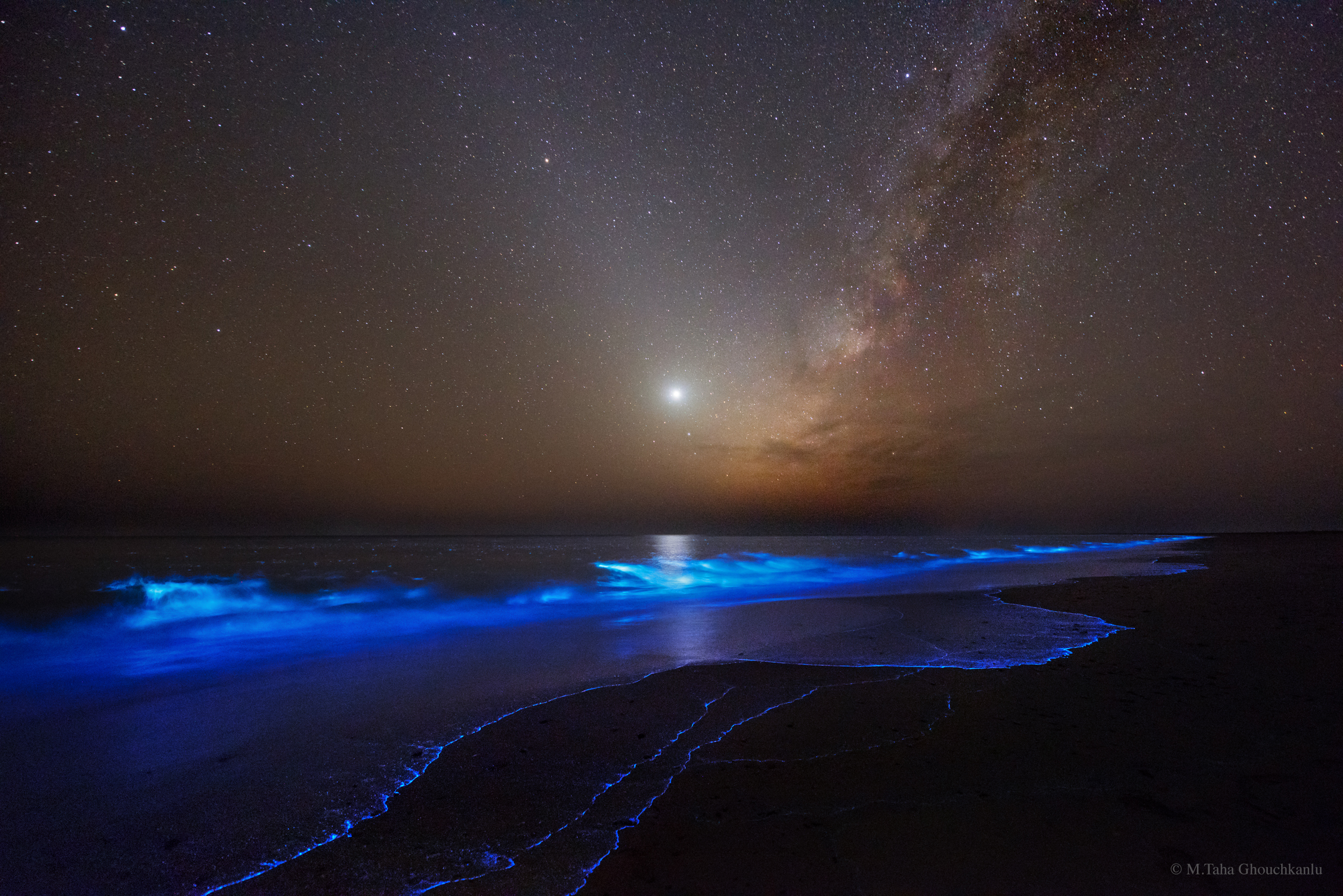
What glows in the night? This night, several unusual glows were evident -- some near, but some far. The foreground surf glimmers blue with the light of bioluminescent plankton. Next out, Earth's atmosphere dims the horizon and provides a few opaque clouds. Farther out, the planet Venus glows bright near the image center. If you slightly avert your eyes, a diagonal beam of light will stand out crossing behind Venus. This band is zodiacal light, sunlight scattered by dust in our Solar System. Much farther away are numerous single bright stars, most closer than 100 light years away. Farthest away, also rising diagonally and making a "V" with the zodiacal light, is the central band of our Milky Way Galaxy. Most of the billions of Milky Way stars and dark clouds are thousands of light years away. The featured image was taken last November on the Iranian coast of Gulf of Oman.
¿Qué brilla en la noche? Esta noche, varios brillos inusuales eran evidentes: algunos cercanos, pero otros lejos. La superficie del primer plano brilla en azul con la luz de plancton bioluminiscente. Más allá, la atmósfera terrestre atenúa el horizonte y proporciona algunas nubes opacas. Más lejos, el planeta Venus brilla brillante cerca del centro de la imagen. Si se desvía ligeramente la mirada, un haz de luz diagonal se destacará cruzando detrás de Venus. Esta banda es la luz zodiacal, luz solar dispersada por el polvo en nuestro Sistema Solar. Mucho más lejos hay numerosas estrellas brillantes individuales, la mayoría de las cuales están a menos de 100 años luz de distancia. Lo más lejos, también ascendiendo diagonalmente y formando un "V" con la luz zodiacal, está la banda central de nuestra Galaxia de la Vía Láctea. La mayoría de las billones de estrellas de la Vía Láctea y las nubes oscuras están a miles de años luz de distancia. La imagen destacada fue tomada el mes pasado en la costa iraní del Golfo de Omán.