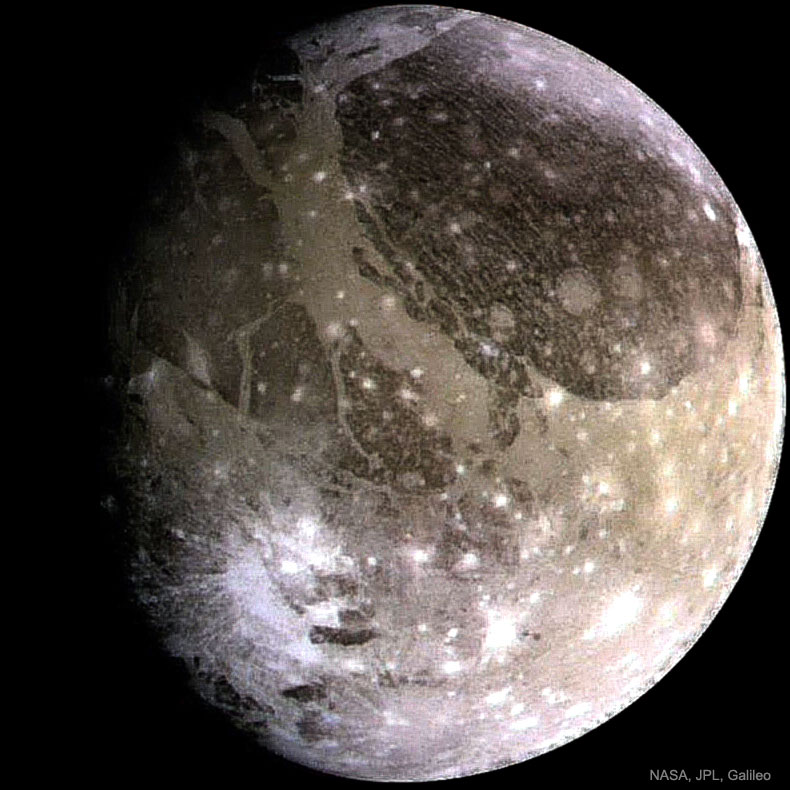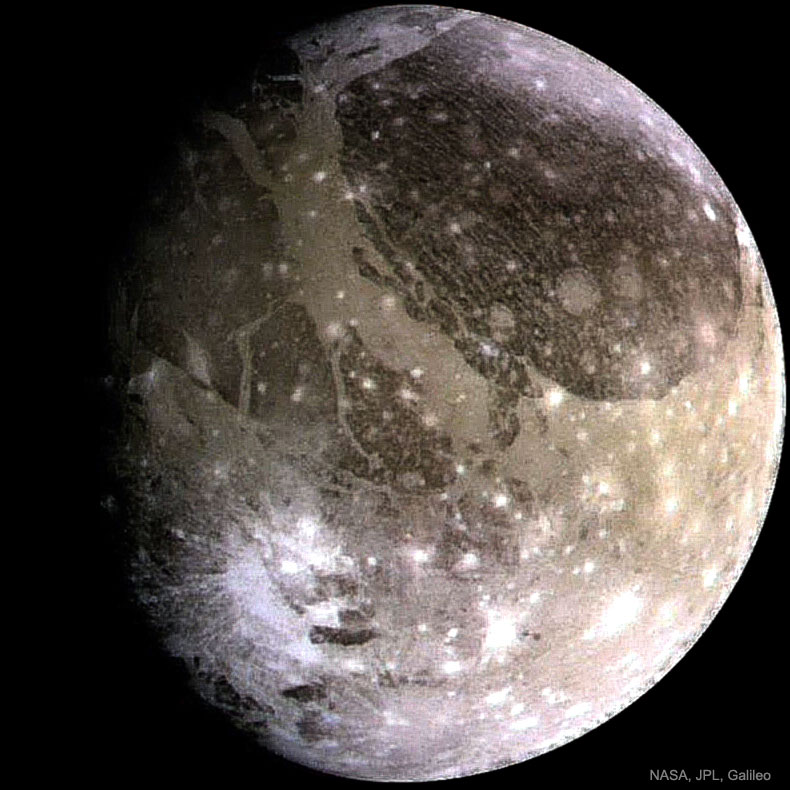
What does the largest moon in the Solar System look like? Jupiter's moon Ganymede, larger than even Mercury and Pluto, has an icy surface speckled with bright young craters overlying a mixture of older, darker, more cratered terrain laced with grooves and ridges. The large circular feature on the upper right, called Galileo Regio, is an ancient region of unknown origin. Ganymede is thought to have an ocean layer that contains more water than Earth and might contain life. Like Earth's Moon, Ganymede keeps the same face towards its central planet, in this case Jupiter. The featured image was taken about 20 years ago by NASA's Galileo probe, which ended its mission by diving into Jupiter's atmosphere in 2003. Currently, NASA's Juno spacecraft orbits Jupiter and is studying the giant planet's internal structure, among many other attributes.
¿Qué aspecto tiene la luna más grande del Sistema Solar? La luna de Júpiter, Ganimedes, más grande incluso que Mercurio y Plutón, tiene una superficie helada salpicada de cráteres brillantes y jóvenes que cubren una mezcla de terrenos más antiguos, oscuros y craterizados, con surcos y crestas. La gran característica circular en la parte superior derecha, llamada Galileo Regio, es una región antigua de origen desconocido. Se cree que Ganimedes tiene una capa oceánica que contiene más agua que la Tierra y podría albergar vida. Al igual que la Luna de la Tierra, Ganimedes siempre muestra la misma cara hacia su planeta central, en este caso Júpiter. La imagen destacada fue tomada hace aproximadamente 20 años por la sonda Galileo de la NASA, que terminó su misión sumergiéndose en la atmósfera de Júpiter en 2003. Actualmente, la nave espacial Juno de la NASA orbita Júpiter y estudia la estructura interna del gigantesco planeta, entre otros muchos atributos.