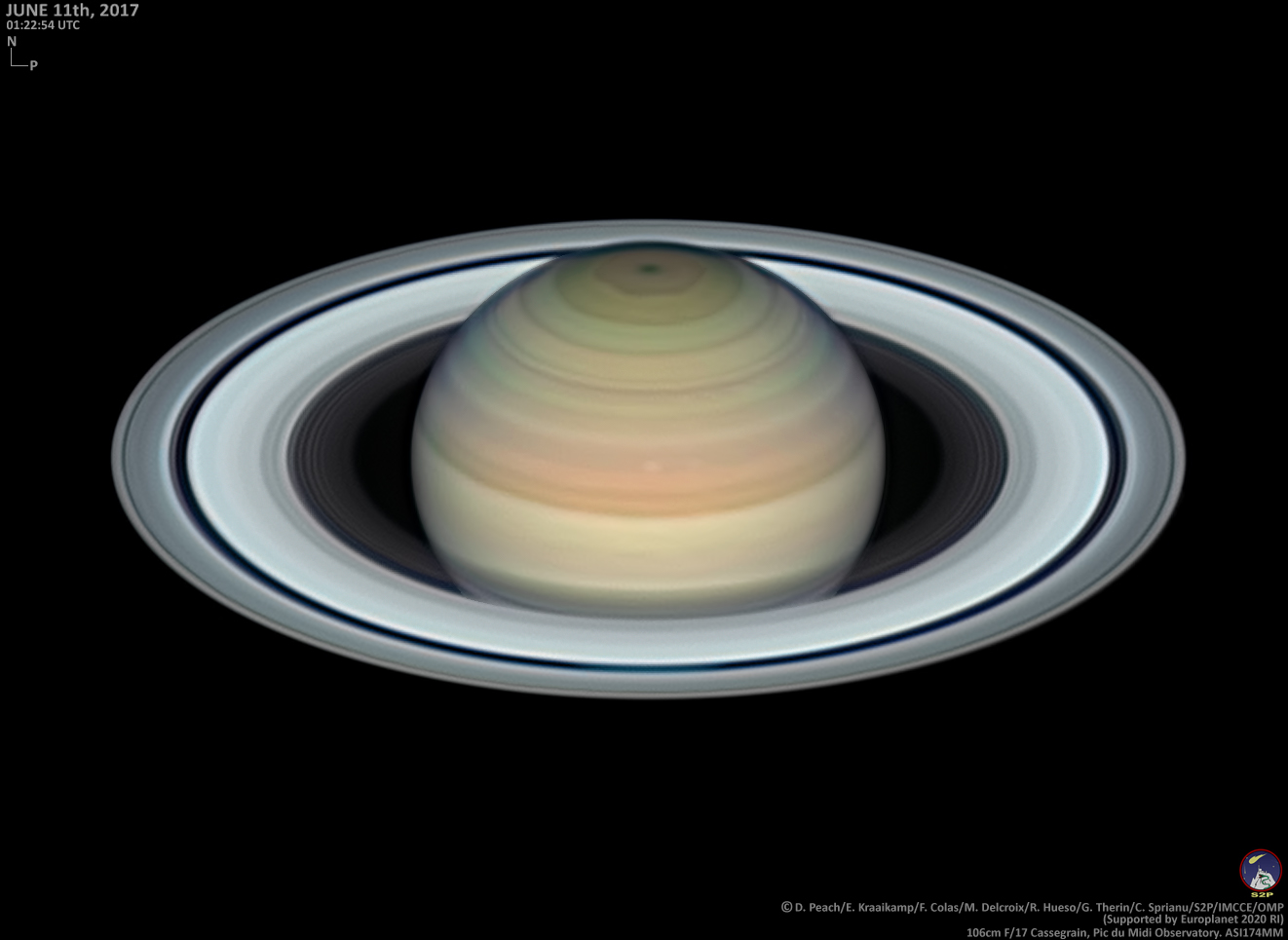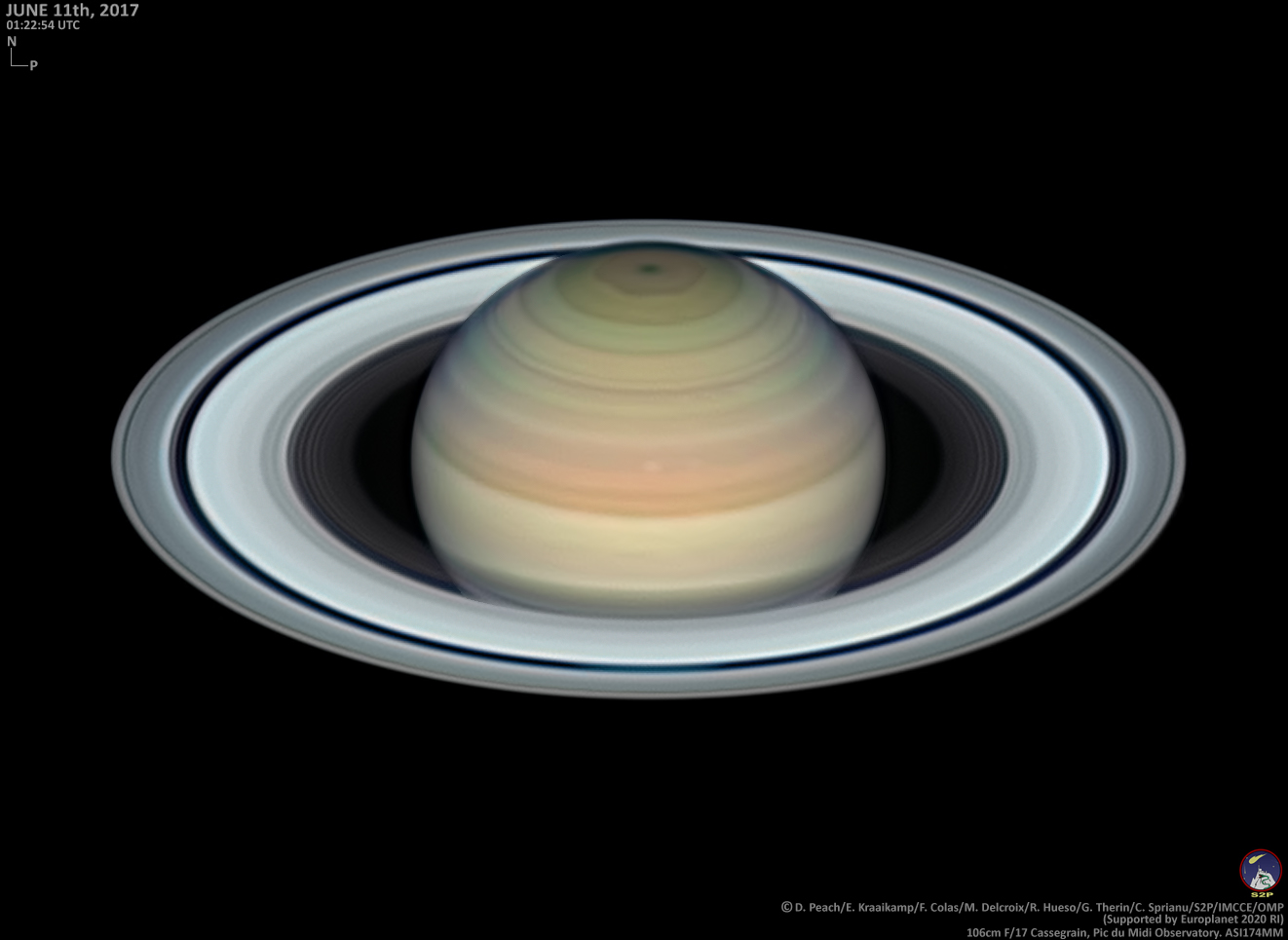
Saturn reached its 2017 opposition on June 16. Of course, opposition means opposite the Sun in Earth's sky and near opposition Saturn is up all night, at its closest and brightest for the year. This remarkably sharp image of the ringed planet was taken only days before, on June 11, with a 1-meter telescope from the mountain top Pic du Midi observatory. North is at the top with the giant planet's north polar storm and curious hexagon clearly seen bathed in sunlight. But Saturn's spectacular ring system is also shown in stunning detail. The narrow Encke division is visible around the entire outer A ring, small ringlets can be traced within the fainter inner C ring, and Saturn's southern hemisphere can be glimpsed through the wider Cassini division. Near opposition Saturn's rings also appear exceptionally bright, known as the opposition surge or Seeliger Effect. Directly illuminated from Earth's perspective, the ring's icy particles cast no shadows and strongly backscatter sunlight creating the dramatic increase in brightness. Still, the best views of the ringed planet are currently from the Saturn-orbiting Cassini spacecraft. Diving close, Cassini's Grand Finale orbit number 9 is in progress.
Saturno alcanzó su oposición de 2017 el 16 de junio. Por supuesto, la oposición significa opuesto al Sol en el cielo terrestre, y cerca de la oposición, Saturno está visible durante toda la noche, a su punto más cercano y brillante del año. Esta imagen extraordinariamente nítida del planeta anillado fue tomada solo días antes, el 11 de junio, con un telescopio de 1 metro del observatorio de Pic du Midi, ubicado en la cima de una montaña. El norte está en la parte superior, con la tormenta polar norte del gigantesco planeta y el curioso hexágono claramente visibles, bañados en la luz solar. Sin embargo, el espectacular sistema de anillos de Saturno también se muestra en detalles asombrosos. La estrecha división de Encke es visible alrededor de todo el anillo exterior A, se pueden distinguir pequeños anillos dentro del más tenue anillo interior C, y se puede entrever el hemisferio sur de Saturno a través de la más amplia división de Cassini. Cerca de la oposición, los anillos de Saturno también aparecen excepcionalmente brillantes, un fenómeno conocido como el efecto de oposición o efecto Seeliger. Iluminados directamente desde la perspectiva terrestre, las partículas heladas de los anillos no proyectan sombras y dispersan fuertemente la luz solar, creando un aumento dramático en el brillo. Sin embargo, las mejores vistas del planeta anillado provienen actualmente de la nave espacial Cassini, que orbita Saturno. En su trayectoria final, la órbita número 9 de Cassini está en progreso.