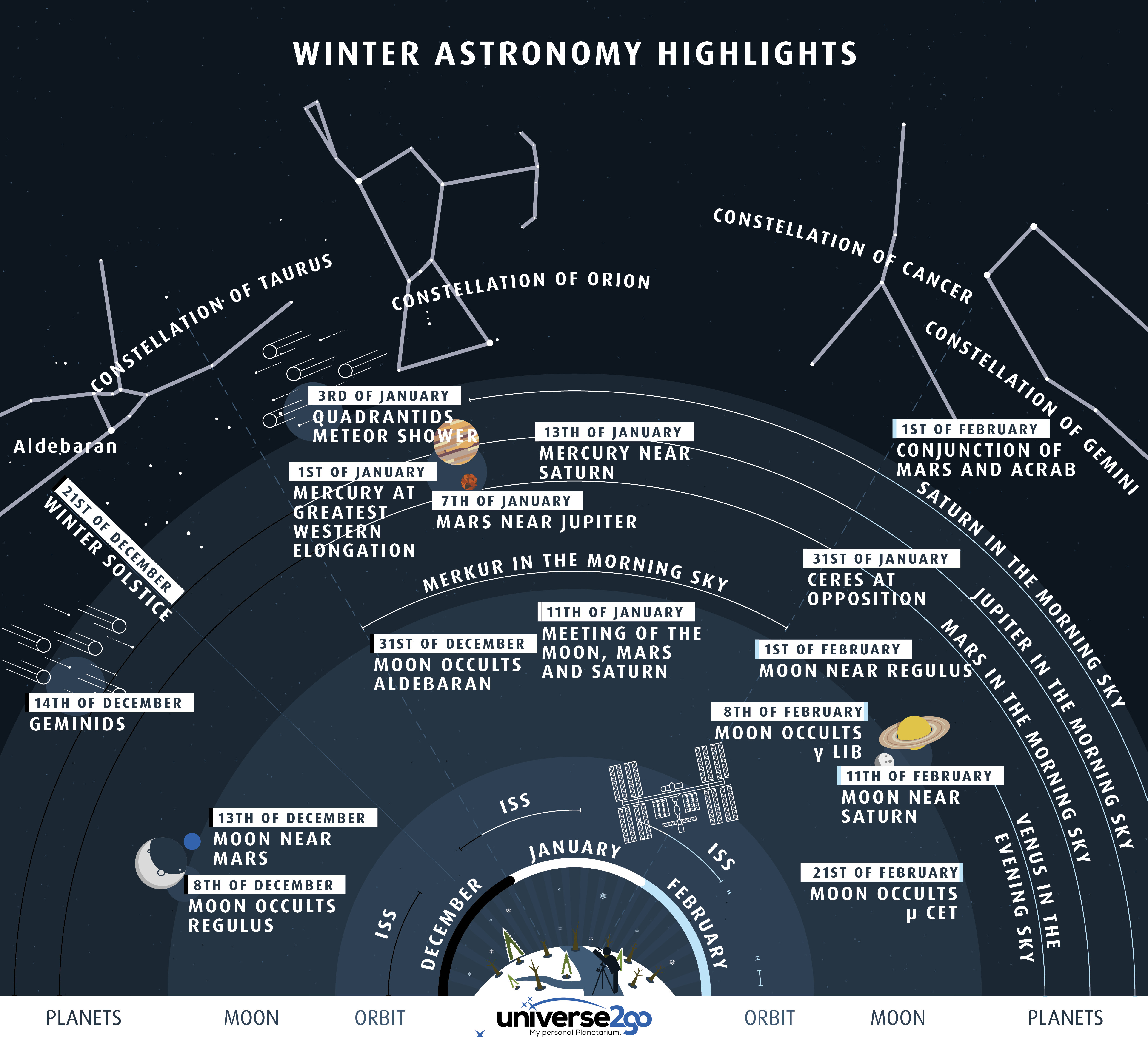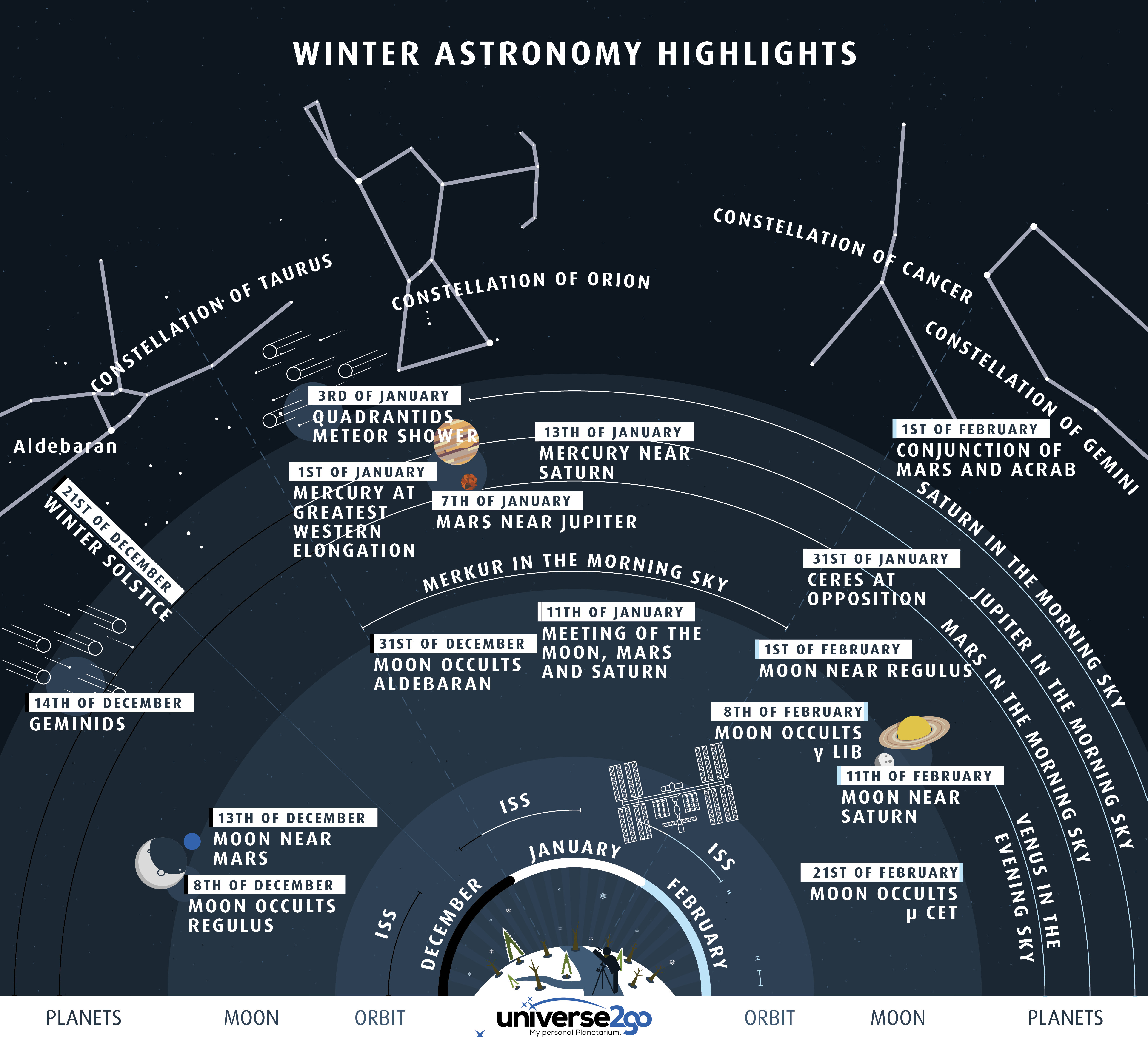
What's up in the sky this winter? The featured graphic gives a few highlights for Earth's northern hemisphere. Viewed as a clock face centered at the bottom, early winter sky events fan out toward the left, while late winter events are projected toward the right. Objects relatively close to Earth are illustrated, in general, as nearer to the cartoon figure with the telescope at the bottom center -- although almost everything pictured can be seen without a telescope. Highlights of this winter's sky include the Geminids meteor shower peaking this week, the constellation of Orion becoming notable in the evening sky, and many planets being visible before sunrise in February. As true in every season, the International Space Station (ISS) can be sometimes be found drifting across your sky if you know just when and where to look.
¿Qué se puede ver en el cielo este invierno? La imagen destacada ofrece algunos de los principales acontecimientos para el hemisferio norte de la Tierra. Si se considera el cielo como una cara de reloj centrada en la parte inferior, los eventos del inicio del invierno se extienden hacia la izquierda, mientras que los eventos del final del invierno se proyectan hacia la derecha. Los objetos relativamente cercanos a la Tierra se representan, en general, más cerca de la figura dibujada con el telescopio en el centro inferior — aunque casi todo lo mostrado puede verse sin telescopio. Entre los destacados del cielo invernal se incluyen la lluvia de meteoros Geminidas, que alcanzará su máximo esta semana, la constelación de Orión, que se volverá notable en el cielo de la noche, y la visibilidad de muchos planetas antes del amanecer en febrero. Como es cierto en cada estación, la Estación Espacial Internacional (ISS) puede verse a veces cruzando tu cielo si sabes cuándo y dónde mirar.