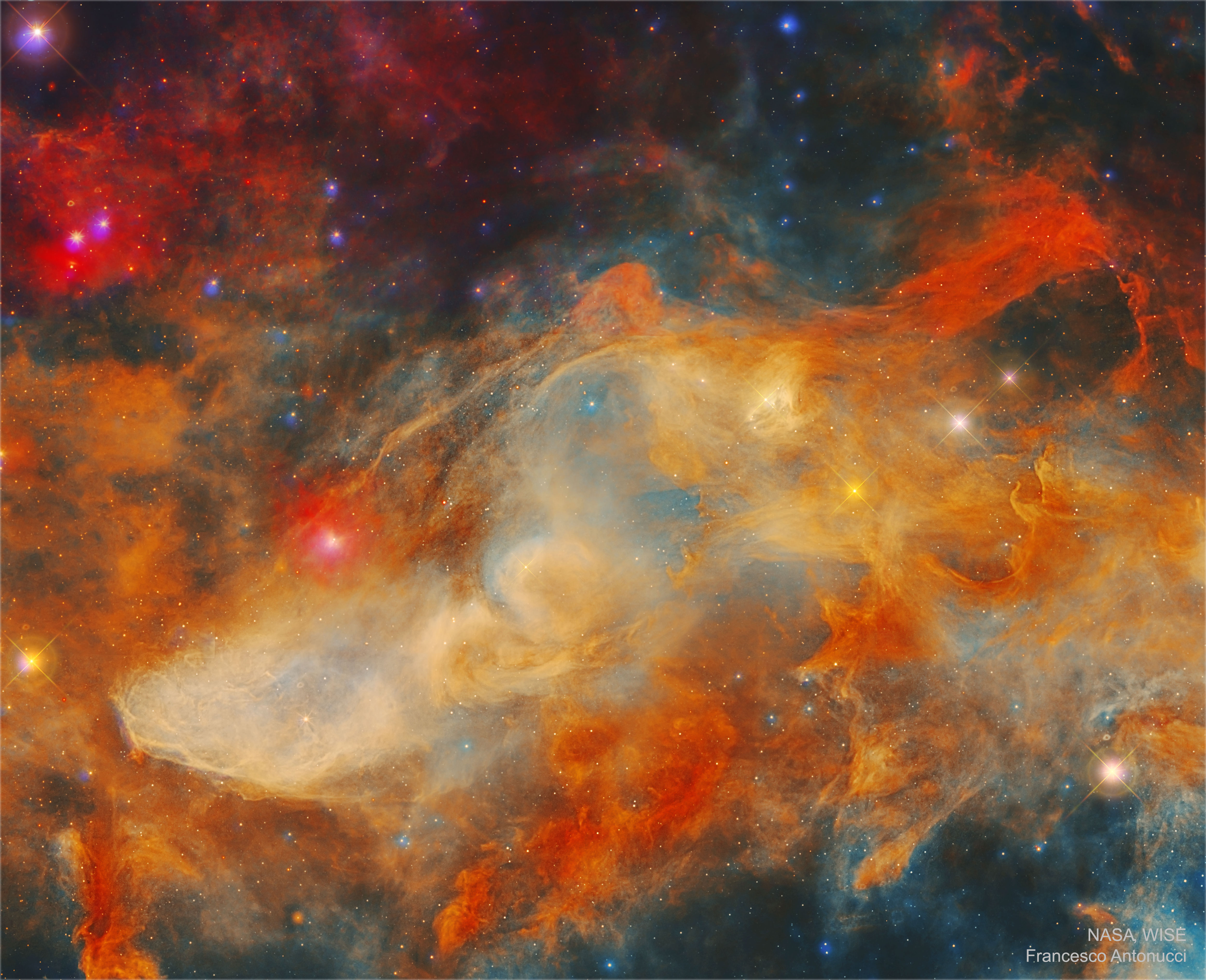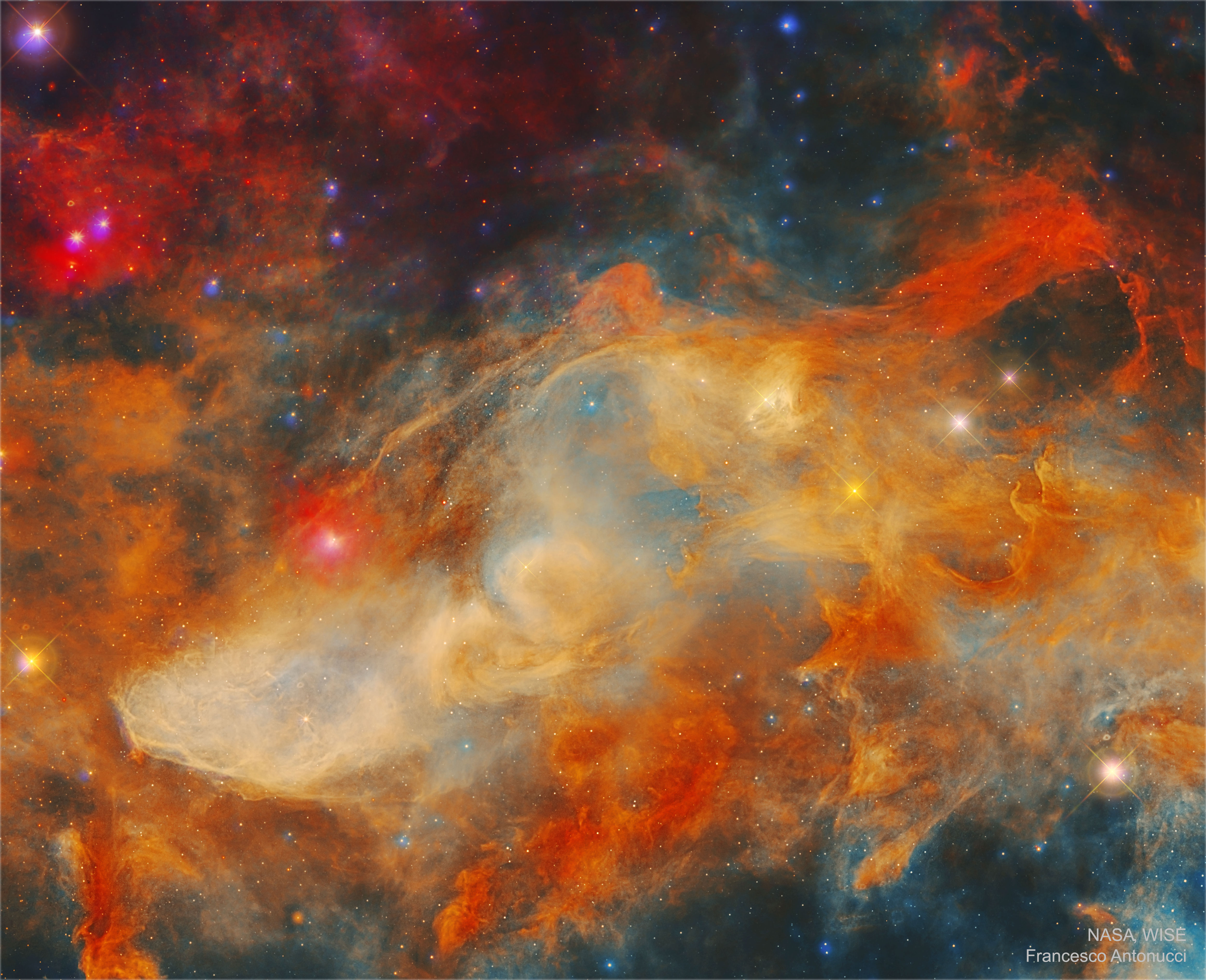
The Blue Horsehead Nebula looks quite different in infrared light. In visible light, the reflecting dust of the nebula appears blue and shaped like a horse's head. In infrared light, however, a complex labyrinth of filaments, caverns, and cocoons of glowing dust and gas emerges, making it hard to even identify the equine icon. The featured image of the nebula was created in three infrared colors (R=22, G=12, B=4.6 microns) from data taken by NASA's orbiting Wide Field Infrared Survey Explorer (WISE) spacecraft. The nebula is cataloged as IC 4592 and spans about 40 light years, lying about 400 light years away toward the constellation Scorpius along the plane of our Milky Way Galaxy. IC 4592 is fainter but covers an angularly greater region than the better known Horsehead Nebula of Orion. The star that predominantly illuminates and heats the dust is Nu Scorpii, visible as the reddened star left of center.
El Caballito de Burro Azul se ve bastante diferente en luz infrarroja. En luz visible, el polvo reflejante de la nebulosa aparece de color azul y tiene forma de cabeza de caballo. Sin embargo, en luz infrarroja, emerge un complejo laberinto de filamentos, cuevas y capullos de polvo y gas brillantes, dificultando incluso identificar el icono ecuestre. La imagen destacada de la nebulosa fue creada en tres colores infrarrojos (R=22, G=12, B=4.6 micrones) a partir de datos tomados por la nave espacial NASA Wide Field Infrared Survey Explorer (WISE) en órbita. La nebulosa está catalogada como IC 4592 y tiene un tamaño de aproximadamente 40 años luz, ubicada a unos 400 años luz de distancia hacia la constelación de Escorpión, a lo largo del plano de nuestra galaxia, la Vía Láctea. IC 4592 es más tenue, pero cubre una región angularmente mayor que la más conocida Nebulosa del Caballito de Burro en Orión. La estrella que principalmente ilumina y calienta el polvo es Nu Scorpii, visible como la estrella rojiza a la izquierda del centro.