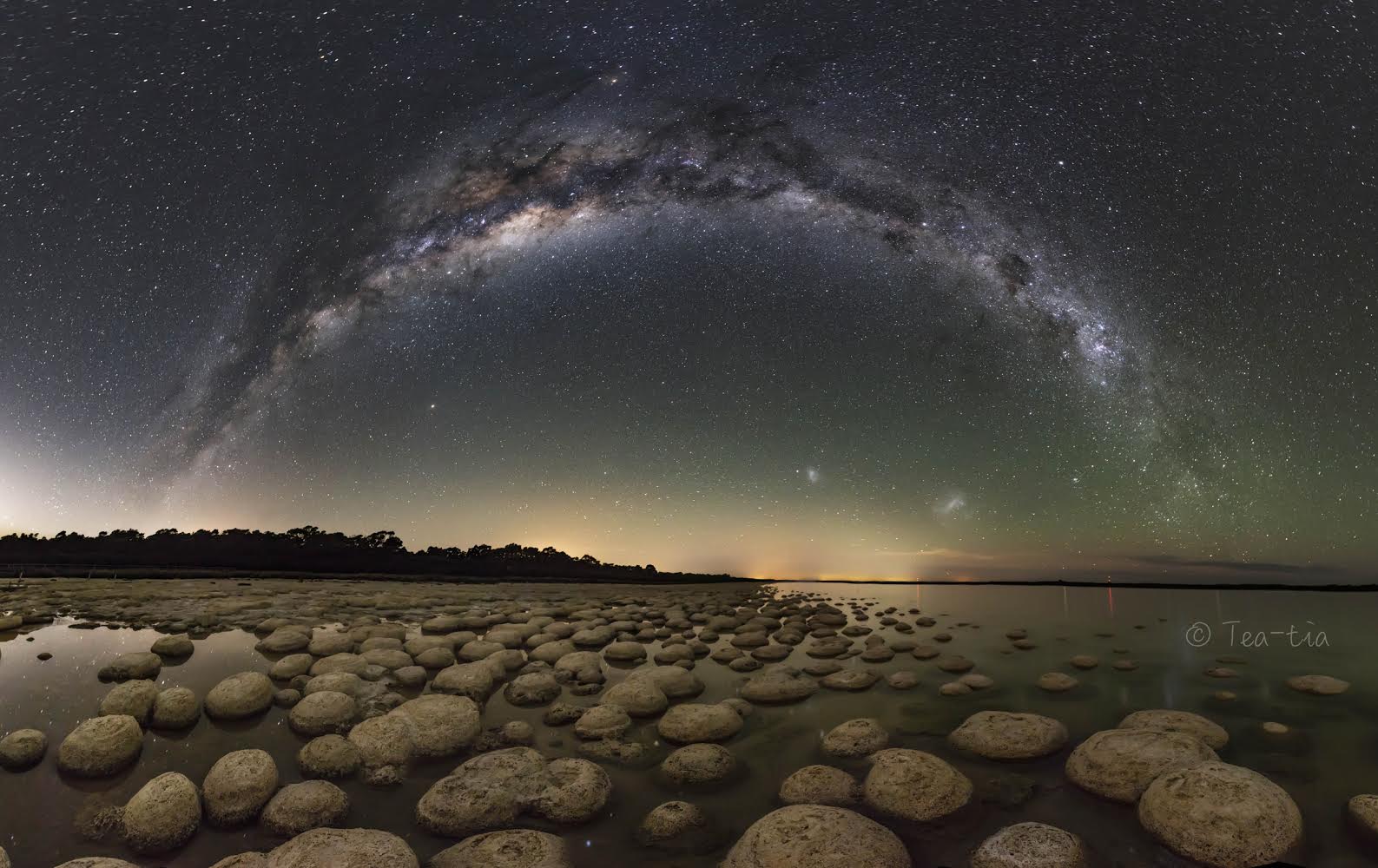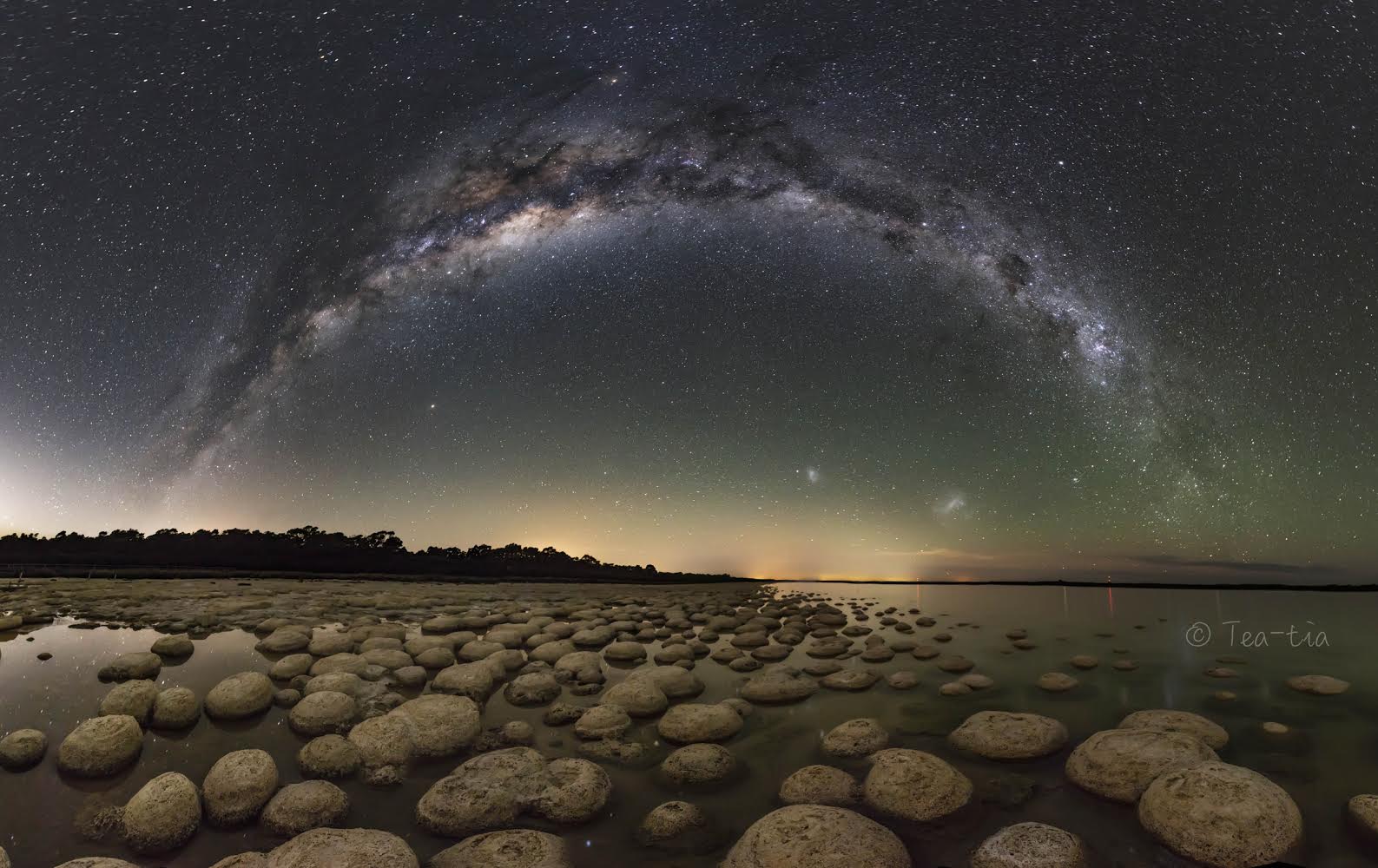
They may look like round rocks, but they're alive. Moreover, they are modern versions of one of the oldest known forms of life: stromatolites. Fossils indicate that stromatolites appeared on Earth about 3.7 billion years ago -- even before many of the familiar stars in the modern night sky were formed. In the featured image taken in Western Australia, only the ancient central arch of our Milky Way Galaxy formed earlier. Even the Magellanic Clouds, satellite galaxies of our Milky Way and visible in the featured image below the Milky Way's arch, didn't exist in their current form when stromatolites first grew on Earth. Stromatolites are accreting biofilms of billions of microorganisms that can slowly move toward light. Using this light to liberate oxygen into the air, ancient stromatolites helped make Earth hospitable to other life forms including, eventually, humans. Almost Hyperspace: Random APOD Generator
Pueden parecer rocas redondas, pero están vivas. Además, son versiones modernas de una de las formas de vida más antiguas conocidas: los estromatolitos. Los fósiles indican que los estromatolitos aparecieron en la Tierra hace aproximadamente 3.700 millones de años — incluso antes de que se formaran muchas de las estrellas familiares del cielo nocturno moderno. En la imagen destacada tomada en Australia Occidental, solo el antiguo arco central de nuestra galaxia, la Vía Láctea, se formó antes. Incluso las Nubes de Magallanes, galaxias satélite de nuestra Vía Láctea y visibles en la imagen destacada debajo del arco de la Vía Láctea, no existían en su forma actual cuando los estromatolitos comenzaron a crecer por primera vez en la Tierra. Los estromatolitos son biofilms acumulativos de miles de millones de microorganismos que pueden moverse lentamente hacia la luz. Usando esta luz para liberar oxígeno al aire, los estromatolitos antiguos ayudaron a hacer la Tierra habitable para otras formas de vida, incluyendo, finalmente, a los humanos.