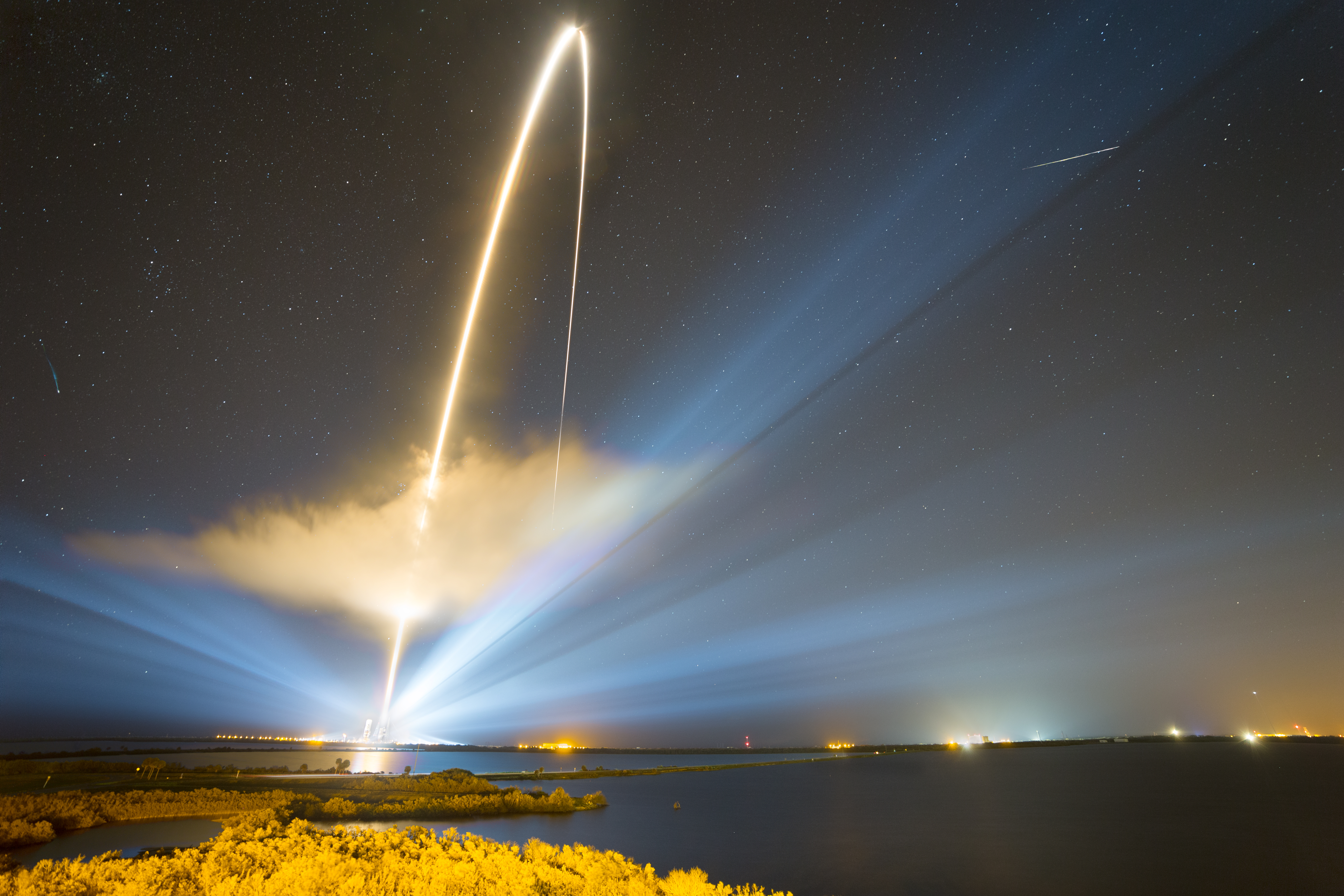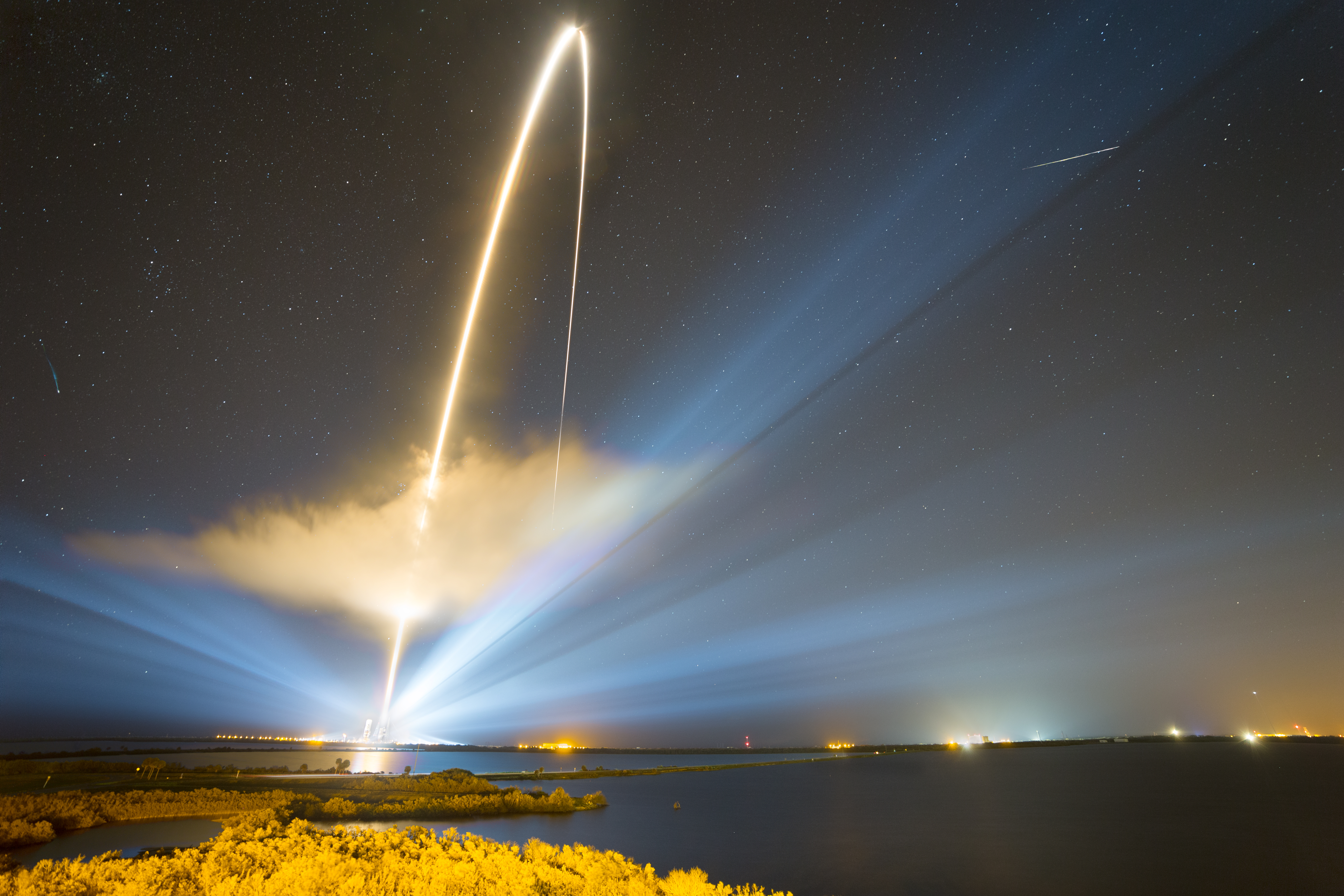
The brief flash of a bright Perseid meteor streaks across the upper right in this composited series of exposures made early Sunday morning near the peak of the annual Perseid meteor shower. Set up about two miles from Space Launch Complex 37 at Cape Canaveral Air Force Station, the photographer also captured the four minute long trail of a Delta IV Heavy rocket carrying the Parker Solar Probe into the dark morning sky. Perseid meteors aren't slow. The grains of dust from periodic comet Swift-Tuttle vaporize as they plow through Earth's upper atmosphere at about 60 kilometers per second (133,000 mph). On its way to seven gravity-assist flybys of Venus over its seven year mission, the Parker Solar Probe's closest approach to the Sun will steadily decrease, finally reaching a distance of 6.1 million kilometers (3.8 million miles). That's about 1/8 the distance between Mercury and the Sun, and within the solar corona, the Sun's tenuous outer atmosphere. By then it will be traveling roughly 190 kilometers per second (430,000 mph) with respect to the Sun, a record for fastest spacecraft from planet Earth. Gallery: Perseid meteor shower 2018
Un breve destello de un meteoro Perseid brillante cruza la esquina superior derecha en esta composición de exposiciones realizadas temprano el domingo por la mañana, cerca del pico de la lluvia anual de meteoros Perseid. El fotógrafo, que se encontraba a unos dos kilómetros del Complejo de Lanzamiento Espacial 37 en la Base Aérea de Cabo Cañaveral, también capturó la trayectoria de cuatro minutos de un cohete Delta IV Heavy que transportaba la nave Parker Solar Probe hacia el oscuro cielo matutino. Los meteoros Perseid no son lentos. Los granos de polvo provenientes del cometa periódico Swift-Tuttle se vaporizan al atravesar la atmósfera superior de la Tierra a unos 60 kilómetros por segundo (133 000 mph). Durante su misión de siete años, en la que realizará siete maniobras de asistencia gravitacional alrededor de Venus, la nave Parker Solar Probe se acercará progresivamente al Sol, alcanzando finalmente una distancia de 6,1 millones de kilómetros (3,8 millones de millas). Eso es aproximadamente 1/8 de la distancia entre Mercurio y el Sol, y dentro de la corona solar, la tenue atmósfera exterior del Sol. En ese momento, se moverá a unos 190 kilómetros por segundo (430 000 mph) en relación con el Sol, un récord para la nave espacial más rápida jamás lanzada desde la Tierra.