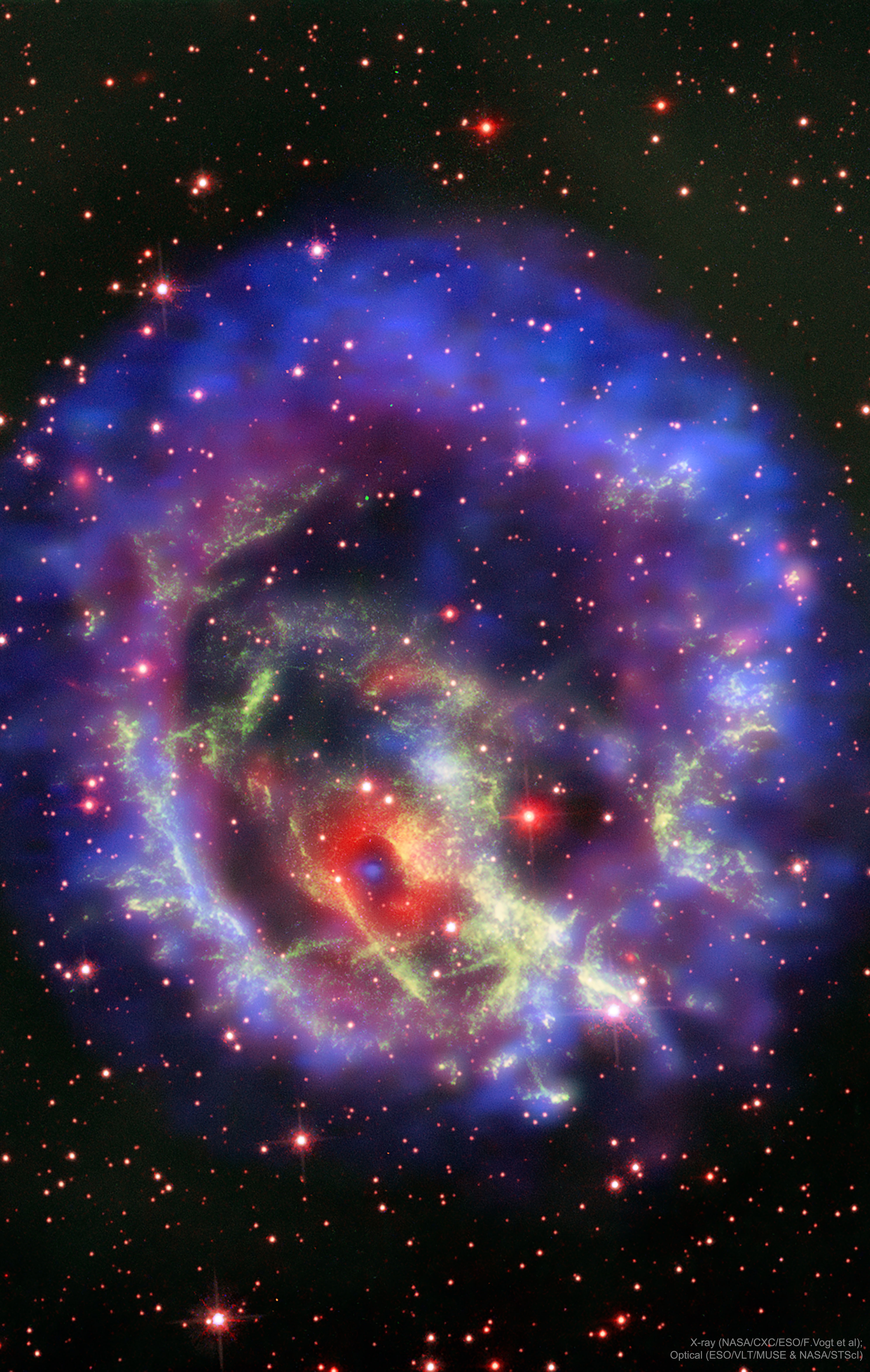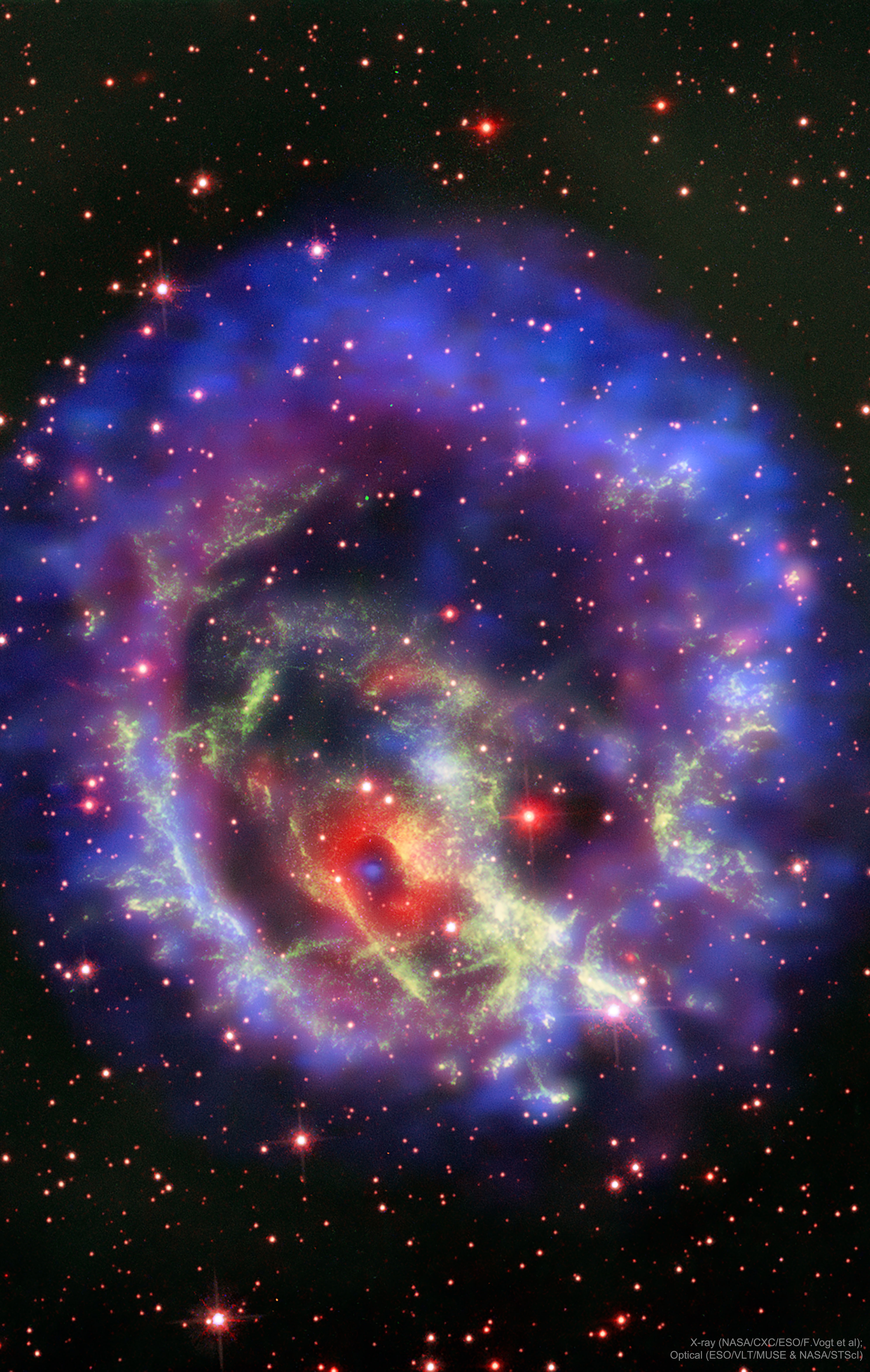
Why is this neutron star off-center? Recently a lone neutron star has been found within the debris left over from an old supernova explosion. The "lonely neutron star" in question is the blue dot at the center of the red nebula near the bottom left of E0102-72.3. In the featured image composite, blue represents X-ray light captured by NASA's Chandra Observatory, while red and green represent optical light captured by ESO's Very Large Telescope in Chile and NASA's Hubble Space Telescope in orbit. The displaced position of this neutron star is unexpected since the dense star is thought to be the core of the star that exploded in the supernova and created the outer nebula. It could be that the neutron star in E0102 was pushed away from the nebula's center by the supernova itself, but then it seems odd that the smaller red ring remains centered on the neutron star. Alternatively, the outer nebula could have been expelled during a different scenario -- perhaps even involving another star. Future observations of the nebulas and neutron star appear likely to resolve the situation.
¿Por qué esta estrella de neutrones está desplazada del centro? Recientemente se ha encontrado una estrella de neutrones solitaria dentro de los restos dejados por una antigua explosión de supernova. La 'estrella de neutrones solitaria' en cuestión es el punto azul en el centro de la nebulosa roja cerca de la esquina inferior izquierda de E0102-72.3. En la imagen compuesta destacada, el azul representa la luz de rayos X capturada por la observación Chandra de la NASA, mientras que el rojo y el verde representan la luz óptica capturada por el Very Large Telescope de ESO en Chile y por el telescopio espacial Hubble de la NASA en órbita. La posición desplazada de esta estrella de neutrones es inesperada, ya que se cree que la estrella densa es el núcleo de la estrella que explotó en la supernova y creó la nebulosa exterior. Podría ser que la estrella de neutrones en E0102 haya sido empujada lejos del centro de la nebulosa por la propia supernova, pero entonces resulta extraño que el anillo rojo más pequeño permanezca centrado en la estrella de neutrones. Como alternativa, la nebulosa exterior podría haberse expulsado durante un escenario diferente, quizás incluso involucrando otra estrella. Observaciones futuras de las nebulosas y la estrella de neutrones parecen probablemente resolver la situación.