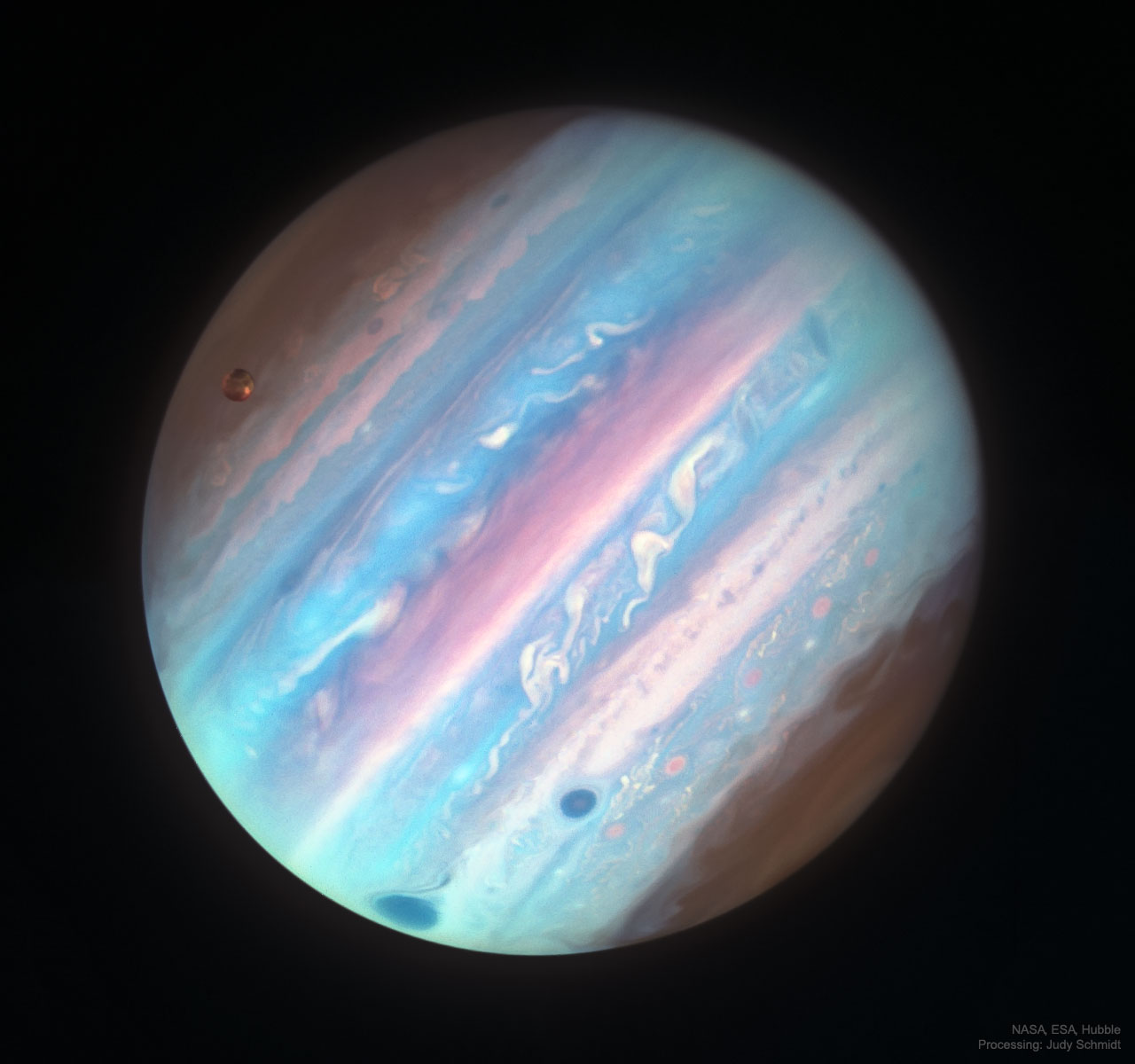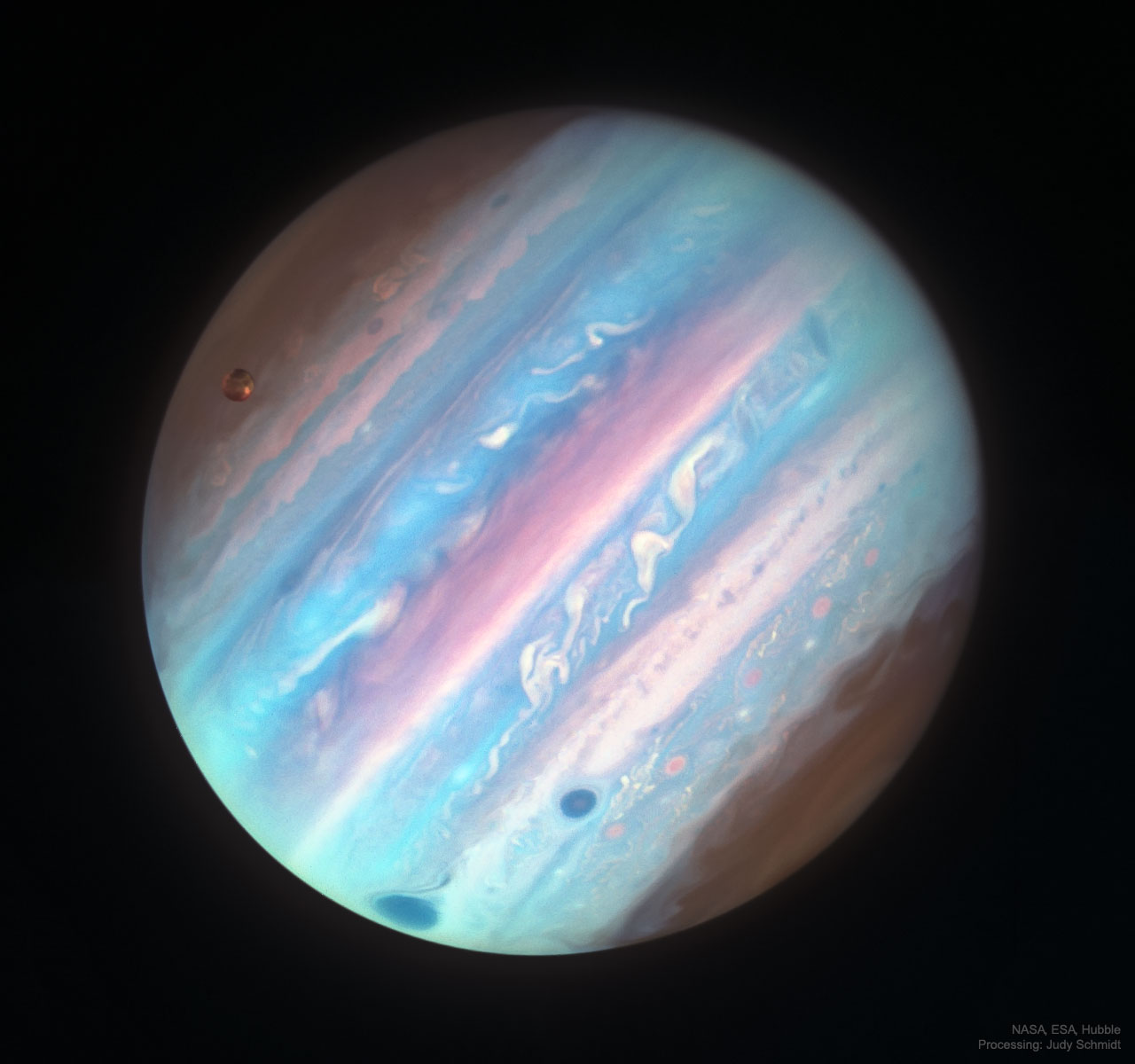
Jupiter looks a bit different in ultraviolet light. To better interpret Jupiter's cloud motions and to help NASA's robotic Juno spacecraft understand the planetary context of the small fields that it sees, the Hubble Space Telescope is being directed to regularly image the entire Jovian giant. The colors of Jupiter being monitored go beyond the normal human visual range to include both ultraviolet and (not pictured) infrared light. Featured from 2017, Jupiter appears different in near ultraviolet light, partly because the amount of sunlight reflected back is distinct, giving differing cloud heights and latitudes discrepant brightnesses. In the near UV, Jupiter's poles appear relatively dark, as does its Great Red Spot and a smaller (optically) white oval to the right. The String of Pearl storms farther to the right, however, are brightest in near ultraviolet, and so here appear (false-color) pink. Jupiter's largest moon Ganymede appears on the upper left. Juno continues on its looping 53-day orbits around Jupiter, while Earth-orbiting Hubble is now recovering from the loss of a stabilizing gyroscope.
Júpiter se ve un poco diferente en luz ultravioleta. Para interpretar mejor los movimientos de las nubes de Júpiter y ayudar a la nave espacial robótica Juno de NASA a comprender el contexto planetario de los campos pequeños que observa, se está utilizando el Telescopio Espacial Hubble para tomar imágenes regulares de todo el gigante joviano. Los colores de Júpiter que se monitorean van más allá del rango normal de visión humana y incluyen tanto la luz ultravioleta como (no mostrada) la luz infrarroja. Destacado desde 2017, Júpiter aparece diferente en luz ultravioleta cercana, en parte porque la cantidad de luz solar reflejada es distinta, lo que da a diferentes alturas y latitudes de las nubes brillos desiguales. En la luz ultravioleta cercana, los polos de Júpiter aparecen relativamente oscuros, al igual que su Gran Mancha Roja y un óvalo blanco (ópticamente) más pequeño a la derecha. Sin embargo, las tormentas de la Cadena de Perlas más allá a la derecha son las más brillantes en ultravioleta cercano, y por lo tanto aquí aparecen (en color falso) en rosa. La luna más grande de Júpiter, Ganímedes, aparece en la esquina superior izquierda. Juno continúa en sus órbitas de 53 días alrededor de Júpiter, mientras que el Hubble, que orbita la Tierra, ahora se está recuperando del fallo de un giroscopio estabilizador.