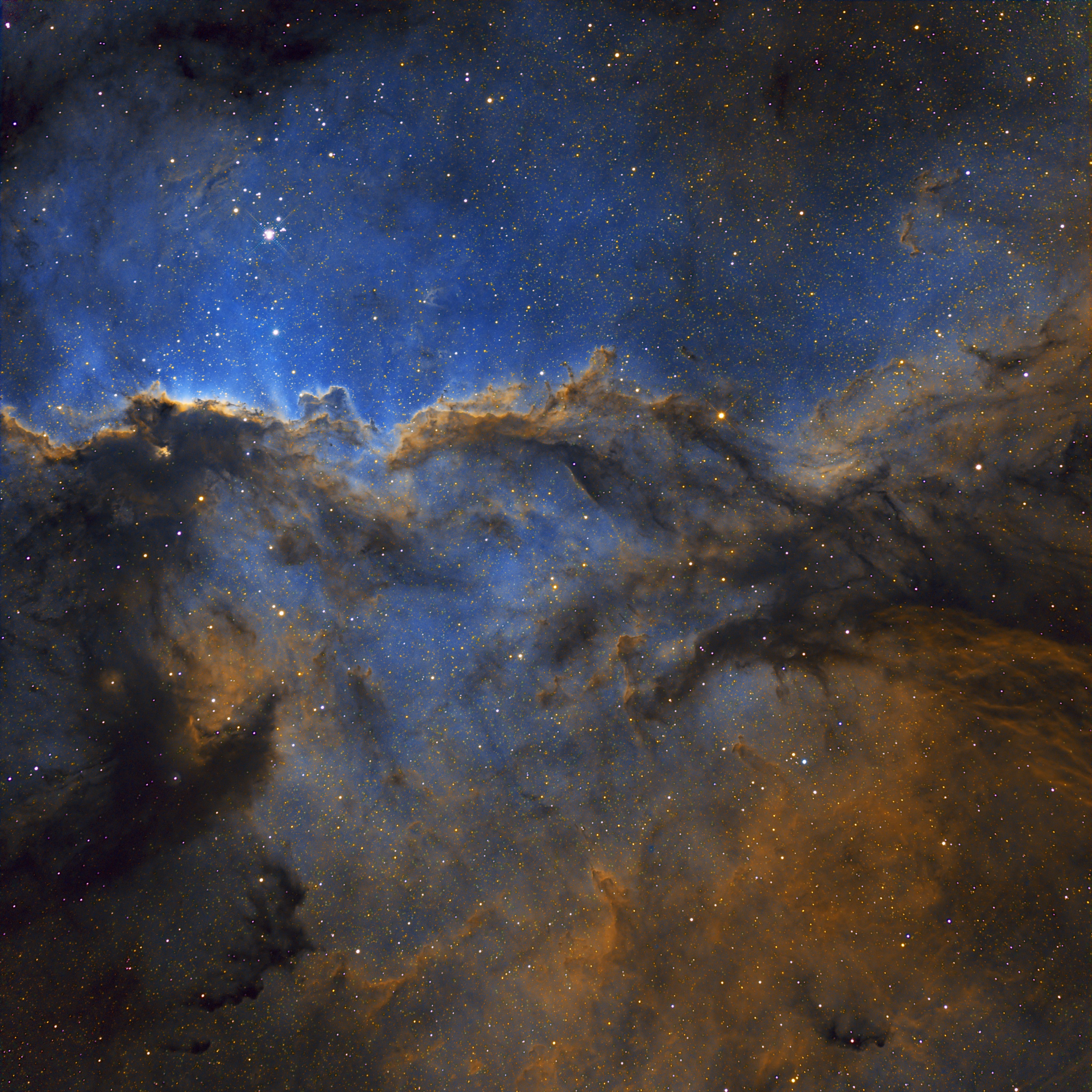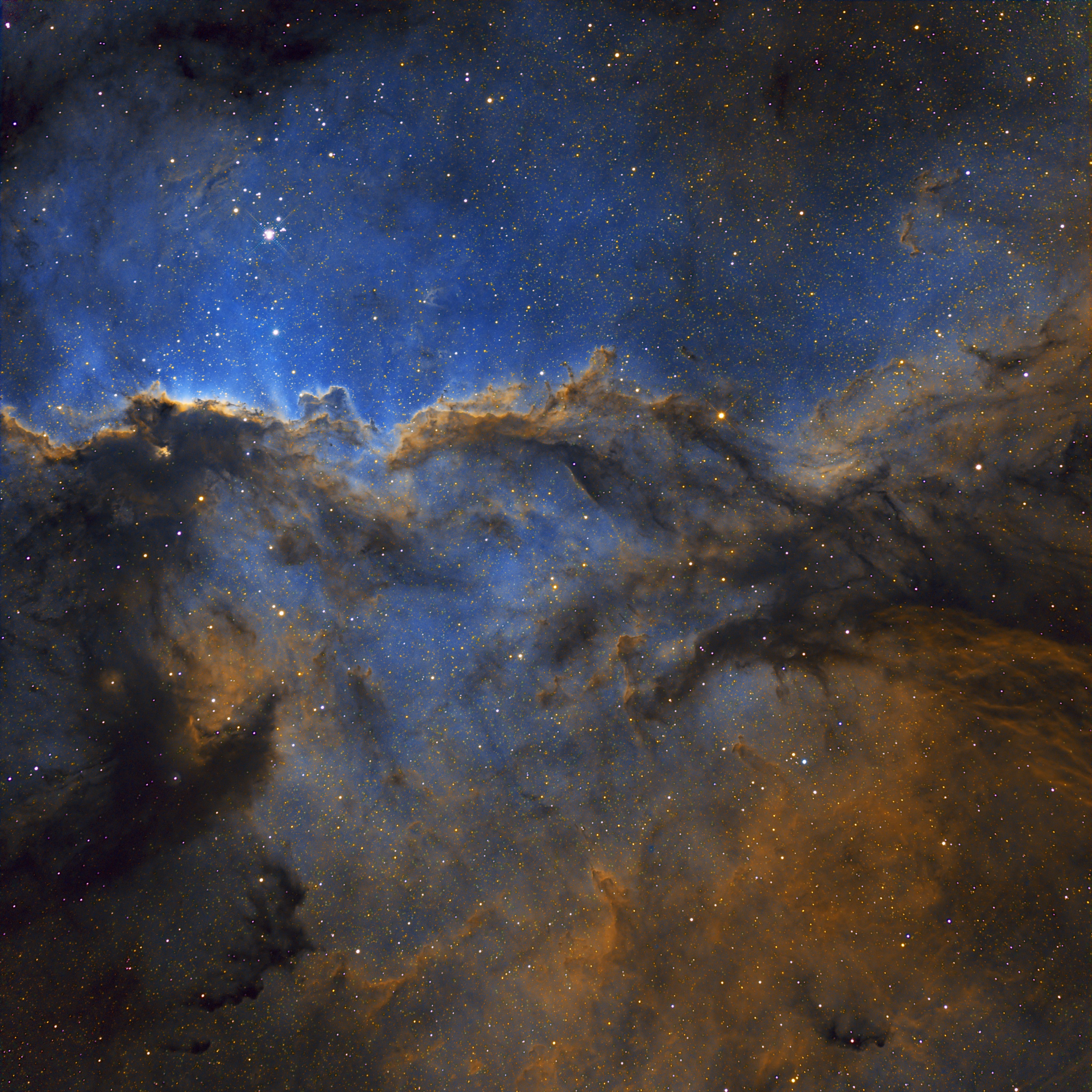
Dark shapes with bright edges winging their way through dusty NGC 6188 are tens of light-years long. The emission nebula is found near the edge of an otherwise dark large molecular cloud in the southern constellation Ara, about 4,000 light-years away. Born in that region only a few million years ago, the massive young stars of the embedded Ara OB1 association sculpt the fantastic shapes and power the nebular glow with stellar winds and intense ultraviolet radiation. The recent star formation itself was likely triggered by winds and supernova explosions, from previous generations of massive stars, that swept up and compressed the molecular gas. With image data from the Chilescope Observatory, a false-color Hubble palette was used to create this gorgeous wide-field image and shows emission from sulfur, hydrogen, and oxygen atoms in red, green, and blue hues. The field of view spans about four full Moons, corresponding to about 150 light years at the estimated distance of NGC 6188.
Formas oscuras con bordes brillantes se desplazan a través del nebuloso NGC 6188, extendiéndose por decenas de años luz. Esta nebulosa de emisión se encuentra cerca del borde de una nube molecular oscura y extensa en la constelación austral Ara, a unos 4000 años luz de distancia. Las estrellas jóvenes y masivas de la asociación Ara OB1, nacidas en esa región hace solo unos pocos millones de años, moldean estas formas fantásticas y alimentan el brillo nebuloso con vientos estelares y radiación ultravioleta intensa. La formación estelar reciente probablemente fue desencadenada por vientos y explosiones de supernova, provenientes de generaciones anteriores de estrellas masivas, que recogieron y comprimieron el gas molecular. Con datos de imagen del Chilescope Observatory, se utilizó una paleta de colores falsos tipo Hubble para crear esta hermosa imagen de campo amplio, que muestra la emisión de átomos de azufre, hidrógeno y oxígeno en tonos rojo, verde y azul. El campo de visión abarca aproximadamente cuatro lunas llenas, lo que corresponde a unos 150 años luz a la distancia estimada de NGC 6188.