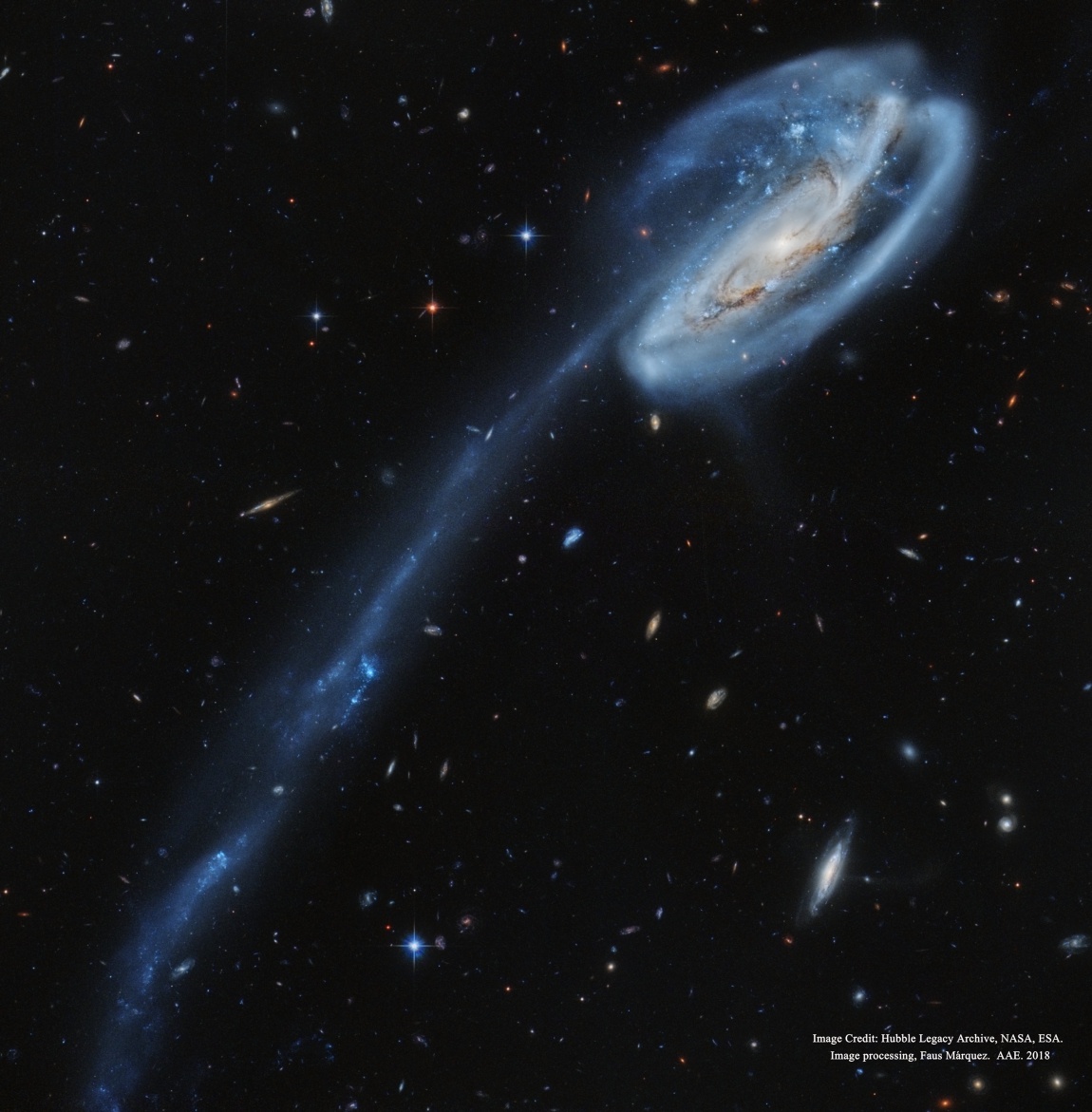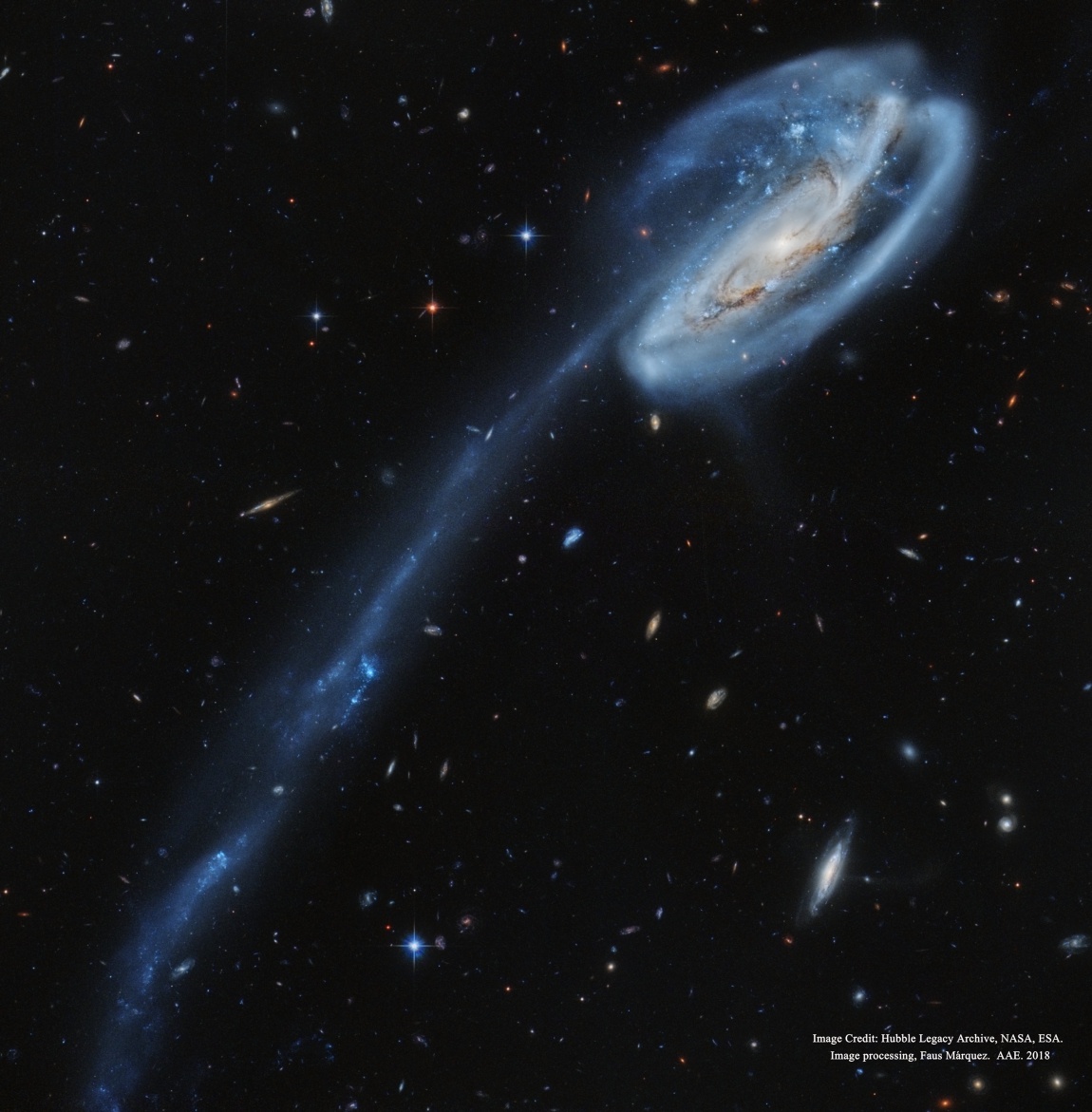
Why does this galaxy have such a long tail? In this stunning vista, based on image data from the Hubble Legacy Archive, distant galaxies form a dramatic backdrop for disrupted spiral galaxy Arp 188, the Tadpole Galaxy. The cosmic tadpole is a mere 420 million light-years distant toward the northern constellation of the Dragon (Draco). Its eye-catching tail is about 280 thousand light-years long and features massive, bright blue star clusters. One story goes that a more compact intruder galaxy crossed in front of Arp 188 - from right to left in this view - and was slung around behind the Tadpole by their gravitational attraction. During the close encounter, tidal forces drew out the spiral galaxy's stars, gas, and dust forming the spectacular tail. The intruder galaxy itself, estimated to lie about 300 thousand light-years behind the Tadpole, can be seen through foreground spiral arms at the upper right. Following its terrestrial namesake, the Tadpole Galaxy will likely lose its tail as it grows older, the tail's star clusters forming smaller satellites of the large spiral galaxy. New: Instagram page features cool images recently submitted to APOD
Crédito: NASA, Hubble Legacy Archive ¿Por qué esta galaxia tiene una cola tan larga? En esta impresionante vista, basada en datos de imagen del Hubble Legacy Archive, galaxias distantes forman un dramático fondo para la galaxia espiral interrumpida Arp 188, la Galaxia Rana. La rana cósmica se encuentra a solo 420 millones de años luz de distancia, en la constelación norteña del Dragón (Draco). Su cola llamativa tiene unos 280 000 años luz de longitud y destaca por sus grandes y brillantes cúmulos estelares azules. Una teoría sugiere que una galaxia más compacta pasó frente a Arp 188, de derecha a izquierda en esta vista, y fue lanzada alrededor de la Rana debido a su atracción gravitacional. Durante el encuentro cercano, fuerzas de marea arrancaron estrellas, gas y polvo de la galaxia espiral, formando la espectacular cola. La galaxia intrusa, cuya distancia se estima en unos 300 000 años luz detrás de la Rana, se puede ver a través de los brazos espirales delanteros en la parte superior derecha. Siguiendo el nombre de su contraparte terrestre, la Galaxia Rana probablemente perderá su cola a medida que envejezca, los cúmulos estelares de la cola formando satélites más pequeños de la gran galaxia espiral.