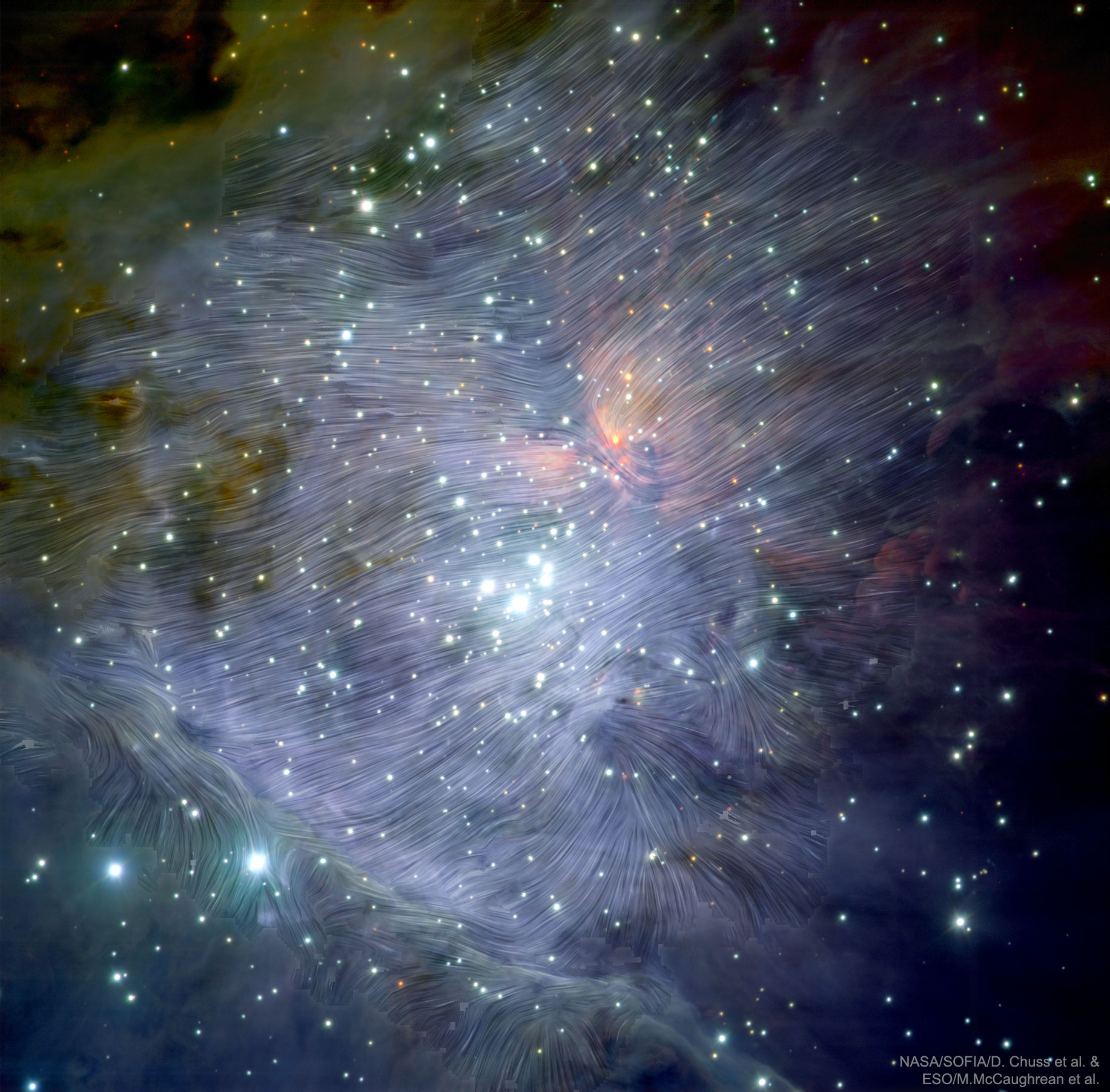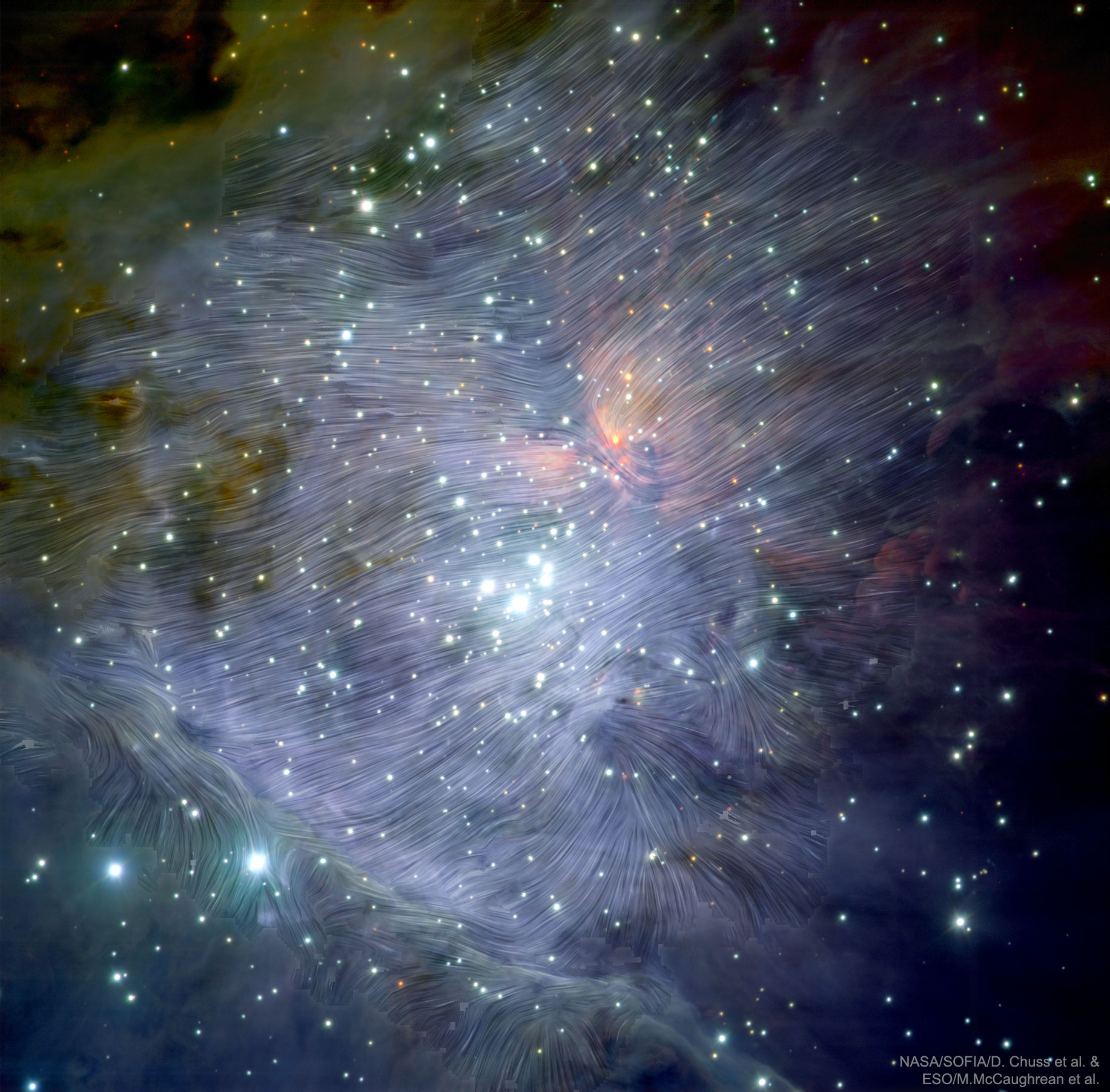
Can magnetism affect how stars form? Recent analysis of Orion data from the HAWC+ instrument on the airborne SOFIA observatory indicate that, at times, it can. HAWC+ is able to measure the polarization of far-infrared light which can reveal the alignment of dust grains by expansive ambient magnetic fields. In the featured image, these magnetic fields are shown as curvy lines superposed on an infrared image of the Orion Nebula taken by a Very Large Telescope in Chile. Orion's Kleinmann-Low Nebula is visible slightly to the upper right of the image center, while bright stars of the Trapezium cluster are visible just to the lower left of center. The Orion Nebula at about l300 light years distant is the nearest major star formation region to the Sun.
¿Puede el magnetismo afectar cómo se forman las estrellas? Un análisis reciente de datos de Orión obtenidos con el instrumento HAWC+ del observatorio aéreo SOFIA indica que, en ocasiones, sí lo puede hacer. HAWC+ es capaz de medir la polarización de la luz en el infrarrojo lejano, lo que puede revelar la alineación de los granos de polvo causada por campos magnéticos ambientales extensos. En la imagen destacada, estos campos magnéticos se muestran como líneas curvas superpuestas a una imagen en infrarrojo del Nebulosa de Orión tomada por el Very Large Telescope en Chile. La Nebulosa Kleinmann-Low de Orión es visible ligeramente a la parte superior derecha del centro de la imagen, mientras que las brillantes estrellas del cúmulo del Trapecio son visibles justo a la parte inferior izquierda del centro. La Nebulosa de Orión, a unos 1300 años luz de distancia, es la región más cercana de formación estelar importante al Sol.