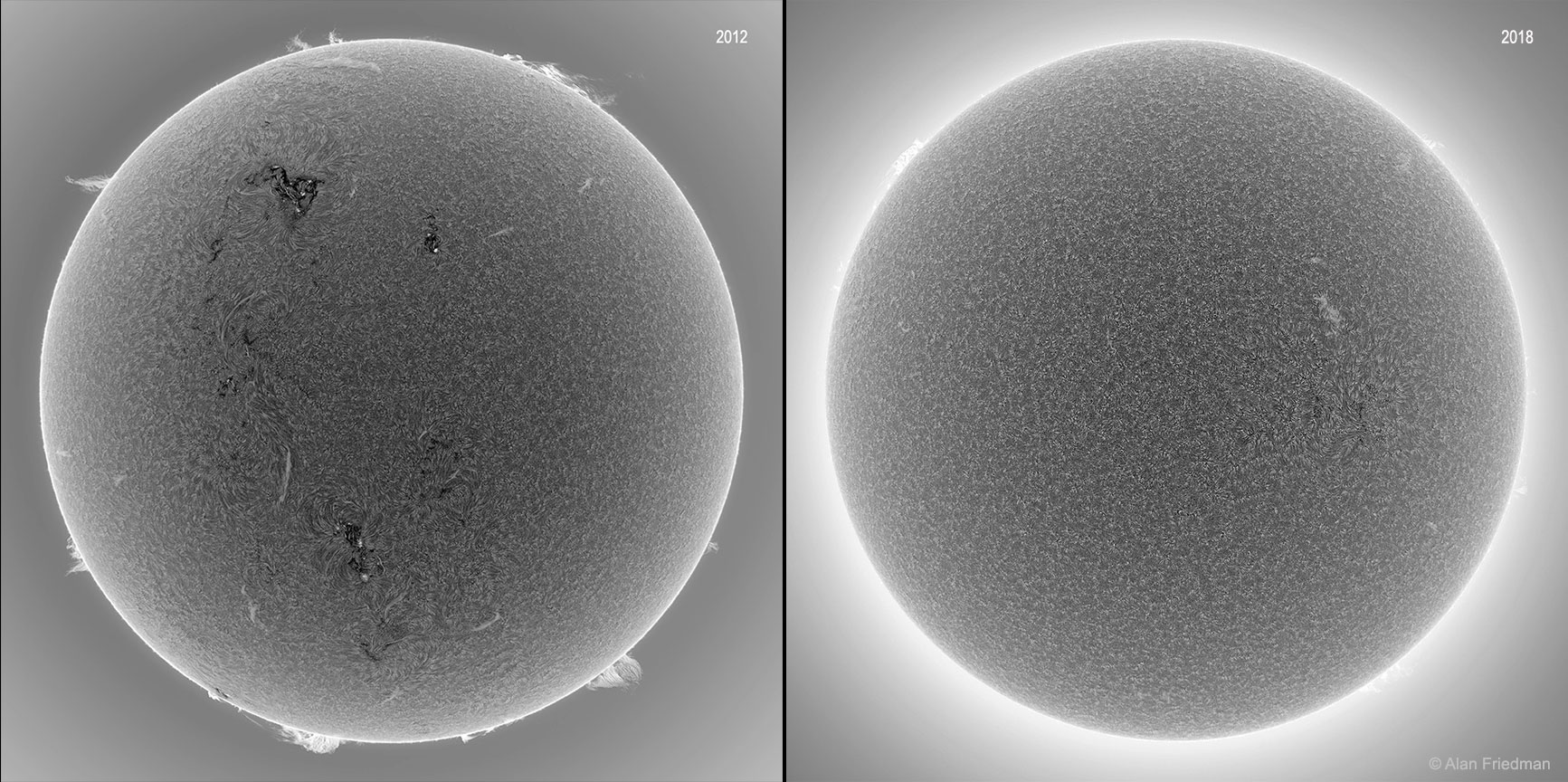
Where have all the sunspots gone? Last month the total number of spots that crossed our Sun was ... zero. Well below of the long term monthly average, the Sun's surface has become as unusually passive this solar minimum just like it did 11 years ago during the last solar minimum. Such passivity is not just a visual spectacle, it correlates with the Sun being slightly dimmer, with holes in the Sun's corona being more stable, and with a reduced intensity in the outflowing solar wind. The reduced wind, in turn, cools and collapses Earth's outer atmosphere (the thermosphere), causing reduced drag on many Earth-orbiting satellites. Pictured in inverted black & white on the left, the Sun's busy surface is shown near solar maximum in 2012, in contrast to the image on the right, which shows the Sun's surface last August, already without spots (for a few days), as solar minimum was setting in. Effects of this unusually static solar minimum are being studied.
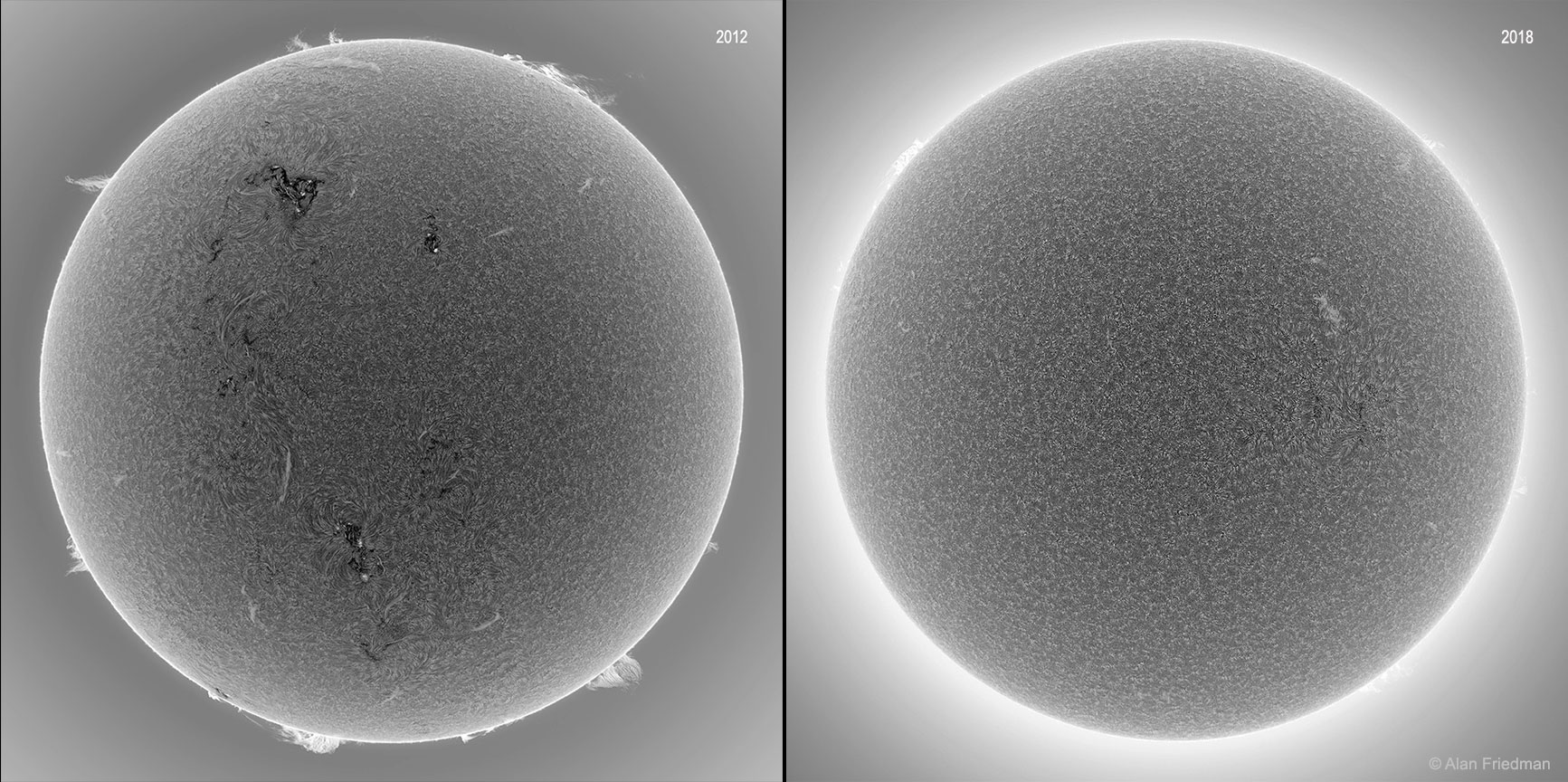
¿A dónde se han ido todas las manchas solares? El mes pasado, el número total de manchas que aparecieron en nuestro Sol fue... cero. Esta cantidad está muy por debajo del promedio mensual a largo plazo, y la superficie solar se ha vuelto inusualmente pasiva durante este mínimo solar, al igual que ocurrió hace 11 años durante el anterior mínimo solar. Esta pasividad no es solo un espectáculo visual, sino que se correlaciona con que el Sol esté ligeramente más tenue, con que los agujeros en la corona solar sean más estables y con una reducción en la intensidad del viento solar que emana del Sol. A su vez, este viento reducido enfría y colapsa la atmósfera exterior de la Tierra (la termósfera), causando una menor resistencia en muchos satélites que orbitan la Tierra. En la imagen de la izquierda, en blanco y negro invertido, se muestra la activa superficie del Sol cerca del máximo solar en 2012, en contraste con la imagen de la derecha, que muestra la superficie solar del mes pasado, ya sin manchas (durante unos días), a medida que se establecía el mínimo solar. Los efectos de este mínimo solar inusualmente estático están siendo estudiados.