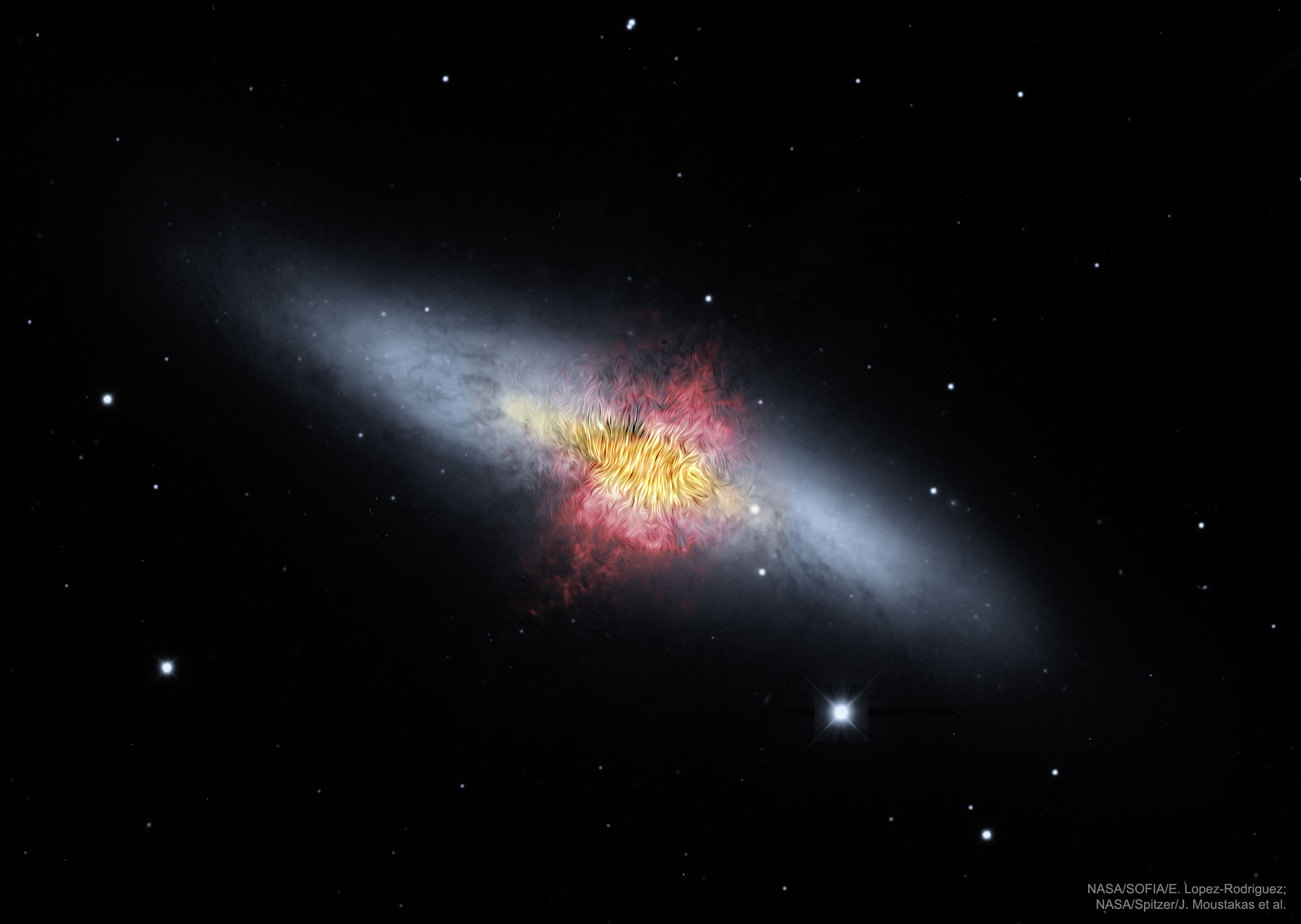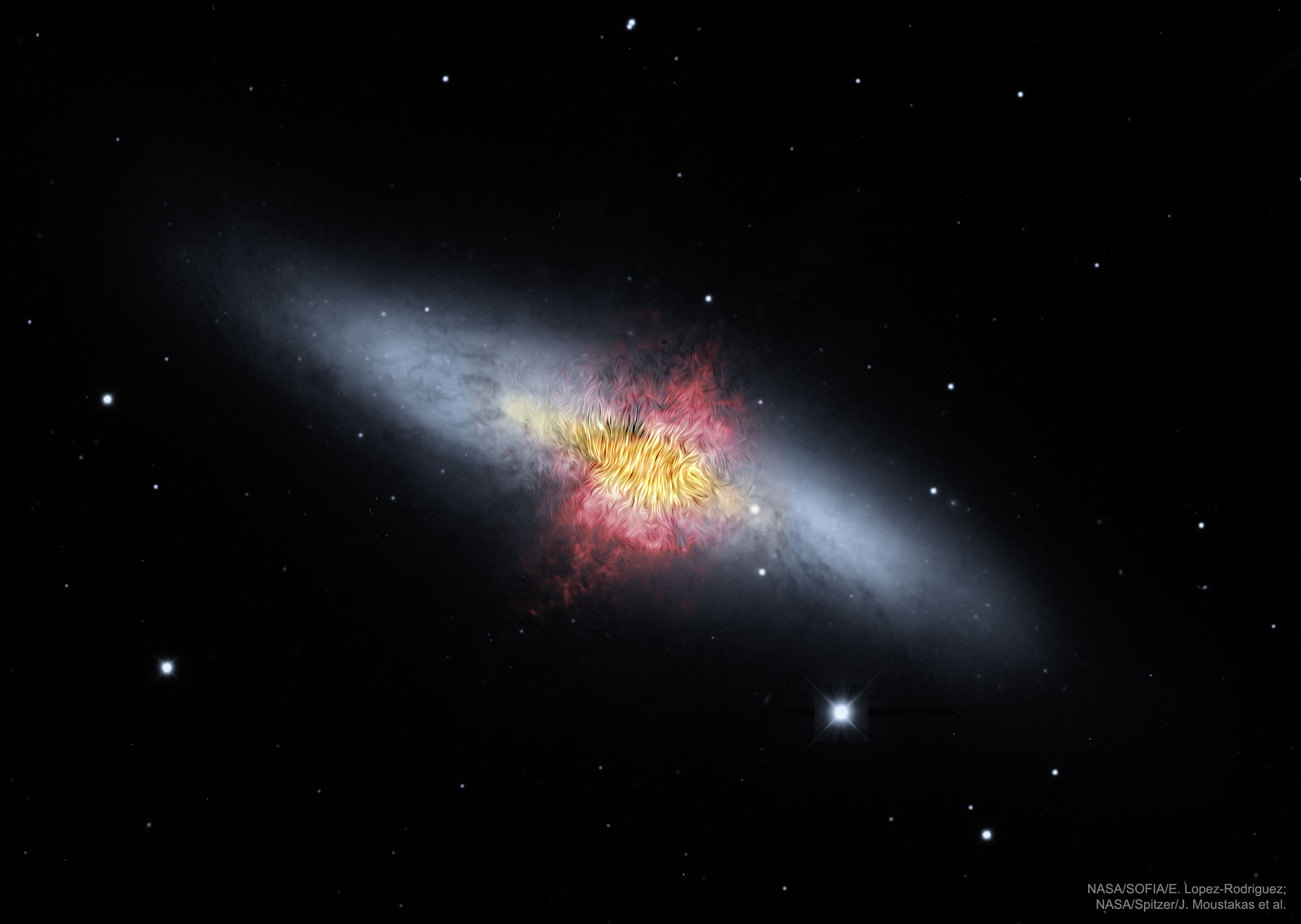
Are galaxies giant magnets? Yes, but the magnetic fields in galaxies are typically much weaker than on Earth's surface, as well as more complex and harder to measure. Recently, though, the HAWC+ instrument onboard the airborne (747) SOFIA observatory has been successful in detailing distant magnetic fields by observing the polarized infrared light emitted by elongated dust grains rotating in alignment with the local magnetic field. HAWC+ observations of M82, the Cigar galaxy, show that the central magnetic field is perpendicular to the disk and parallel to the strong supergalactic wind. This observation bolsters the hypothesis that M82's central magnetic field helps its wind transport the mass of millions of stars out from the central star-burst region. The featured image shows magnetic field lines superposed on top of an optical light (gray) and hydrogen gas (red) image from Kitt Peak National Observatory, further combined with infrared images (yellow) from SOFIA and the Spitzer Space Telescope. The Cigar Galaxy is about 12 million light years distant and visible with binoculars towards the constellation of the Great Bear.
¿Son las galaxias imanes gigantes? Sí, pero los campos magnéticos en las galaxias son típicamente mucho más débiles que en la superficie terrestre, además de más complejos y difíciles de medir. Sin embargo, recientemente, el instrumento HAWC+ a bordo del observatorio aéreo (747) SOFIA ha tenido éxito en detallar campos magnéticos distantes observando la luz infrarroja polarizada emitida por granos de polvo alargados que giran alineados con el campo magnético local. Las observaciones de HAWC+ de M82, la Galaxia Cigarro, muestran que el campo magnético central es perpendicular al disco y paralelo al fuerte viento supergaláctico. Esta observación refuerza la hipótesis de que el campo magnético central de M82 ayuda al viento a transportar la masa de millones de estrellas fuera de la región central de formación estelar intensa. La imagen destacada muestra líneas de campo magnético superpuestas sobre una imagen de luz óptica (gris) y gas de hidrógeno (rojo) del Observatorio Nacional Kitt Peak, combinada posteriormente con imágenes infrarrojas (amarillo) de SOFIA y del Telescopio Espacial Spitzer. La Galaxia Cigarro se encuentra a unos 12 millones de años luz de distancia y es visible con binoculares hacia la constelación de la Osa Mayor.