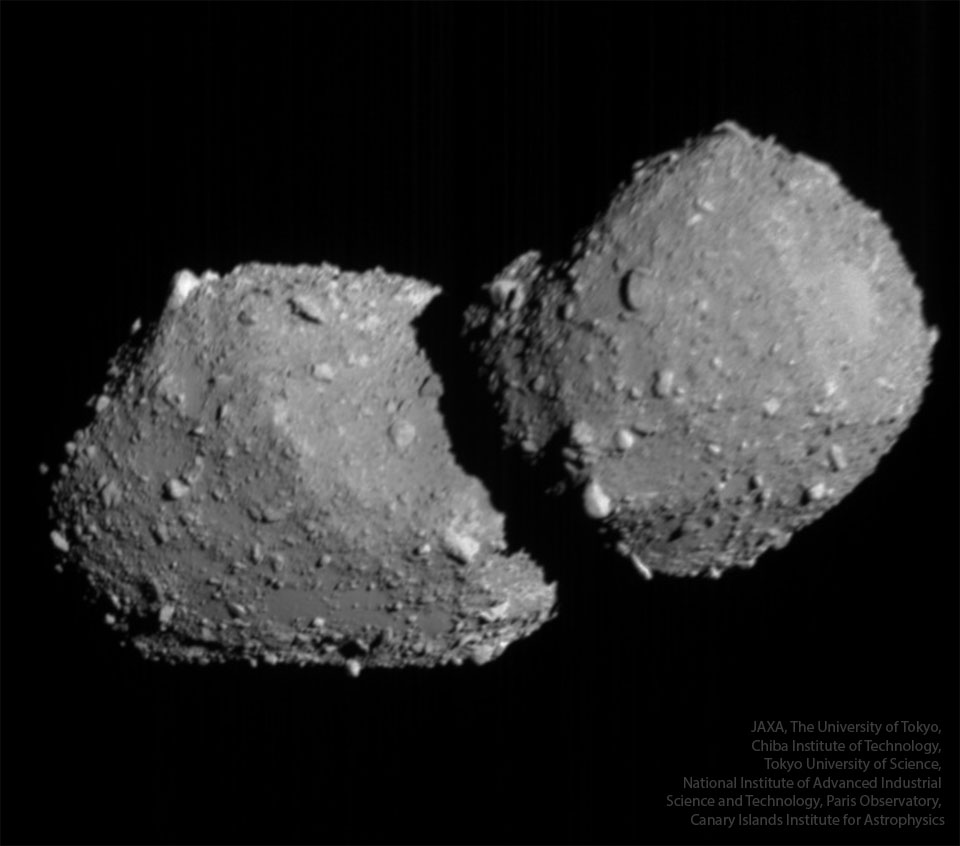
Last month, humanity bounced a robot off an asteroid. The main reason was to collect a surface sample. Despite concern over finding a safely reboundable touchdown spot, Japan's robotic Hayabusa2 spacecraft successfully touched down -- and bounced right back from -- asteroid Ryugu. Before impact, Hayabusa2 fired a small bullet into 162173 Ryugu to scattered surface material and increase the chance that Hayabusa2 would be able to capture some. Next month, Hayabusa2 will fire a much larger bullet into Ryugu in an effort to capture sub-surface material. Near the end of this year, Hayabusa2 is scheduled to depart Ryugu and begin a looping trip back to Earth, hopefully returning small pieces of this near-Earth asteroid in late 2020. Studying Ryugu could tell humanity not only about the minor planet's surface and interior, but about what materials were available in the early Solar System for the development of life.
El mes pasado, la humanidad lanzó un robot contra un asteroide. La razón principal era recolectar una muestra de la superficie. A pesar de las preocupaciones por encontrar un lugar seguro para el impacto y rebote, la nave espacial robótica Hayabusa2 de Japón logró tocar la superficie del asteroide Ryugu y rebotó inmediatamente. Antes del impacto, Hayabusa2 disparó una pequeña bala hacia el asteroide 162173 Ryugu con el fin de dispersar material superficial y aumentar la probabilidad de que Hayabusa2 pudiera capturar algo. El próximo mes, Hayabusa2 disparará una bala mucho más grande hacia Ryugu con el objetivo de capturar material subsuperficial. A finales de este año, se espera que Hayabusa2 abandone Ryugu y comience un viaje en espiral de regreso a la Tierra, esperando devolver pequeñas muestras de este asteroide cercano a la Tierra a finales de 2020. Estudiar Ryugu podría revelar a la humanidad no solo sobre la superficie y el interior del asteroide, sino también sobre los materiales disponibles en el Sistema Solar primitivo para el desarrollo de la vida.