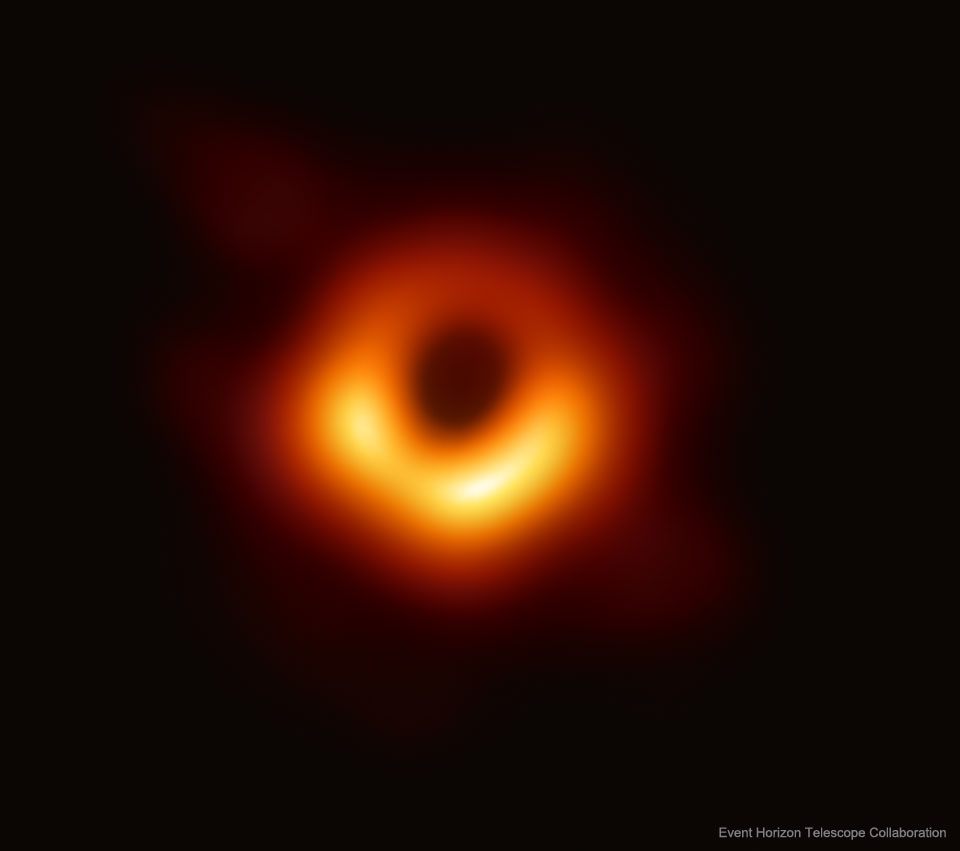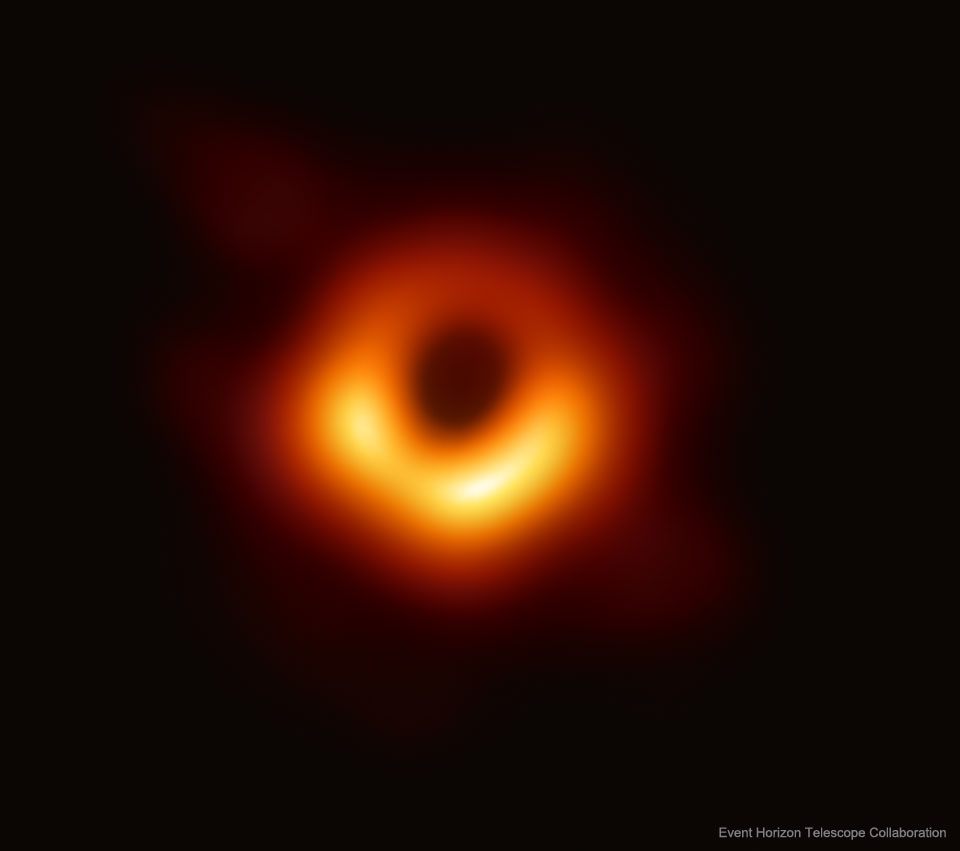
What does a black hole look like? To find out, radio telescopes from around the Earth coordinated observations of black holes with the largest known event horizons on the sky. Alone, black holes are just black, but these monster attractors are known to be surrounded by glowing gas. The first image was released yesterday and resolved the area around the black hole at the center of galaxy M87 on a scale below that expected for its event horizon. Pictured, the dark central region is not the event horizon, but rather the black hole's shadow -- the central region of emitting gas darkened by the central black hole's gravity. The size and shape of the shadow is determined by bright gas near the event horizon, by strong gravitational lensing deflections, and by the black hole's spin. In resolving this black hole's shadow, the Event Horizon Telescope (EHT) bolstered evidence that Einstein's gravity works even in extreme regions, and gave clear evidence that M87 has a central spinning black hole of about 6 billion solar masses. The EHT is not done -- future observations will be geared toward even higher resolution, better tracking of variability, and exploring the immediate vicinity of the black hole in the center of our Milky Way Galaxy.
¿Cómo se ve un agujero negro? Para descubrirlo, telescopios de radio de todo el mundo coordinaron observaciones de los agujeros negros con los horizontes de sucesos más grandes conocidos en el cielo. Por sí solos, los agujeros negros son solo negros, pero estos atractores monstruosos se sabe que están rodeados por gas que brilla. La primera imagen fue publicada ayer y resolvió la región alrededor del agujero negro en el centro de la galaxia M87 a una escala menor a la esperada para su horizonte de sucesos. En la imagen, la región central oscura no es el horizonte de sucesos, sino más bien la sombra del agujero negro — la región central del gas emisor oscurecida por la gravedad del agujero negro central. El tamaño y la forma de la sombra están determinados por el gas brillante cerca del horizonte de sucesos, por las desviaciones de lente gravitacional fuerte, y por la rotación del agujero negro. Al resolver esta sombra del agujero negro, el Telescopio del Horizonte de Sucesos (EHT) reforzó la evidencia de que la gravedad de Einstein funciona incluso en regiones extremas, y proporcionó evidencia clara de que M87 tiene un agujero negro central en rotación de aproximadamente 6 mil millones de masas solares. El EHT no ha terminado — observaciones futuras se enfocarán en una resolución aún mayor, un mejor seguimiento de la variabilidad, y en explorar la inmediata vecindad del agujero negro en el centro de nuestra galaxia, la Vía Láctea.