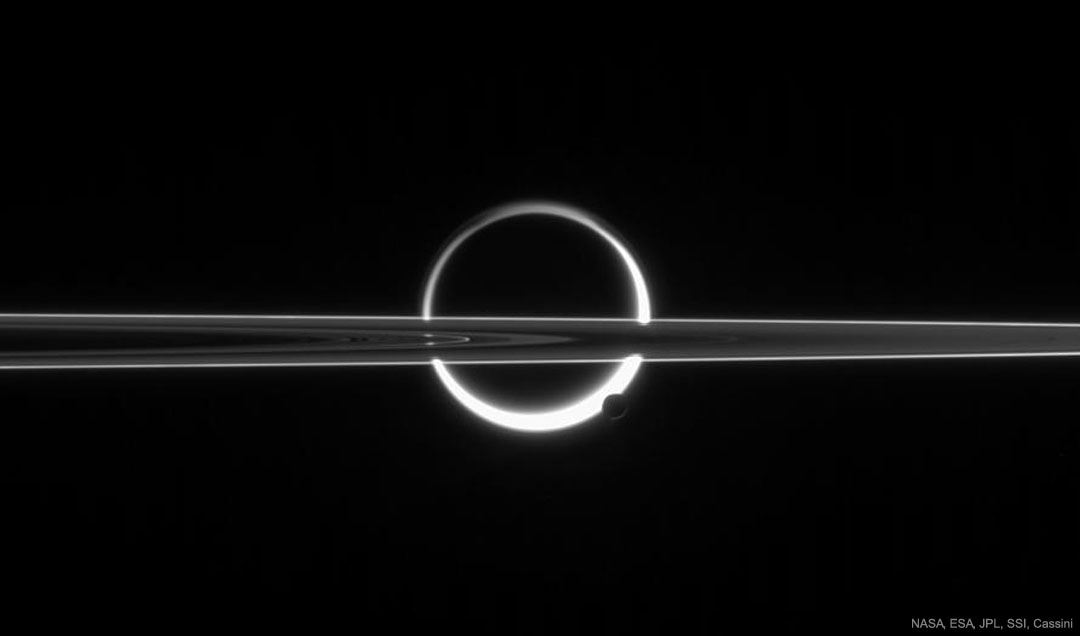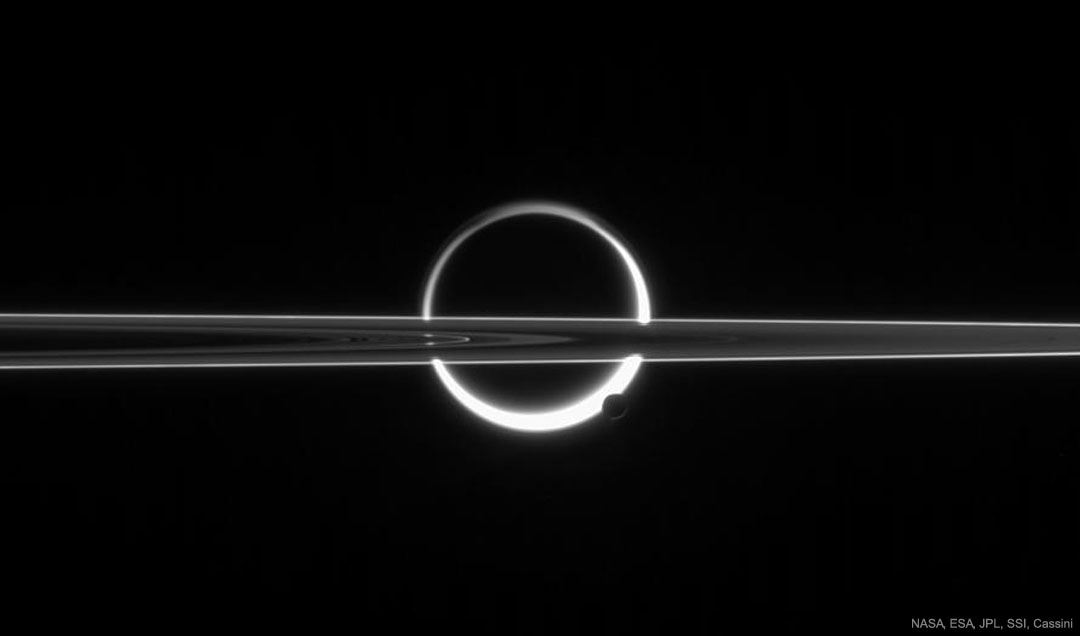
This is not a solar eclipse. Pictured here is a busy vista of moons and rings taken at Saturn. The large circular object in the center of the image is Titan, the largest moon of Saturn and one of the most intriguing objects in the entire Solar System. The dark spot in the center is the main solid part of the moon. The bright surrounding ring is atmospheric haze above Titan, gas that is scattering sunlight to a camera operating onboard the robotic Cassini spacecraft. Cutting horizontally across the image are the rings of Saturn, seen nearly edge on. At the lower right of Titan is Enceladus, a small moon of Saturn. Since the image was taken pointing nearly at the Sun, the surfaces of Titan and Enceladus appear in silhouette, and the rings of Saturn appear similar to a photographic negative. Now if you look really really closely at Enceladus, you can see a hint of icy jets shooting out toward the bottom of the image. It is these jets that inspired future proposals to land on Enceladus, burrow into the ice, and search for signs of extraterrestrial life.
Este no es un eclipse solar. La imagen muestra una escena activa de lunas y anillos tomada en Saturno. El gran objeto circular en el centro es Titán, la luna más grande de Saturno y uno de los objetos más intrigantes del Sistema Solar. La mancha oscura en el centro es la parte sólida principal de la luna. El anillo brillante que la rodea es niebla atmosférica sobre Titán, gas que dispersa la luz solar hacia una cámara operada a bordo de la nave espacial robótica Cassini. Cruzando horizontalmente la imagen están los anillos de Saturno, vistos casi de perfil. En la parte inferior derecha de Titán se encuentra Encelado, una pequeña luna de Saturno. Dado que la imagen fue tomada apuntando casi directamente hacia el Sol, las superficies de Titán y Encelado aparecen en silueta, y los anillos de Saturno se ven similares a una imagen negativa fotográfica. Si observas muy de cerca a Encelado, puedes ver un ligero indicio de chorros helados que salen hacia la parte inferior de la imagen. Son estos chorros los que inspiraron propuestas futuras para aterrizar en Encelado, excavar en el hielo y buscar signos de vida extraterrestre.