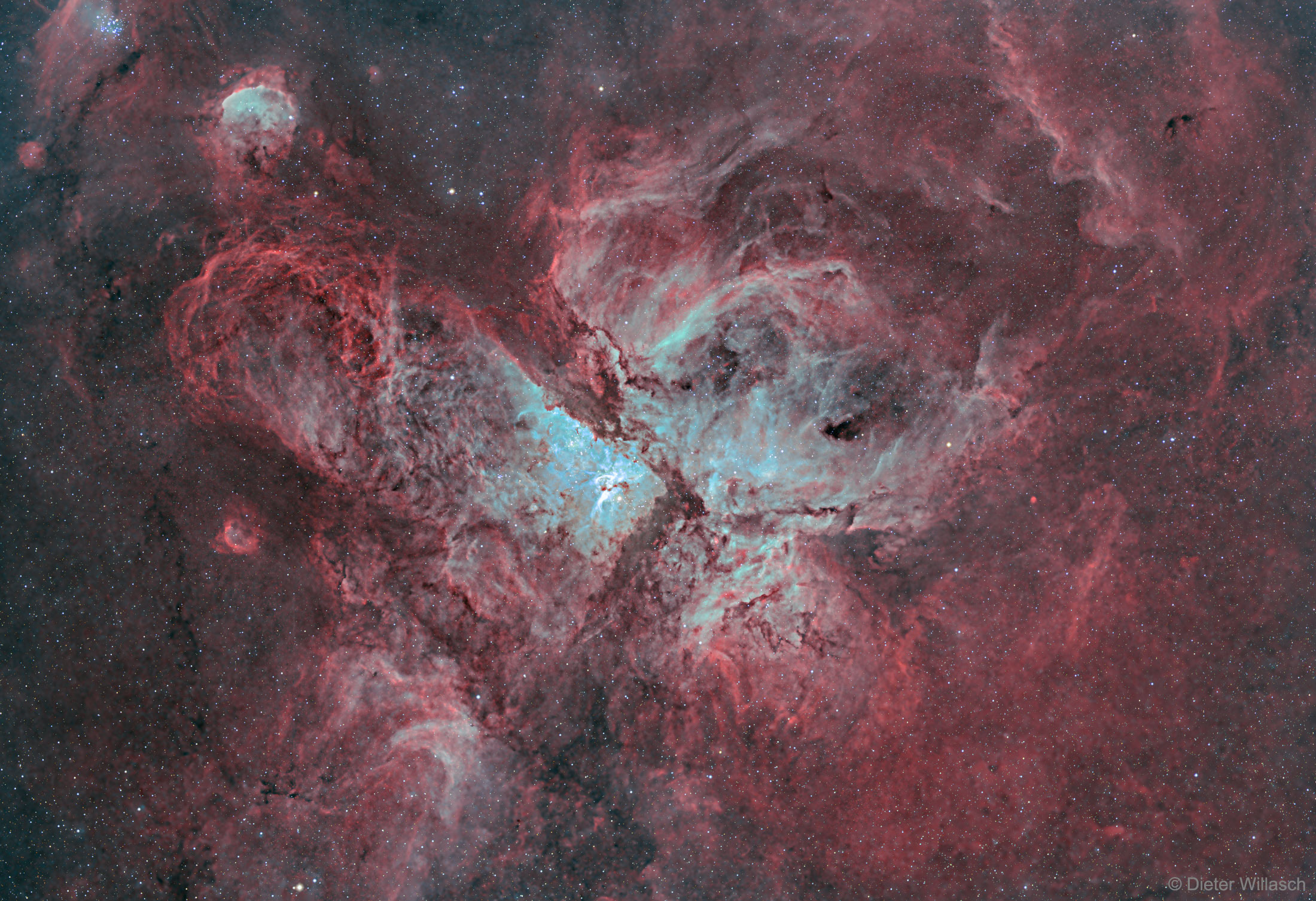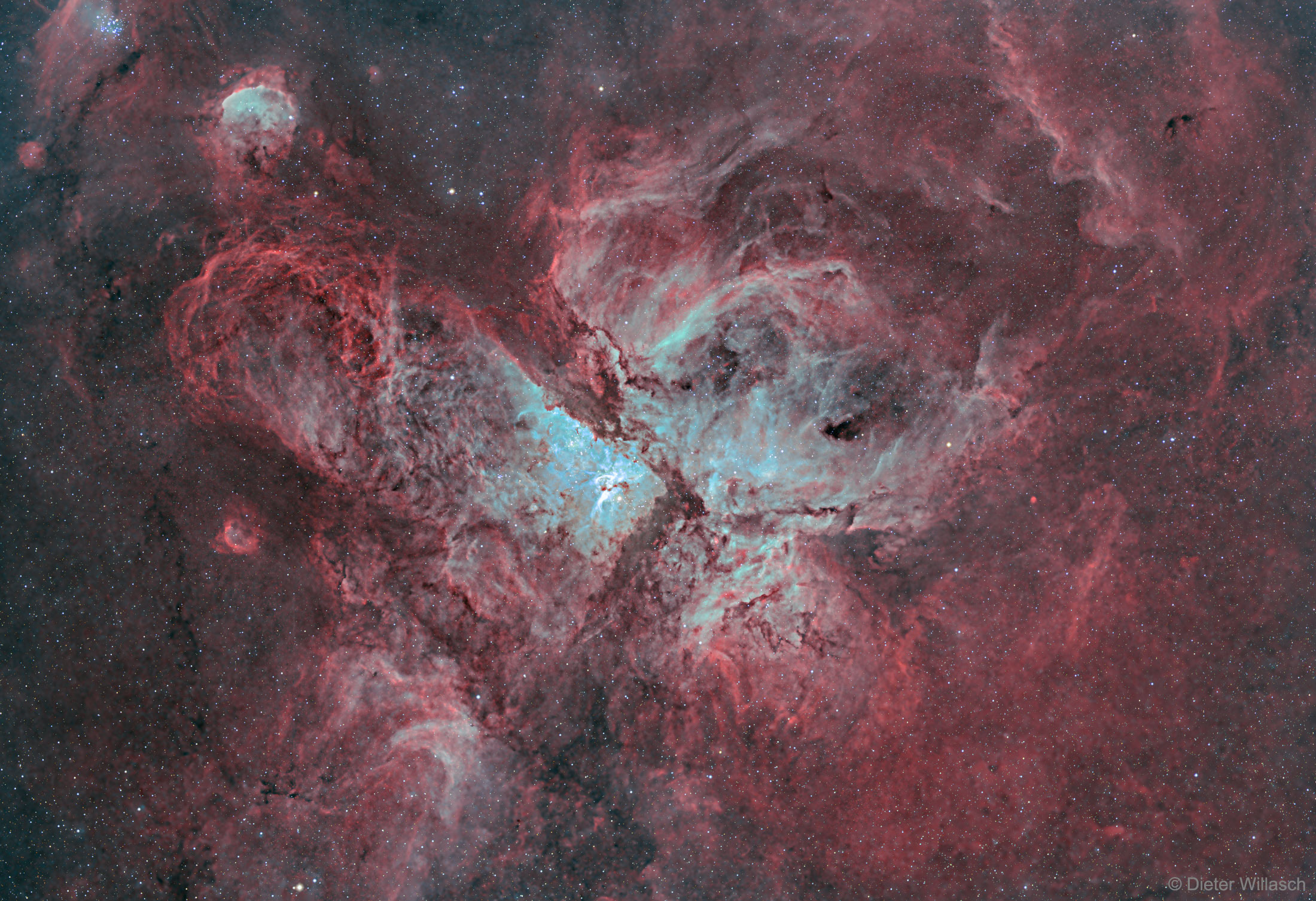
What's happening in the center of the Carina Nebula? Stars are forming, dying, and leaving an impressive tapestry of dark dusty filaments. The entire Carina Nebula, cataloged as NGC 3372, spans over 300 light years and lies about 8,500 light-years away in the constellation of Carina. The nebula is composed predominantly of hydrogen gas, which emits the pervasive red glow seen in this highly detailed featured image. The blue glow in the center is created by a trace amount of glowing oxygen. Young and massive stars located in the nebula's center expel dust when they explode in supernovae. Eta Carinae, the most energetic star in the nebula's center, was one of the brightest stars in the sky in the 1830s, but then faded dramatically.
¿Qué está sucediendo en el centro de la nebulosa Carina? Estrellas están naciendo, muriendo y dejando una impresionante trama de finos filamentos oscuros de polvo. La nebulosa Carina, catalogada como NGC 3372, abarca más de 300 años luz y se encuentra a unos 8500 años luz de distancia en la constelación de Carina. La nebulosa está compuesta principalmente de gas hidrógeno, que emite el resplandor rojizo general que se observa en esta imagen detallada. El brillo azul en el centro es creado por una pequeña cantidad de oxígeno que emite luz. Estrellas jóvenes y masivas ubicadas en el centro de la nebulosa expulsan polvo cuando explotan en supernovas. Eta Carinae, la estrella más energética en el centro de la nebulosa, fue una de las estrellas más brillantes del cielo en la década de 1830, pero luego se atenuó drásticamente.