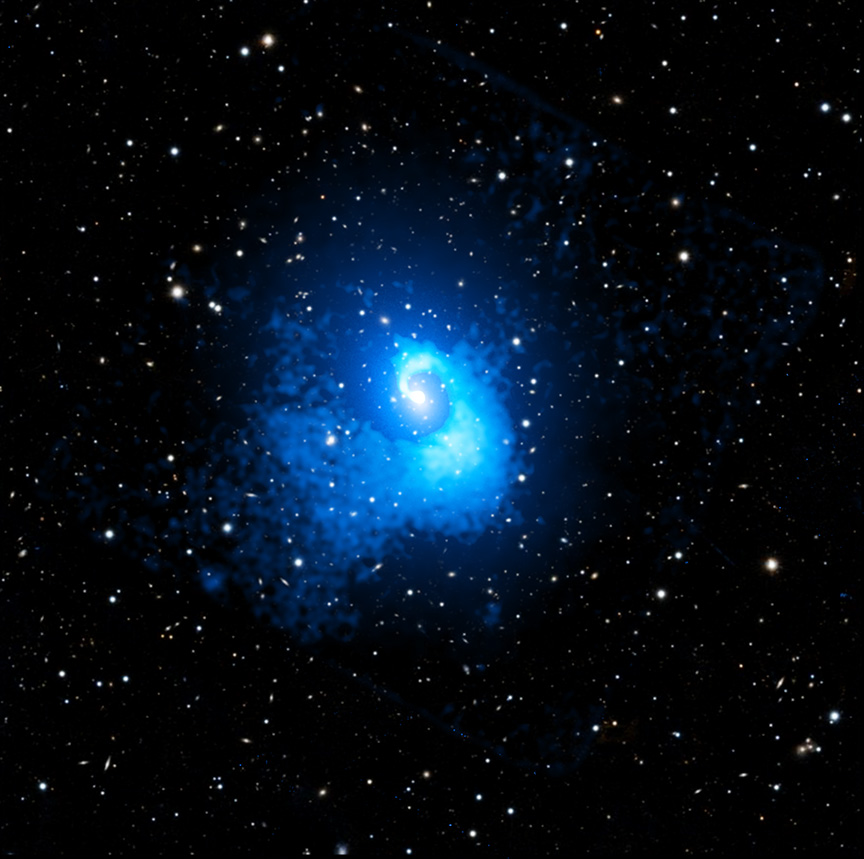
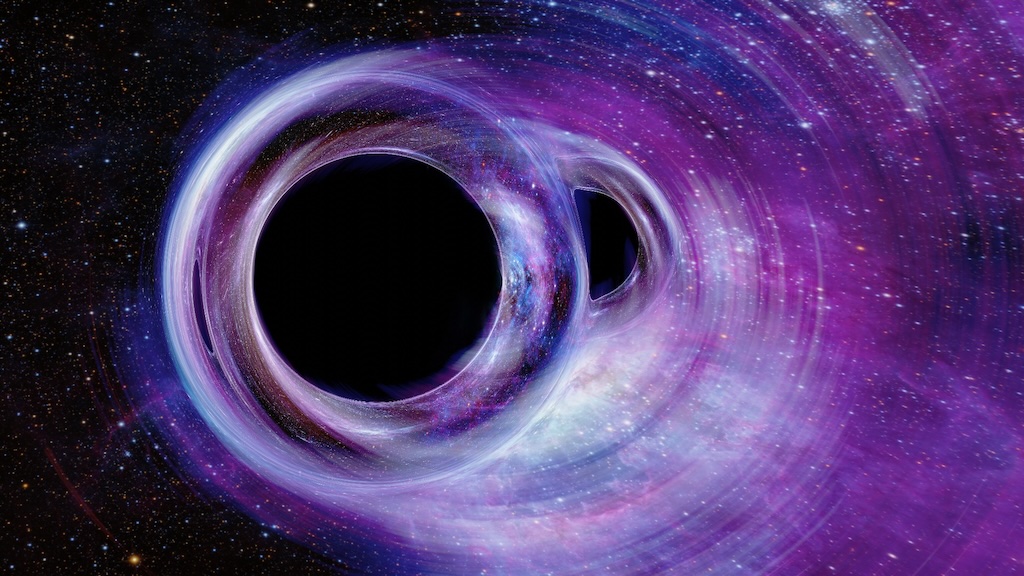
What would it look like to orbit a black hole? Many black holes are surrounded by swirling pools of gas known as accretion disks. These disks can be extremely hot, and much of the orbiting gas will eventually fall through the black hole's event horizon -- where it will never be seen again. The featured animation is an artist's rendering of the curious disk spiraling around the supermassive black hole at the center of spiral galaxy NGC 3147. Gas at the inner edge of this disk is so close to the black hole that it moves unusually fast -- at 10 percent of the speed of light. Gas this fast shows relativistic beaming, making the side of the disk heading toward us appear significantly brighter than the side moving away. The animation is based on images of NGC 3147 made recently with the Hubble Space Telescope. Astrophysicists: Browse 2,000+ codes in the Astrophysics Source Code Library
¿Cómo se vería orbitar un agujero negro? Muchos agujeros negros están rodeados por piscinas giratorias de gas conocidas como discos de acreción. Estos discos pueden ser extremadamente calientes, y gran parte del gas en órbita eventualmente caerá a través del horizonte de eventos del agujero negro — donde nunca será visto nuevamente. La animación destacada es una representación artística del curioso disco que gira alrededor del agujero negro supermasivo en el centro de la galaxia espiral NGC 3147. El gas en el borde interior de este disco está tan cerca del agujero negro que se mueve a una velocidad inusualmente alta — el 10 por ciento de la velocidad de la luz. Este gas tan rápido muestra el efecto de apuntamiento relativista, haciendo que el lado del disco que se acerca a nosotros aparezca significativamente más brillante que el lado que se aleja. La animación se basa en imágenes de NGC 3147 tomadas recientemente con el Telescopio Espacial Hubble.