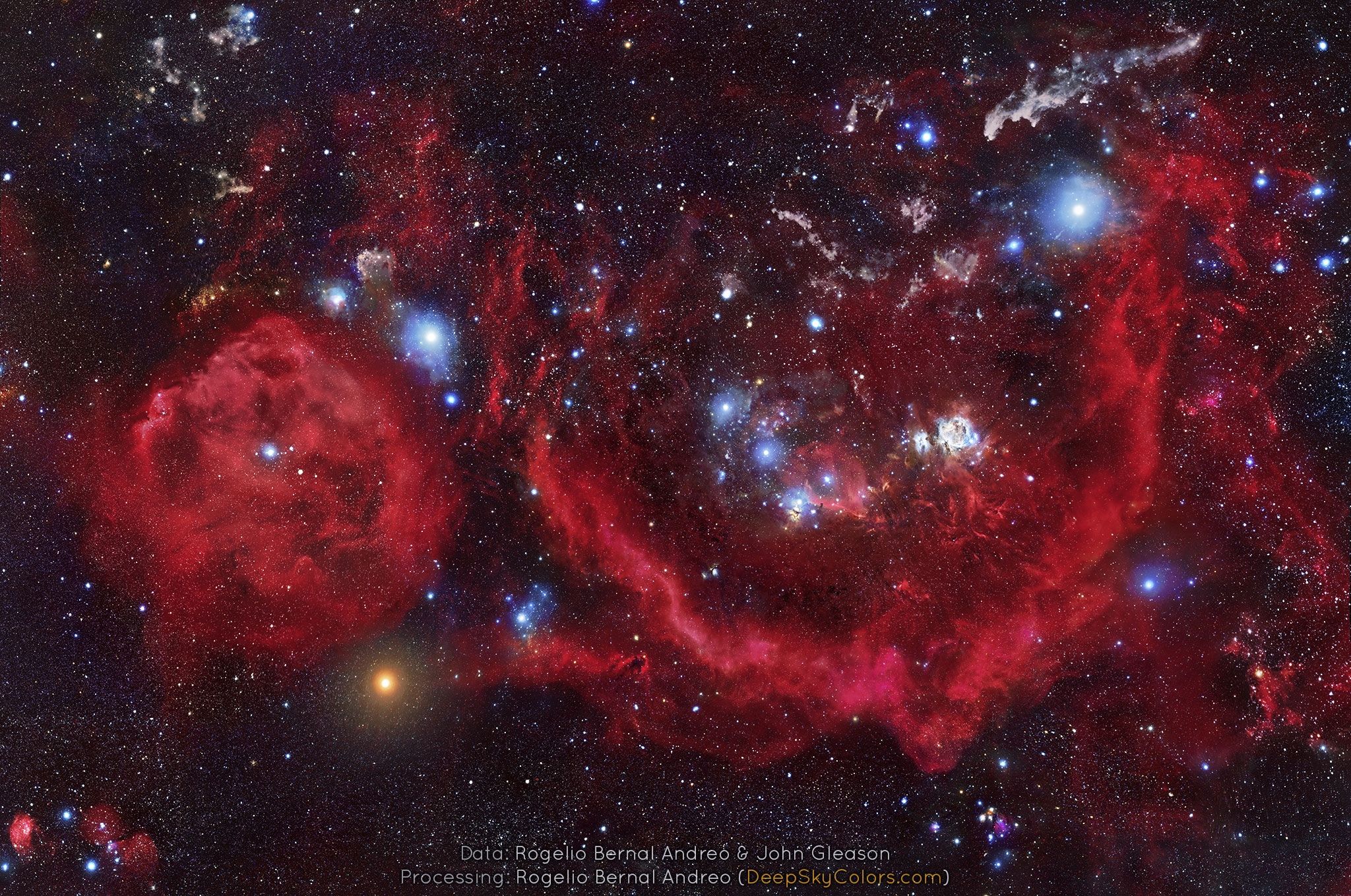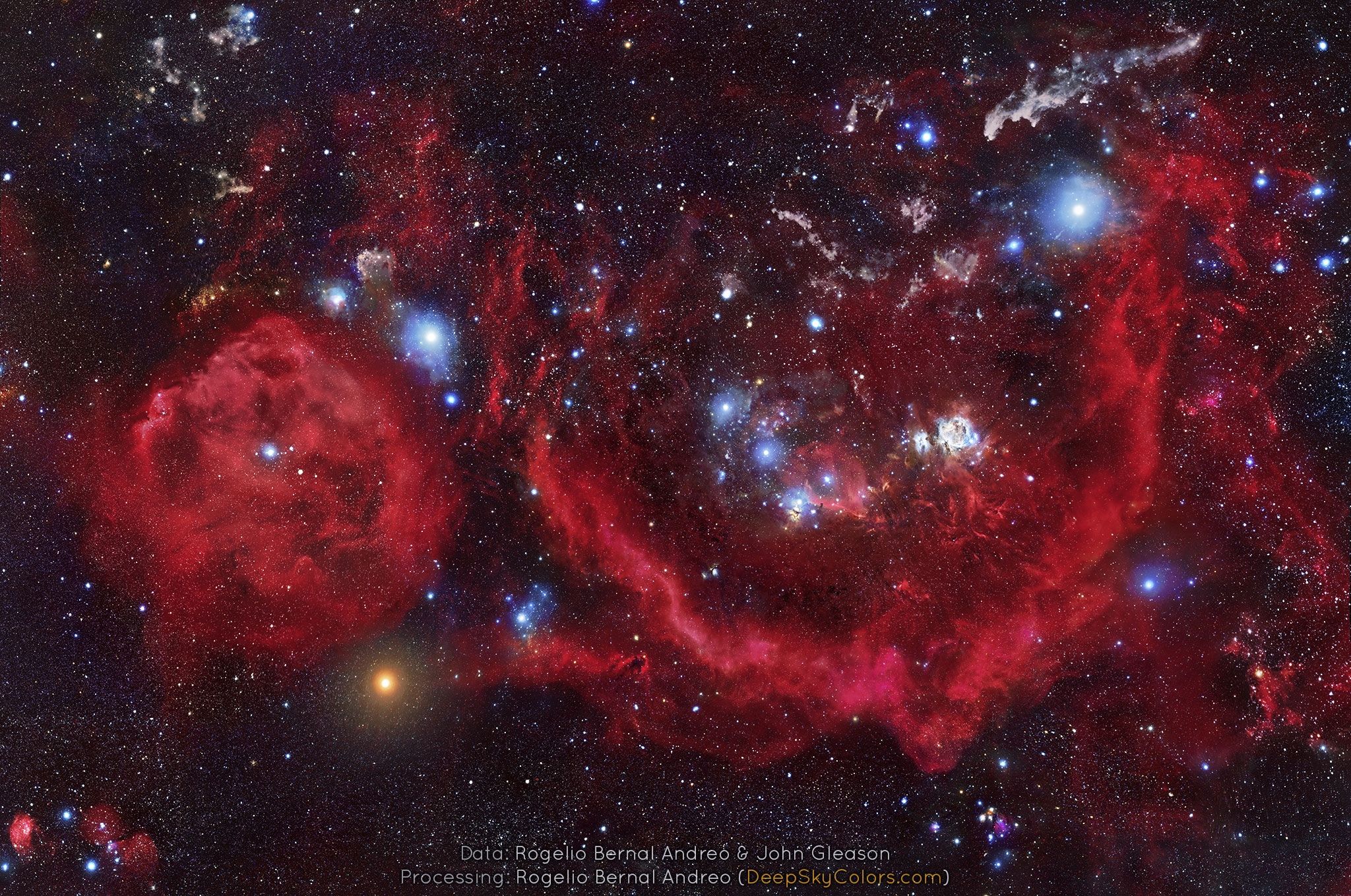
Do you recognize this constellation? Although it is one of the most recognizable star groupings on the sky, this is a more full Orion than you can see -- an Orion only revealed with long exposure digital camera imaging and post-processing. Here the cool red giant Betelgeuse takes on a strong orange tint as the brightest star at the lower left. Orion's hot blue stars are numerous, with supergiant Rigel balancing Betelgeuse on the upper right, and Bellatrix at the upper left. Lined up in Orion's belt are three stars all about 1,500 light-years away, born from the constellation's well-studied interstellar clouds. To the right of Orion's belt is a bright but fuzzy patch that might also look familiar -- the stellar nursery known as Orion's Nebula. Finally, just barely visible to the unaided eye but quite striking here is Barnard's Loop -- a huge gaseous emission nebula surrounding Orion's Belt and Nebula discovered over 100 years ago by the pioneering Orion photographer E. E. Barnard. APOD Podcasts: Available on iTunes and YouTube.
¿Reconoces esta constelación? Aunque es uno de los grupos de estrellas más reconocibles del cielo, esta es una visión más completa de Orión de la que puedes ver a simple vista — un Orión revelado solo mediante imágenes con cámaras digitales de larga exposición y postprocesamiento. Aquí, la gigante roja fría Betelgeuse adquiere un fuerte tono naranja como la estrella más brillante en la esquina inferior izquierda. Las estrellas calientes y azules de Orión son numerosas, con la supergigante Rigel equilibrando a Betelgeuse en la esquina superior derecha, y Bellatrix en la esquina superior izquierda. Alineadas en el cinturón de Orión se encuentran tres estrellas, todas a unos 1500 años luz de distancia, nacidas de las bien estudiadas nubes interestelares de la constelación. A la derecha del cinturón de Orión se encuentra un parche brillante pero difuso que también puede parecer familiar — la región de formación estelar conocida como la Nebulosa de Orión. Finalmente, apenas visible a simple vista pero muy llamativo aquí, se encuentra el Bucle de Barnard — una gran nebulosa de emisión gaseosa que rodea el Cinturón y la Nebulosa de Orión, descubierto hace más de 100 años por el pionero fotógrafo de Orión E. E. Barnard.