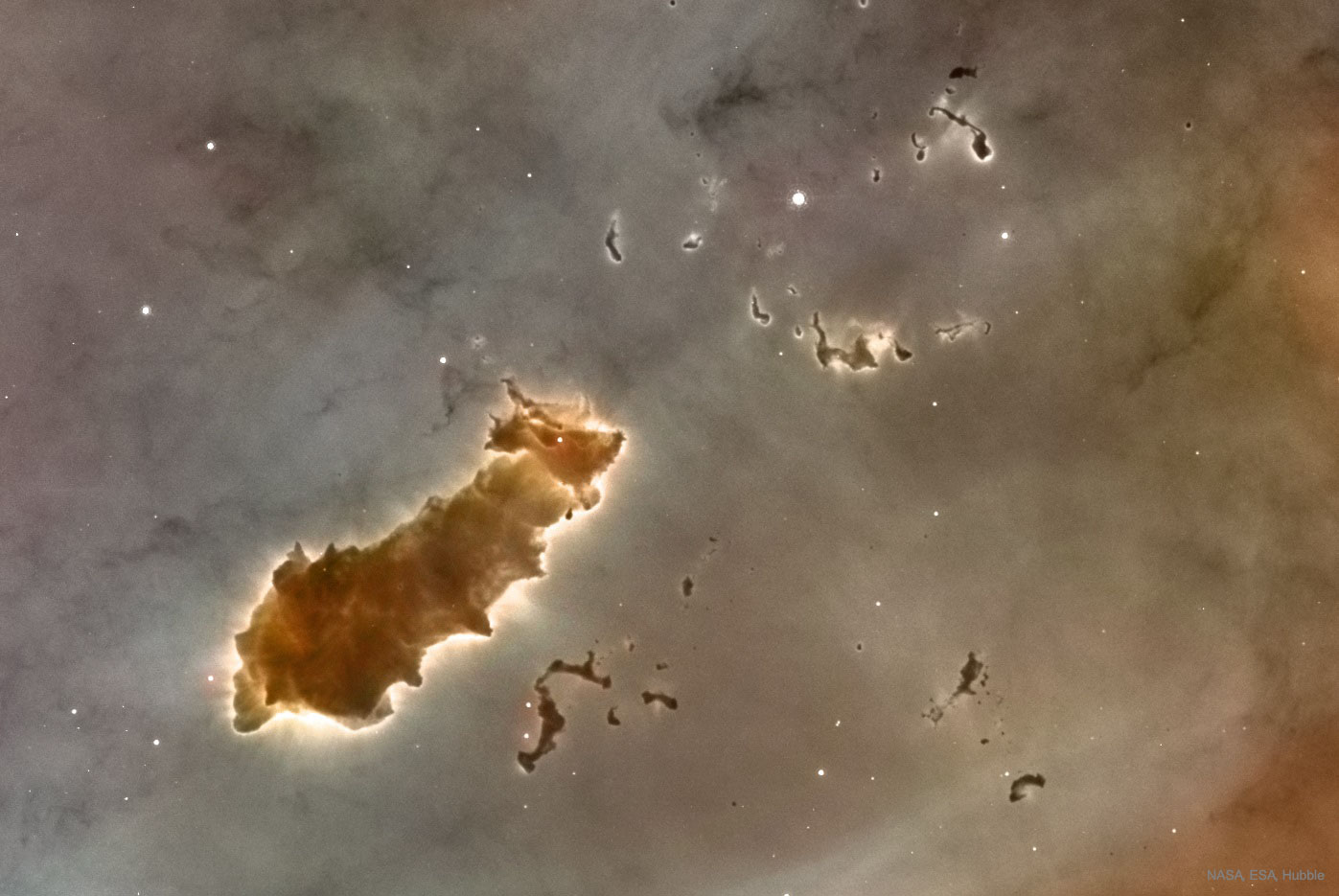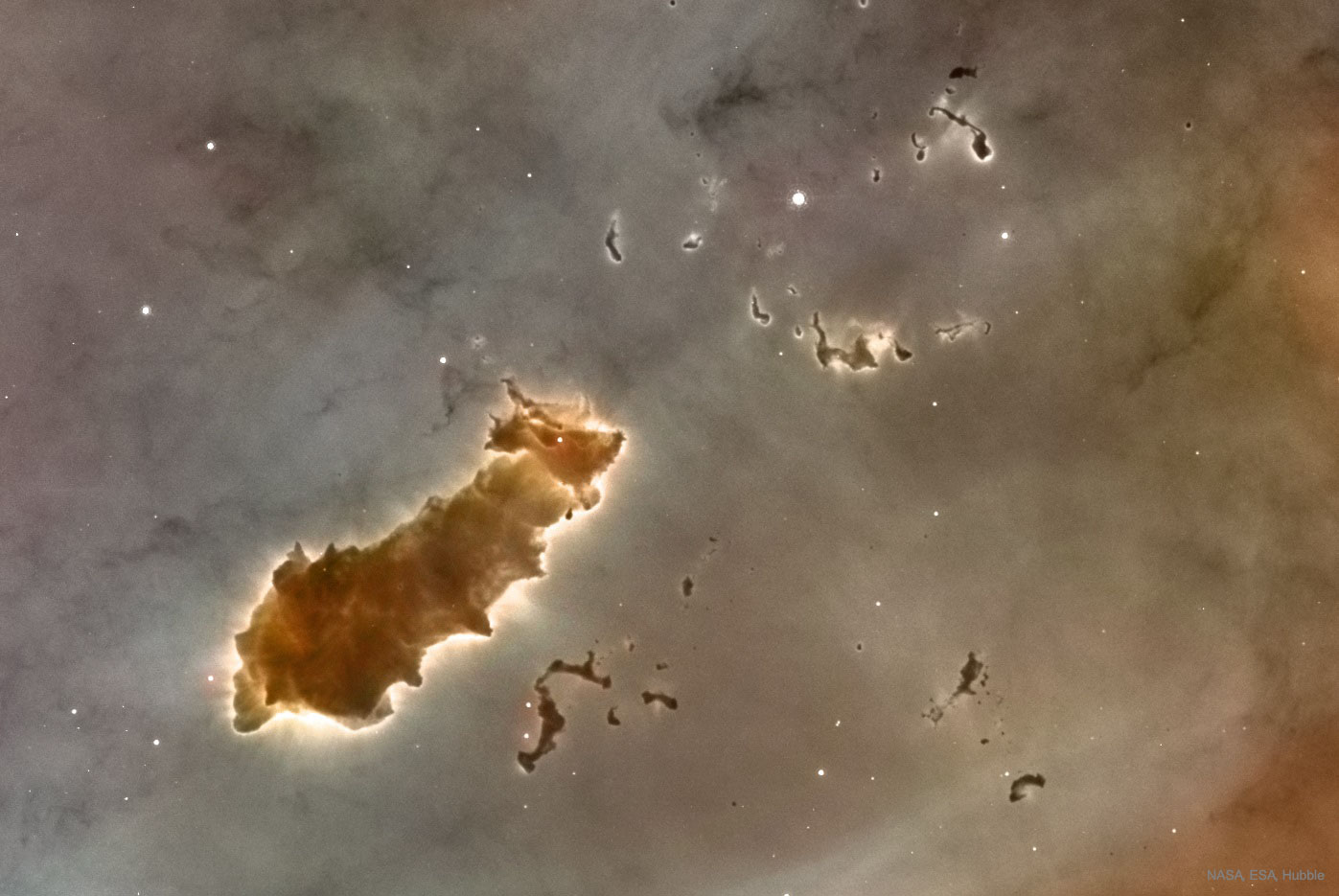
They are not alive -- but they are dying. The unusual forms found in the Carina nebula, a few of which are featured here, might best be described as evaporating. Energetic light and winds from nearby stars are breaking apart the dark dust grains that make the iconic forms opaque. Ironically the figures, otherwise known as dark molecular clouds or bright rimmed globules, frequently create in their midst the very stars that later destroy them. The floating space structures pictured here by the orbiting Hubble Space Telescope span a few light months. The Great Nebula in Carina itself spans about 30 light years, lies about 7,500 light years away, and can be seen with a small telescope toward the constellation of Keel(Carina).
Crédito: NASA, Hubble Space Telescope Ellos no están vivos, pero están muriendo. Las formas inusuales encontradas en la nebulosa Carina, algunas de las cuales se muestran aquí, podrían describirse mejor como evaporándose. La luz y los vientos energéticos de estrellas cercanas están desgarrando los granos de polvo oscuro que hacen que estas formas icónicas sean opacas. Irónicamente, estas figuras, también conocidas como nubes moleculares oscuras o globulos con borde brillante, frecuentemente crean en su interior las mismas estrellas que más tarde las destruyen. Las estructuras espaciales flotantes mostradas aquí por el telescopio espacial Hubble orbitante abarcan unos pocos meses luz. La Gran Nebulosa de Carina misma abarca aproximadamente 30 años luz, se encuentra a unos 7500 años luz de distancia y puede verse con un telescopio pequeño hacia la constelación de Carina (el Quilla).