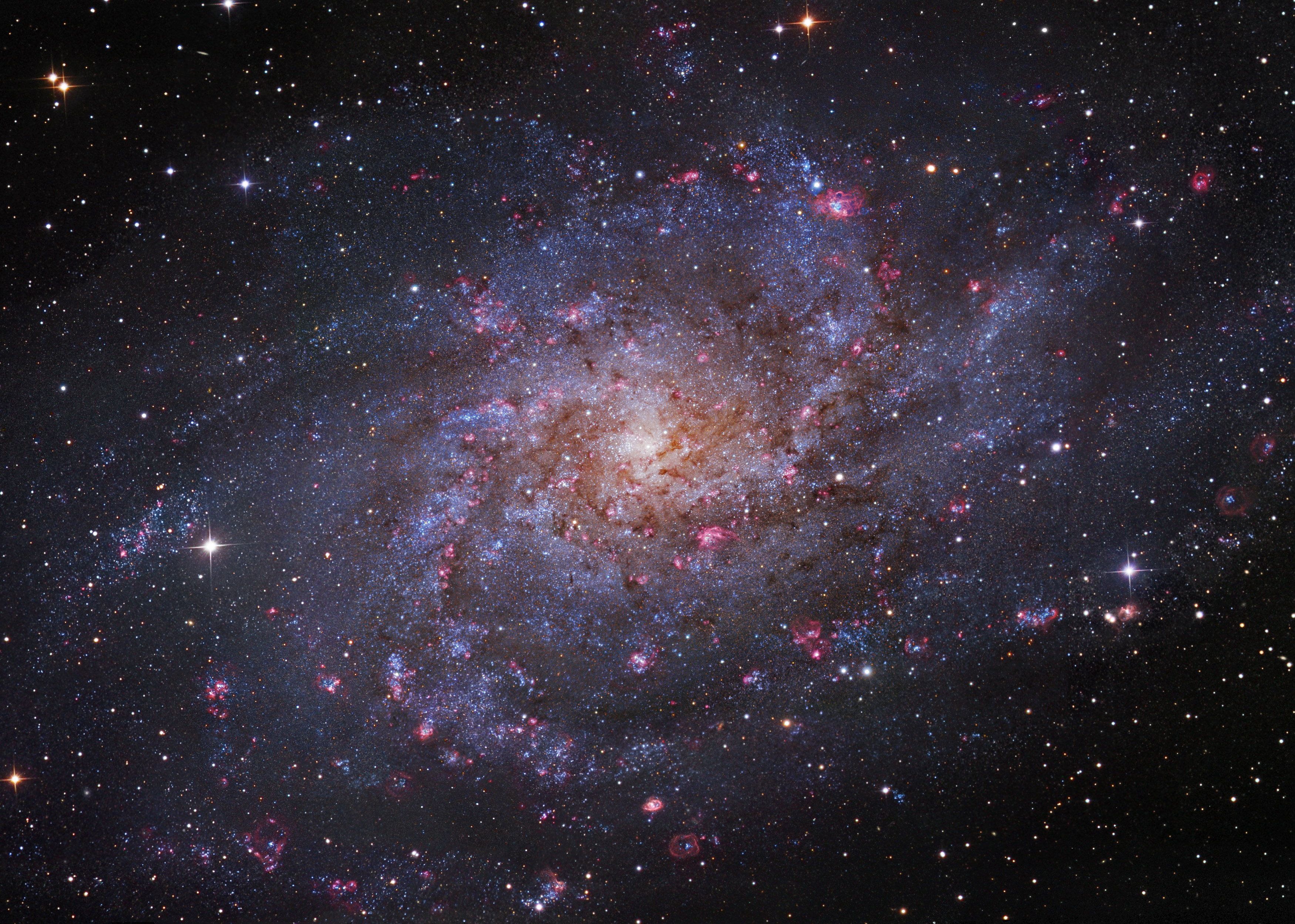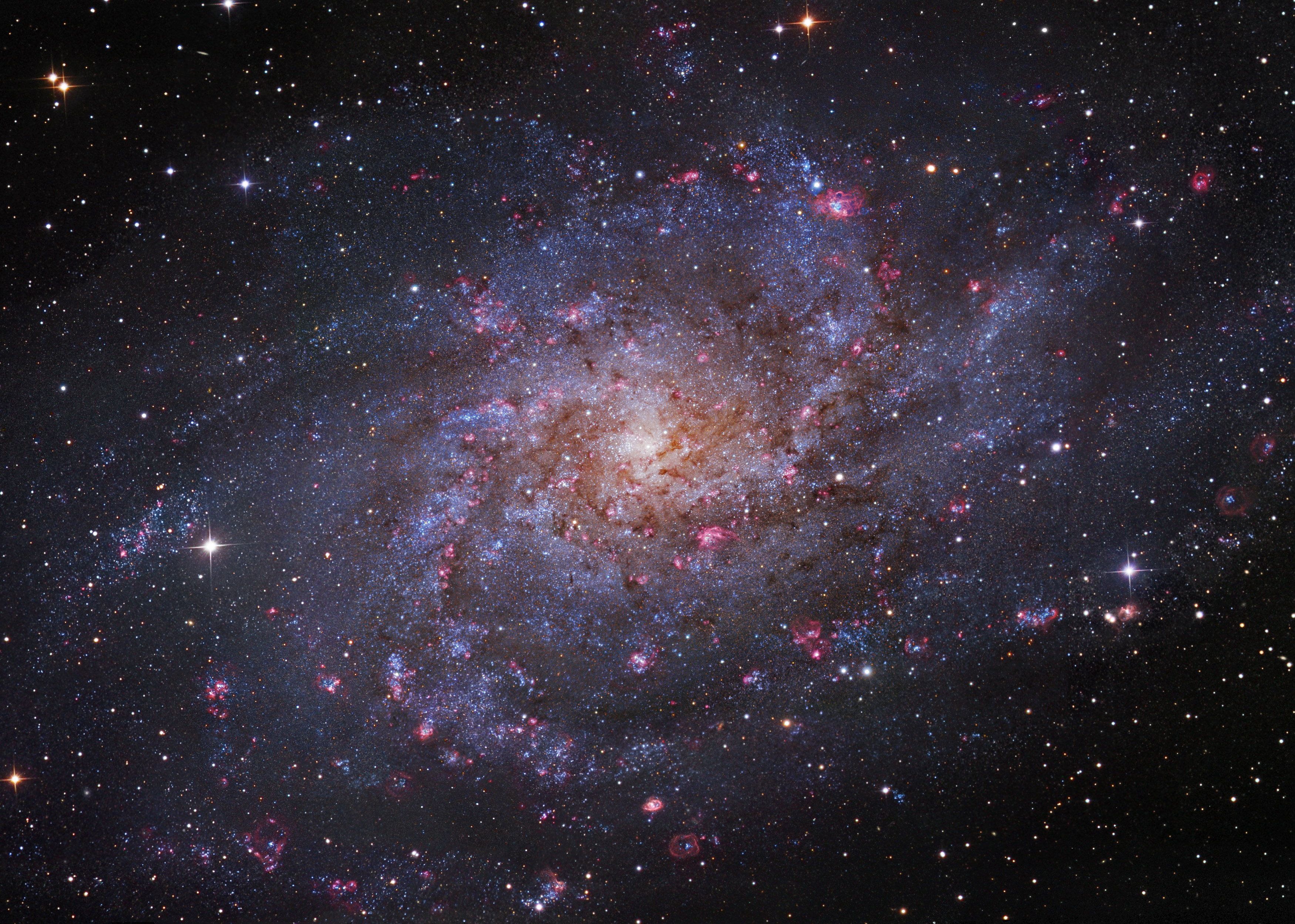
Gorgeous spiral galaxy M33 seems to have more than its fair share of glowing hydrogen gas. A prominent member of the local group of galaxies, M33 is also known as the Triangulum Galaxy and lies a mere 3 million light-years away. The galaxy's inner 30,000 light-years or so are shown in this magnificent 25 panel telescopic mosaic. Based on image data from space and ground-based telescopes, the portrait of M33 shows off the galaxy's reddish ionized hydrogen clouds or HII regions. Sprawling along loose spiral arms that wind toward the core, M33's giant HII regions are some of the largest known stellar nurseries, sites of the formation of short-lived but very massive stars. Intense ultraviolet radiation from the luminous, massive stars ionizes the surrounding hydrogen gas and ultimately produces the characteristic red glow. To enhance this image, broadband data were used to produce a color view of the galaxy and combined with narrowband data recorded through a hydrogen-alpha filter. That filter transmits the light of the strongest visible hydrogen emission line.
La hermosa galaxia en espiral M33 parece tener más de su parte justa de gas de hidrógeno brillante. Un miembro destacado del grupo local de galaxias, M33 también se conoce como la Galaxia del Triángulo y se encuentra a solo 3 millones de años luz de distancia. En esta magnífica mosaico telescópico de 25 paneles se muestra la región interior de unos 30,000 años luz de la galaxia. Basada en datos de imágenes de telescopios terrestres y espaciales, esta representación de M33 muestra las nubes de hidrógeno ionizado o regiones HII de color rojizo. Extendidas a lo largo de brazos espirales sueltos que se curvan hacia el núcleo, las grandes regiones HII de M33 son algunas de las mayores zonas conocidas de formación estelar, lugares donde se forman estrellas de corta vida pero muy masivas. La radiación ultravioleta intensa proveniente de las estrellas luminosas y masivas ioniza el gas de hidrógeno circundante y produce finalmente el característico brillo rojizo. Para mejorar esta imagen, se utilizaron datos de banda ancha para crear una vista en color de la galaxia y se combinaron con datos de banda estrecha registrados a través de un filtro de hidrógeno alfa. Ese filtro transmite la luz de la línea de emisión visible más fuerte del hidrógeno.