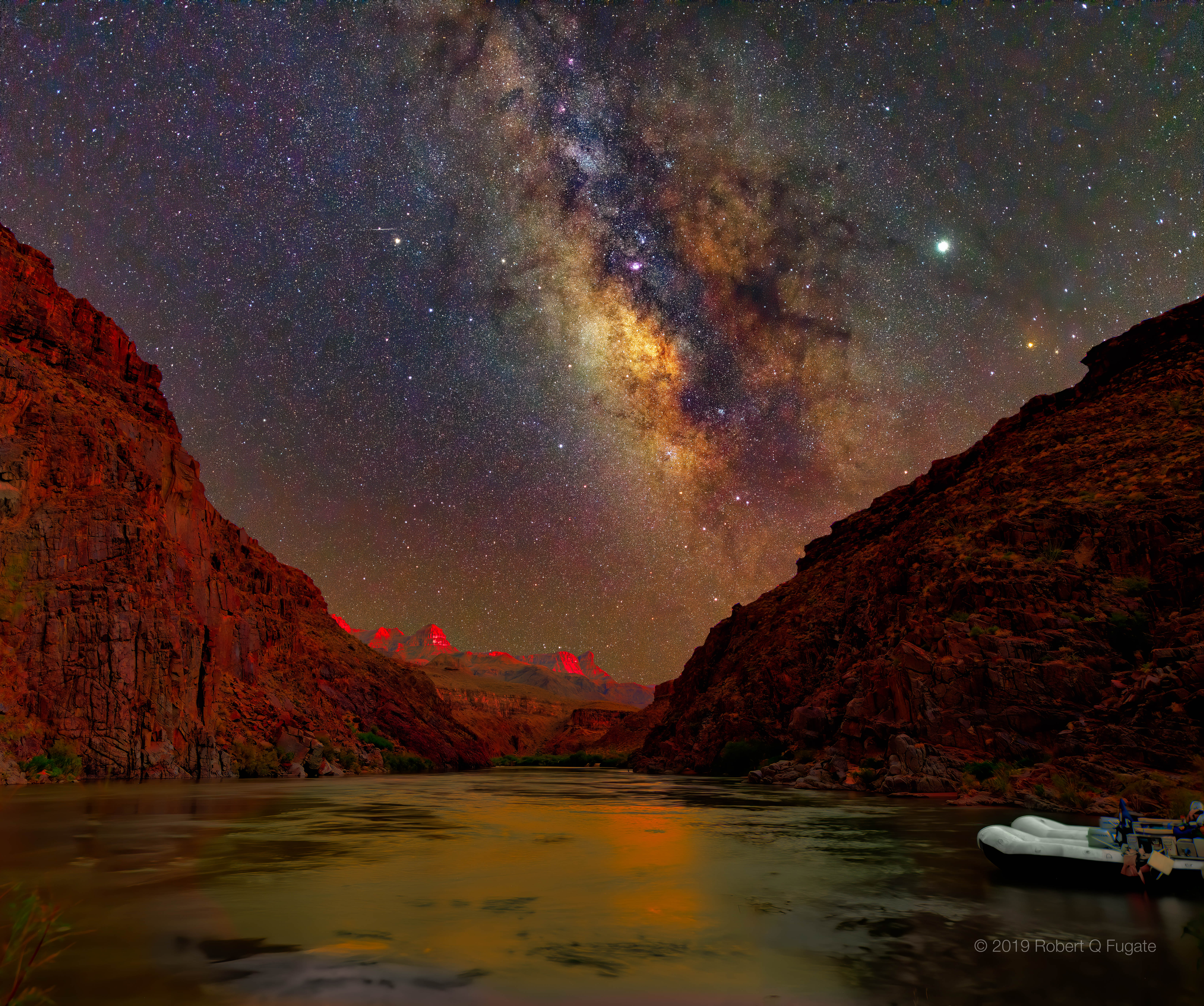
Seeing mountain peaks glow red from inside the Grand Canyon was one of the most incredible sunset experiences of this amateur photographer's life. They appeared even more incredible later, when digitally combined with an exposure of the night sky -- taken by the same camera and from the same location -- an hour later. The two images were taken last August from the 220 Mile Canyon campsite on the Colorado River, Arizona, USA. The peaks glow red because they were lit by an unusually red sunset. Later, high above, the band of the Milky Way Galaxy angled dramatically down, filled with stars, nebula, and dark clouds of dust. To the Milky Way's left is the planet Saturn, while to the right is the brighter Jupiter. Although Jupiter and Saturn are now hard to see, Venus will be visible and quite bright to the west in clear skies, just after sunset, for the next two months. Astrophotography with Your Computer: NASA's Astrophoto Challenges
Ver que las cimas de las montañas brillaran rojas desde el interior del Gran Cañón fue una de las experiencias más increíbles de atardecer en la vida de este fotógrafo aficionado. Aparecieron aún más increíbles más tarde, cuando se combinaron digitalmente con una exposición del cielo nocturno —tomada por la misma cámara y desde el mismo lugar— una hora después. Las dos imágenes se tomaron el mes pasado de agosto desde el campamento 220 Mile Canyon en el río Colorado, Arizona, EE.UU. Las cimas brillan rojas porque estaban iluminadas por un atardecer inusualmente rojizo. Más tarde, muy arriba, la banda de la Vía Láctea se inclinaba dramáticamente hacia abajo, llena de estrellas, nebulosas y nubes oscuras de polvo. A la izquierda de la Vía Láctea se encuentra el planeta Saturno, mientras que a la derecha está el más brillante Júpiter. Aunque Júpiter y Saturno son ahora difíciles de ver, Venus será visible y bastante brillante hacia el oeste en cielos despejados, justo después del atardecer, durante los próximos dos meses.