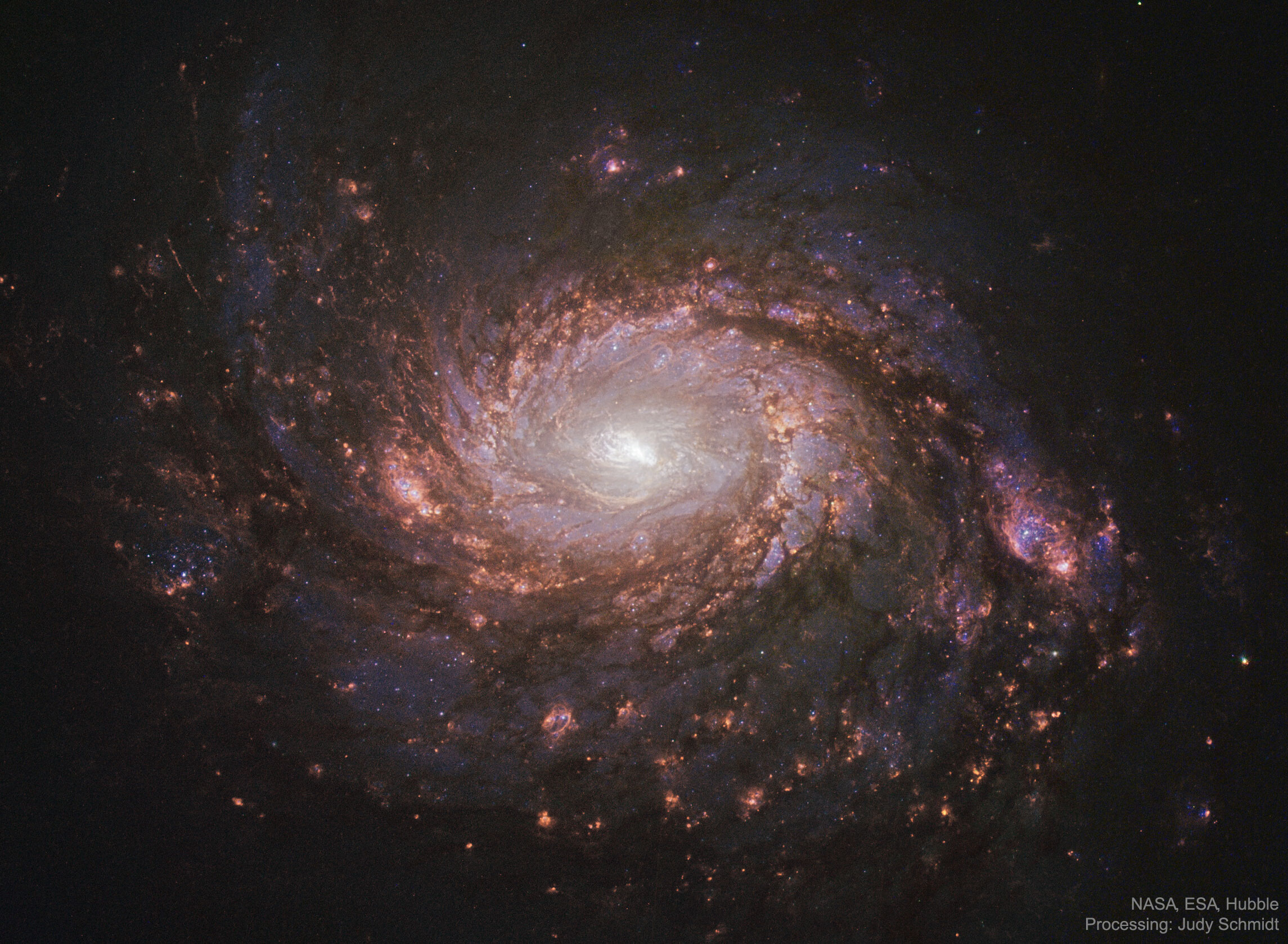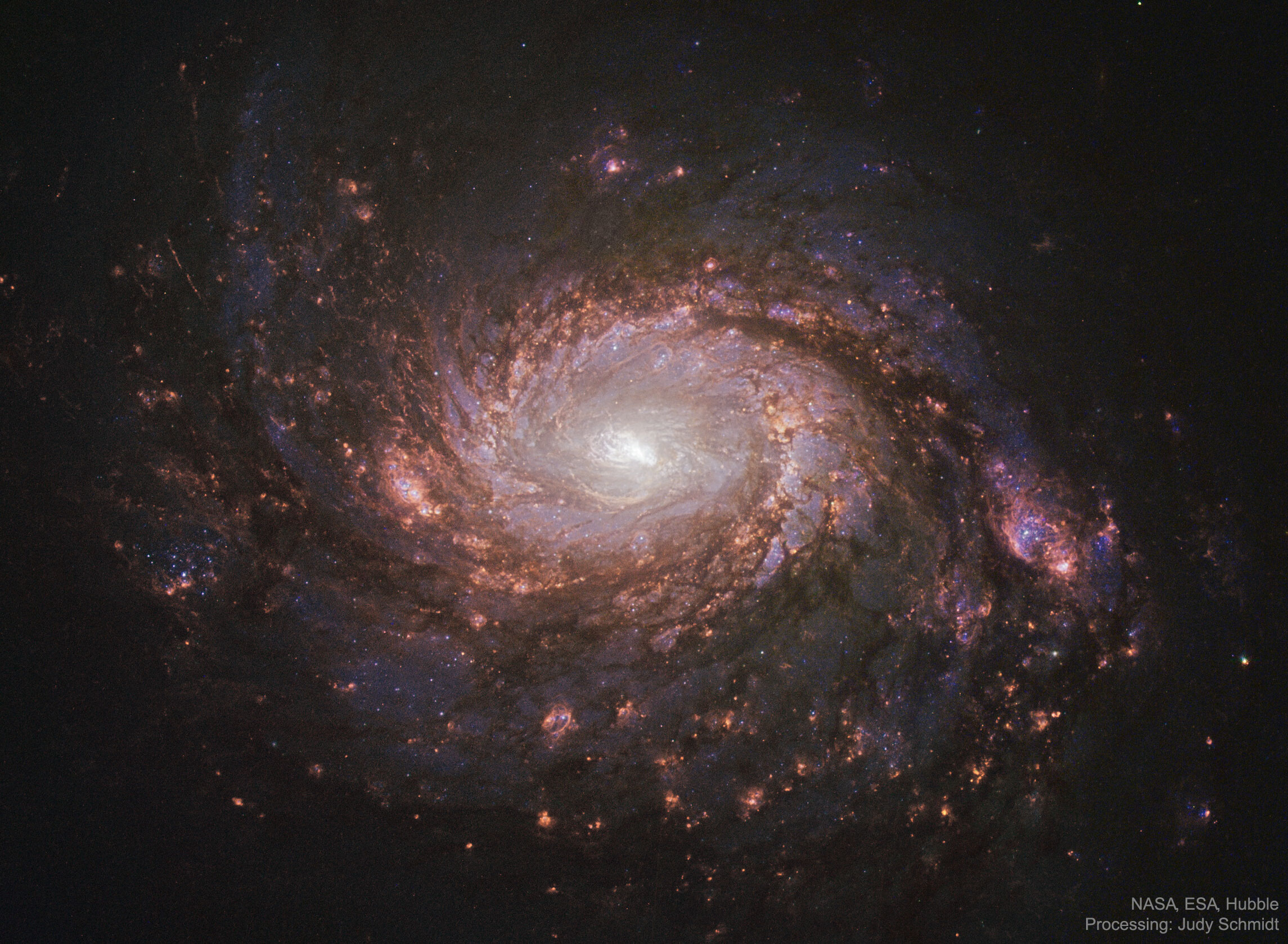
What's happening in the center of nearby spiral galaxy M77? The face-on galaxy lies a mere 47 million light-years away toward the constellation of the Sea Monster (Cetus). At that estimated distance, this gorgeous island universe is about 100 thousand light-years across. Also known as NGC 1068, its compact and very bright core is well studied by astronomers exploring the mysteries of supermassive black holes in active Seyfert galaxies. M77 and its active core glows bright at x-ray, ultraviolet, visible, infrared, and radio wavelengths. The featured sharp image of M77 was taken by the Hubble Space Telescope and is dominated by the (visible) red light emitted by hydrogen. The image shows details of the spiral's winding spiral arms as traced by obscuring dust clouds, and red-tinted star forming regions close in to the galaxy's luminous core. Astrophysicists: Browse 2,100+ codes in the Astrophysics Source Code Library
¿Qué está sucediendo en el centro de la galaxia espiral cercana M77? Esta galaxia observada de cara se encuentra a solo 47 millones de años luz de distancia, en la constelación del Monstruo del Mar (Cetus). A esa distancia estimada, este hermoso universo isla tiene aproximadamente 100 mil años luz de diámetro. También conocida como NGC 1068, su núcleo compacto y muy brillante es ampliamente estudiado por astrónomos que exploran los misterios de los agujeros negros supermasivos en galaxias Seyfert activas. M77 y su núcleo activo brillan intensamente en longitudes de onda de rayos X, ultravioleta, visible, infrarrojo y radio. La imagen nítida de M77 mostrada aquí fue capturada por el Telescopio Espacial Hubble y está dominada por la luz roja visible emitida por el hidrógeno. La imagen muestra detalles de los brazos espirales en espiral, trazados por nubes de polvo que los oscurecen, y regiones de formación estelar teñidas de rojo, cercanas al núcleo luminoso de la galaxia.