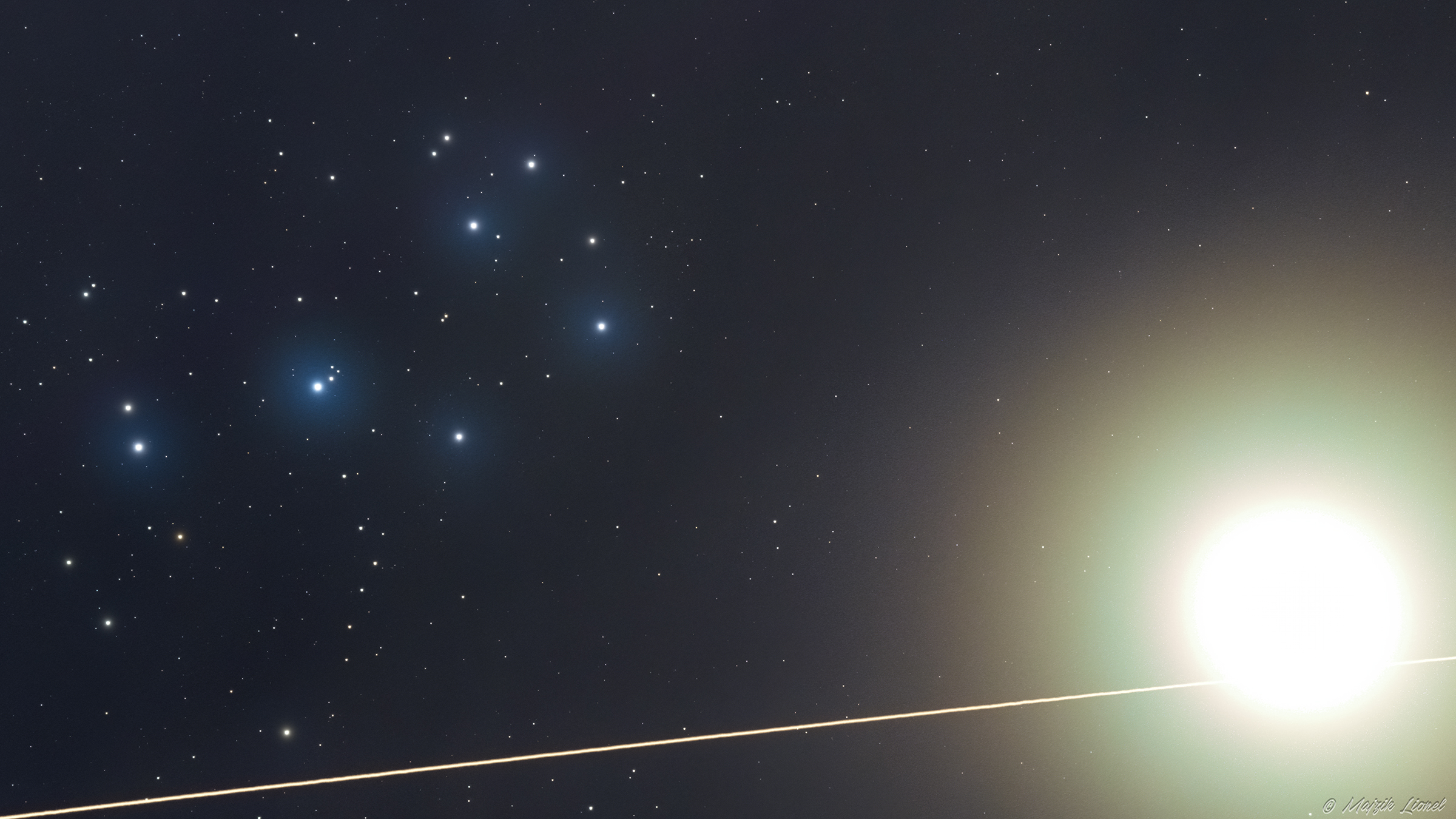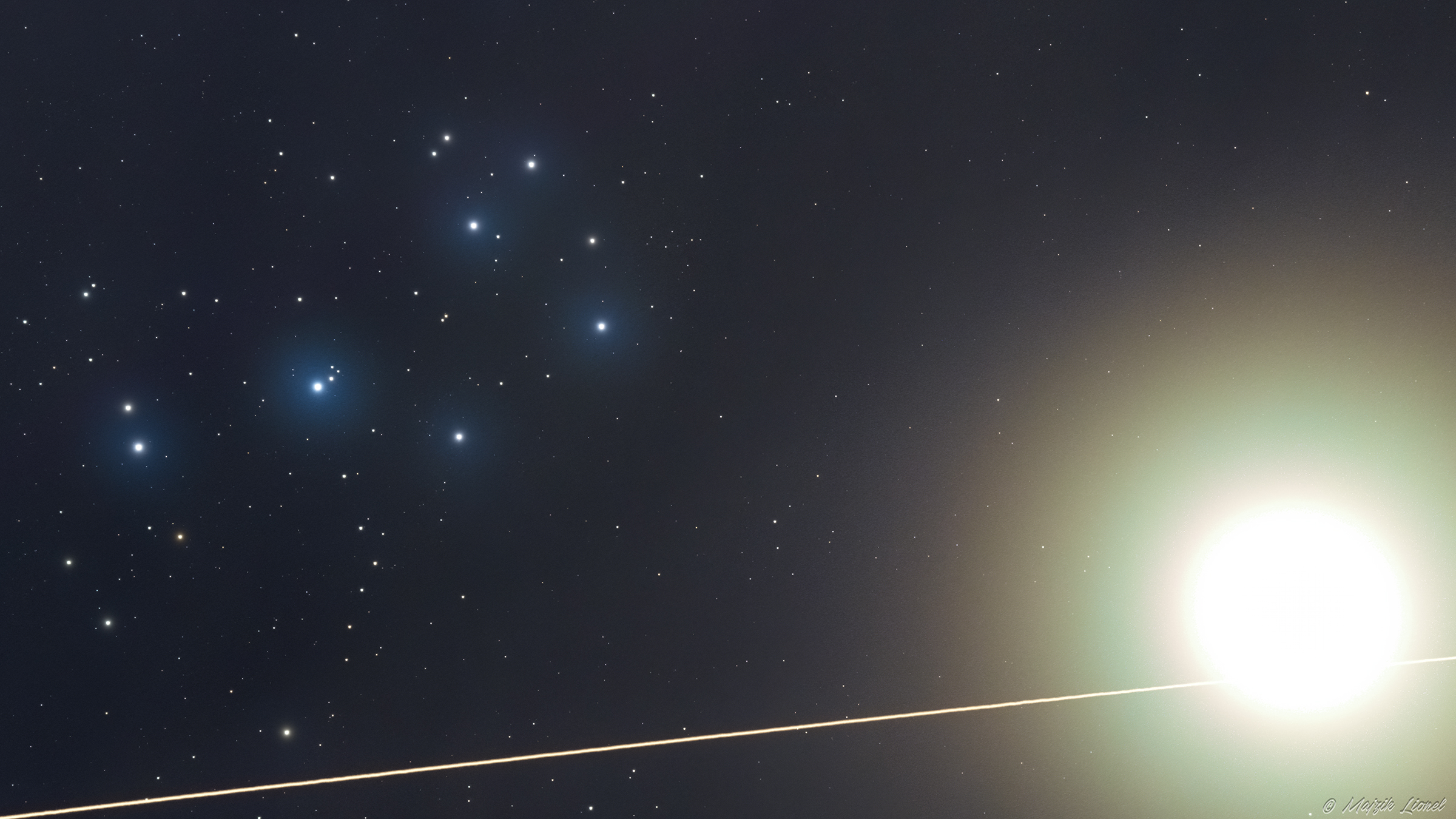
There's a traffic jam in Taurus lately. On April 1, this celestial frame from slightly hazy skies over Tapiobicske, Hungary recorded an impressive pile up toward the zodiacal constellation of the Bull and the Solar System's ecliptic plane. Streaking right to left the International Space Station speeds across the bottom of the telescopic field of view. Wandering about as far from the Sun in planet Earth's skies as it can get, inner planet Venus is bright and approaching much slower, overexposed at the right. Bystanding at the upper left are the sister stars of the Pleiades. No one has been injured in the close encounter though, because it really isn't very close. Continuously occupied since November 2000, the space station orbits some 400 kilometers above the planet's surface. Venus, currently the brilliant evening star, is almost 2/3 of an astronomical unit away. A more permanent resident of Taurus, the Pleiades star cluster is 400 light-years distant.
Crédito: NASA, CGRO SSC En Tauro ha habido un atasco recientemente. El 1 de abril, este marco celestial tomado desde cielos ligeramente nublados sobre Tapiobicske, Hungría, registró un impresionante amontonamiento hacia la constelación zodiacal del Toro y el plano de la eclíptica del Sistema Solar. Desde la derecha hacia la izquierda, la Estación Espacial Internacional cruza rápidamente la parte inferior del campo de visión telescópico. Mercurio, el planeta interior que se aleja tanto del Sol en los cielos de la Tierra como le es posible, es brillante y se acerca mucho más lentamente, sobreexponiéndose a la derecha. A la izquierda superior, están las estrellas gemelas de las Pléyades. Nadie ha resultado herido en el encuentro cercano, porque en realidad no está muy cerca. La estación espacial, ocupada continuamente desde noviembre de 2000, orbita a unos 400 kilómetros sobre la superficie del planeta. Venus, actualmente la estrella brillante de la tarde, se encuentra a casi 2/3 de una unidad astronómica de distancia. Un residente más permanente de Tauro, el cúmulo estelar de las Pléyades se encuentra a 400 años luz de distancia.