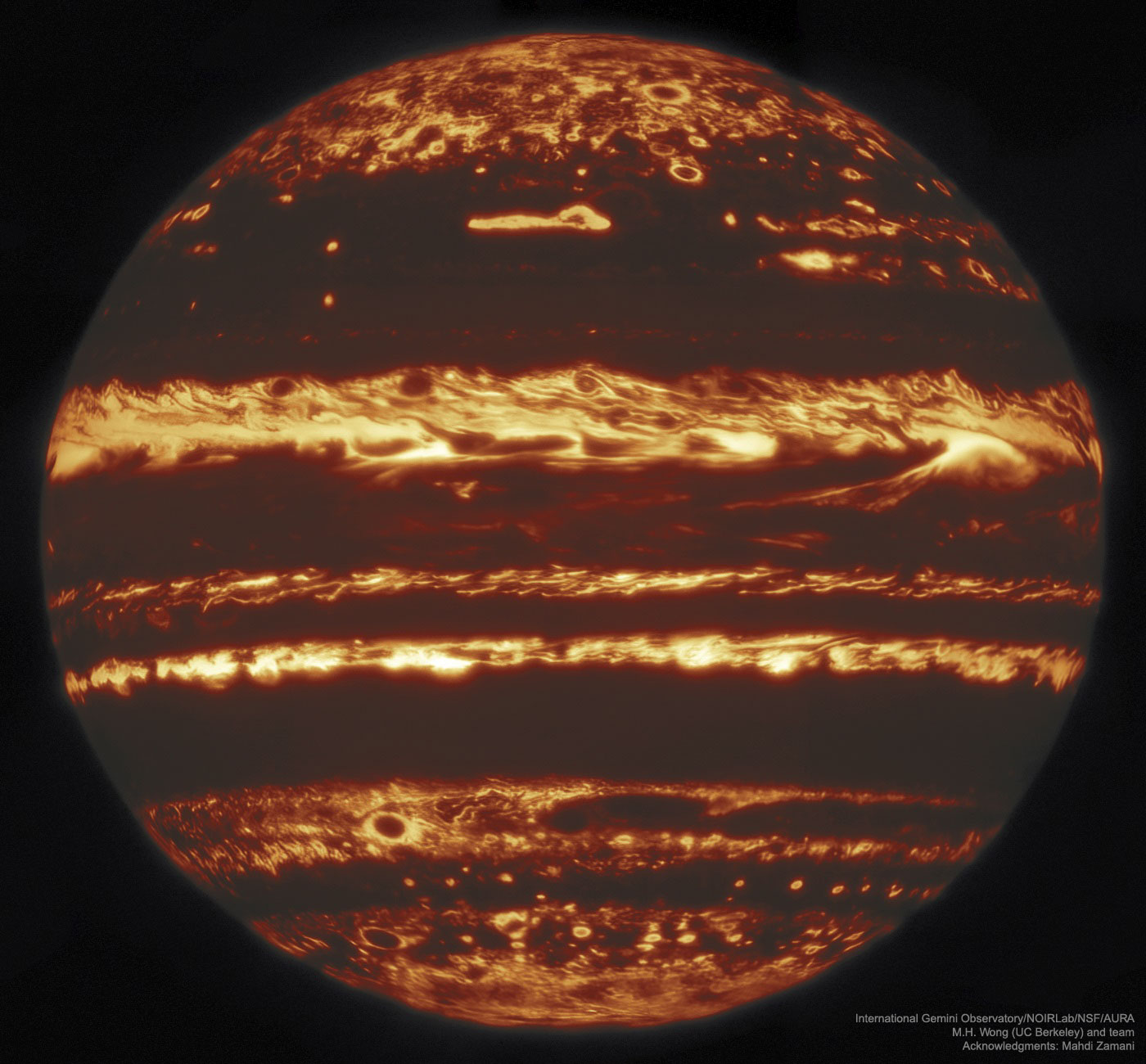
In infrared, Jupiter lights up the night. Recently, astronomers at the Gemini North Observatory in Hawaii, USA, created some of the best infrared photos of Jupiter ever taken from Earth’s surface, pictured. Gemini was able to produce such a clear image using a technique called lucky imaging, by taking many images and combining only the clearest ones that, by chance, were taken when Earth's atmosphere was the most calm. Jupiter’s jack-o’-lantern-like appearance is caused by the planet’s different layers of clouds. Infrared light can pass through clouds better than visible light, allowing us to see deeper, hotter layers of Jupiter's atmosphere, while the thickest clouds appear dark. These pictures, together with ones from the Hubble Space Telescope and the Juno spacecraft, can tell us a lot about weather patterns on Jupiter, like where its massive, planet-sized storms form. Notable APOD Submissions: Flower Moon 2020
En el infrarrojo, Júpiter ilumina la noche. Recientemente, astrónomos del Observatorio Gemini North en Hawái, EE. UU., crearon algunas de las mejores fotos en infrarrojo de Júpiter jamás tomadas desde la superficie terrestre, como se muestra en la imagen. Gemini logró producir una imagen tan clara utilizando una técnica llamada lucky imaging, tomando muchas imágenes y combinando solo las más nítidas, que por casualidad fueron capturadas cuando la atmósfera terrestre estaba más calmada. El aspecto similar a una antorcha de Júpiter se debe a las diferentes capas de nubes del planeta. La luz infrarroja puede atravesar las nubes mejor que la luz visible, permitiéndonos ver capas más profundas y calientes de la atmósfera de Júpiter, mientras que las nubes más espesas aparecen oscuras. Estas imágenes, junto con las obtenidas por el Telescopio Espacial Hubble y la nave espacial Juno, pueden decirnos mucho sobre los patrones climáticos en Júpiter, como en qué lugares se forman sus enormes tormentas de tamaño planetario.