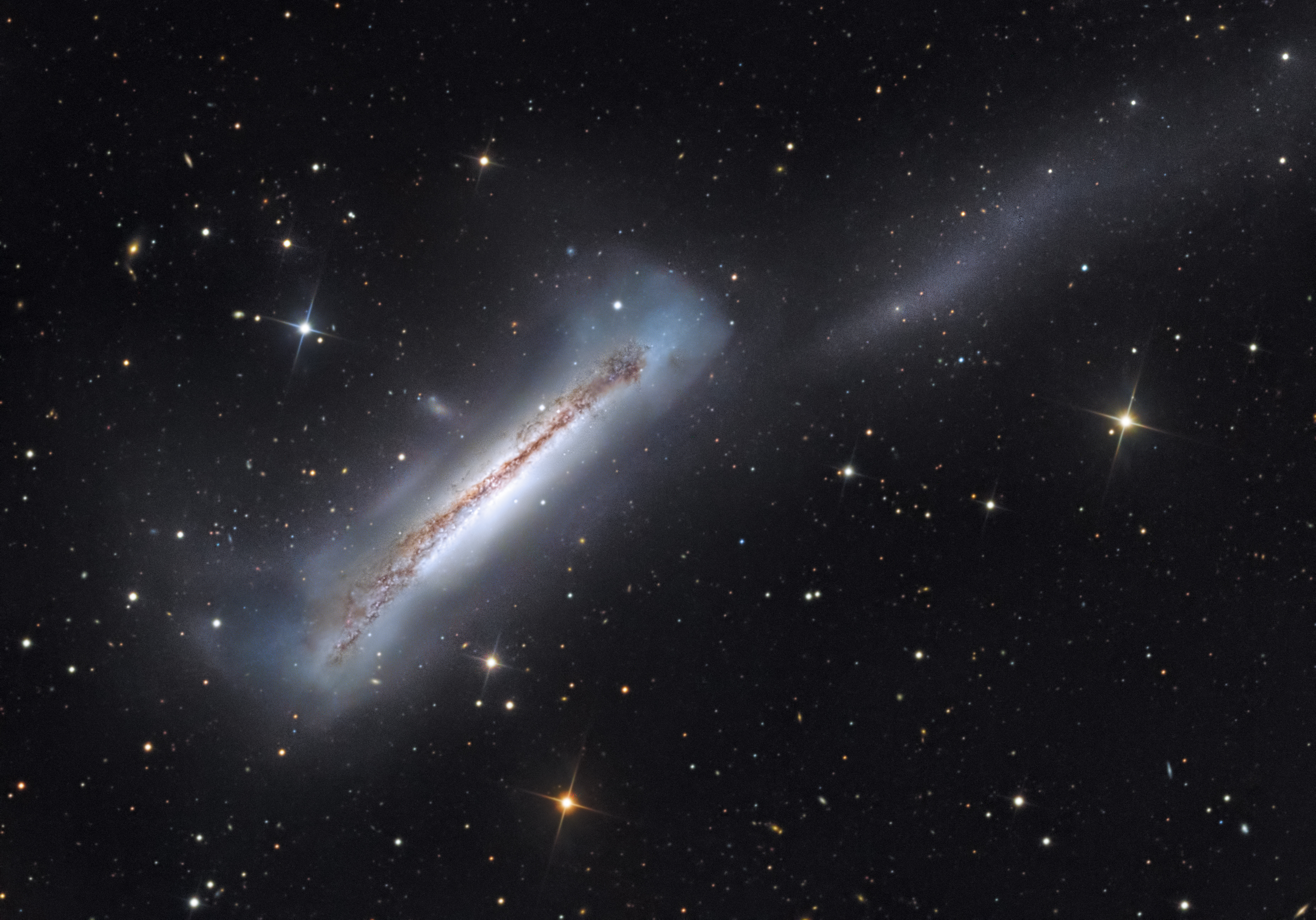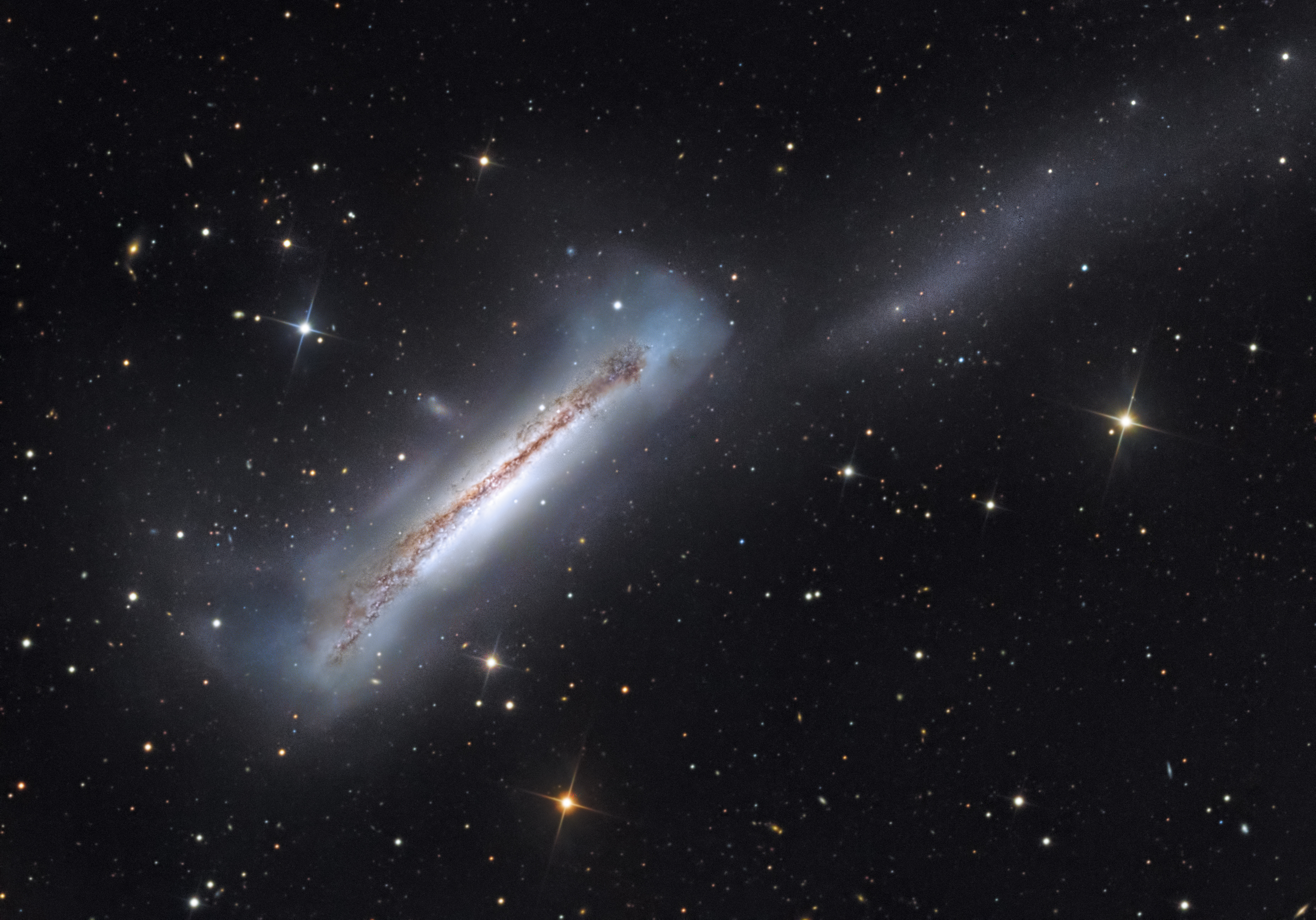
Sharp telescopic views of NGC 3628 show a puffy galactic disk divided by dark dust lanes. Of course, this deep portrait of the magnificent, edge-on spiral galaxy puts some astronomers in mind of its popular moniker, the Hamburger Galaxy. It also reveals a small galaxy nearby, likely a satellite of NGC 3628, and a faint but extensive tidal tail. The drawn out tail stretches for about 300,000 light-years, even beyond the right edge of the wide frame. NGC 3628 shares its neighborhood in the local universe with two other large spirals M65 and M66 in a grouping otherwise known as the Leo Triplet. Gravitational interactions with its cosmic neighbors are likely responsible for creating the tidal tail, as well as the extended flare and warp of this spiral's disk. The tantalizing island universe itself is about 100,000 light-years across and 35 million light-years away in the northern springtime constellation Leo.
Crédito: NASA, ESA, y el Hubble Heritage Team (STScI/AURA) Las vistas telescópicas nítidas de NGC 3628 muestran un disco galáctico abultado dividido por vías oscuras de polvo. Por supuesto, este retrato profundo de la magnífica galaxia espiral vista de perfil hace que algunos astrónomos piensen en su nombre popular, la Galaxia Hamburguesa. También revela una pequeña galaxia cercana, probablemente un satélite de NGC 3628, y una cola de marea tenue pero extensa. La cola alargada se extiende por unos 300 000 años luz, incluso más allá del borde derecho del marco amplio. NGC 3628 comparte su vecindario en el universo local con otras dos grandes espirales, M65 y M66, en un grupo conocido como el Triplete de Leo. Las interacciones gravitacionales con sus vecinos cósmicos probablemente son responsables de crear la cola de marea, así como el brillo extendido y la distorsión del disco de esta galaxia espiral. El fascinante universo isla en sí mismo tiene aproximadamente 100 000 años luz de diámetro y se encuentra a 35 millones de años luz de distancia en la constelación de primavera boreal Leo.