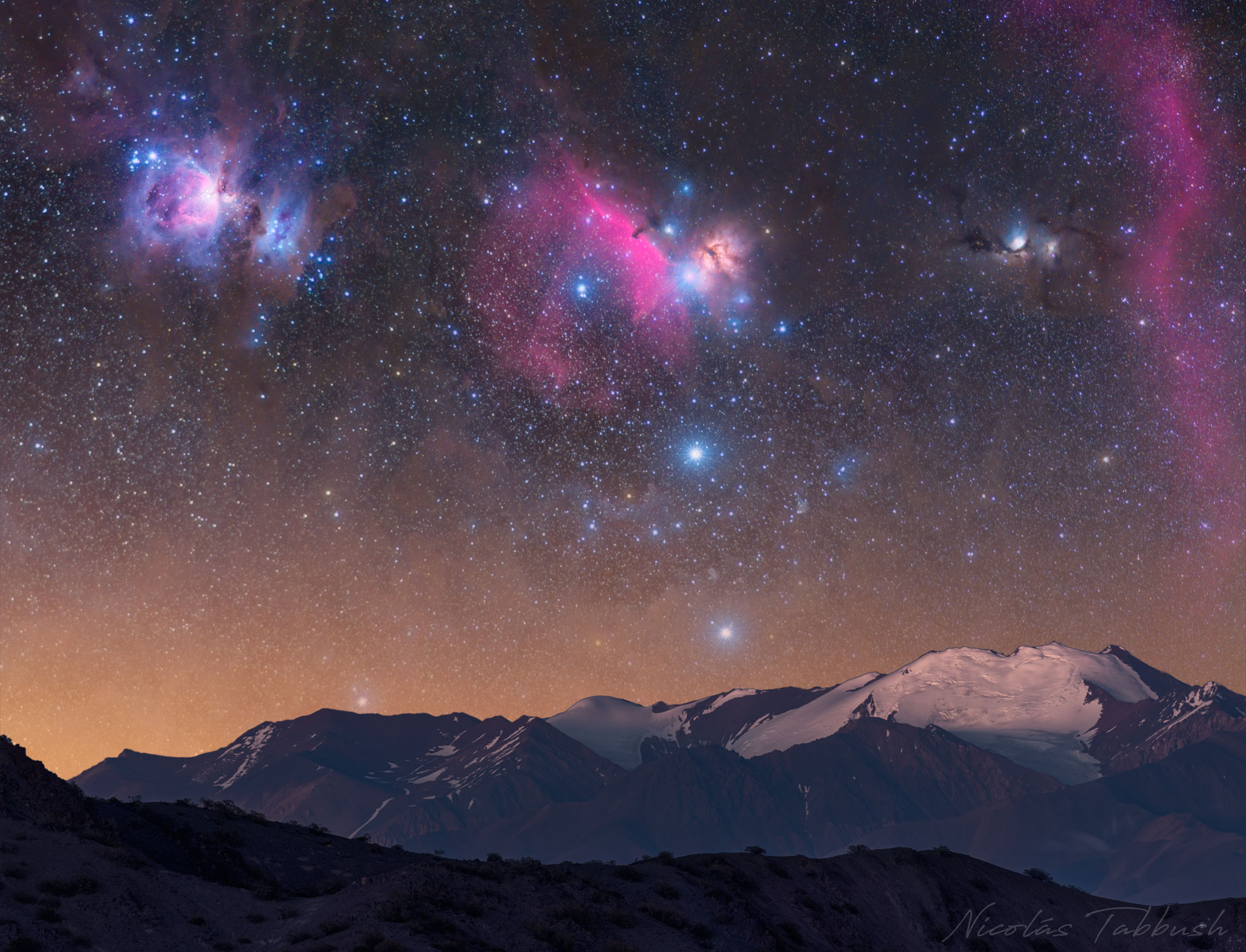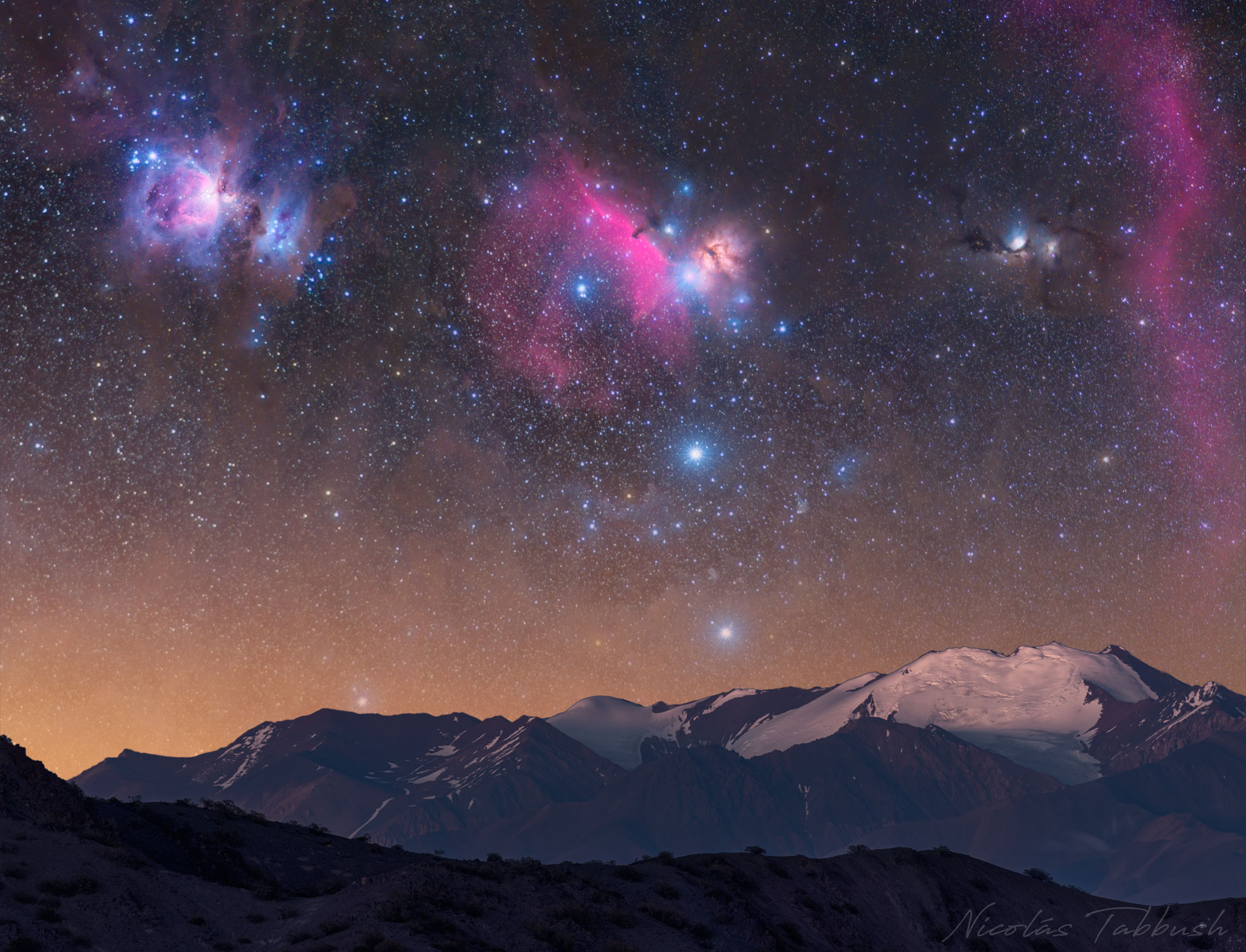
Do you recognize the constellation of Orion? It may be harder than usual in today's featured image because the camera has zoomed in on the center, and the exposure is long enough to enhance nebulas beyond what the unaided human eye can see. Still, once you become oriented, you can see Orion's three belt stars lined up vertically near the image center, and even locate the familiar Orion Nebula on the upper left. Famous faint features that are also visible include the dark Horsehead Nebula indentation near the image center, and the dusty Flame Nebula just to its right. Part of the Orion-encircling Barnard's Loop can also be found on the far right. The image combines multiple sky-tracking shots of the background in different colors with a single static foreground exposure taken at twilight -- all captured with the same camera and from the same location. The picturesque scene was captured early last year from mountains in San Juan, Argentina. Next picture: June 11 < | Archive | Submissions | Index | Search | Calendar | RSS | Education | About APOD | Discuss | > Authors & editors: Robert Nemiroff (MTU) & Jerry Bonnell (UMCP) NASA Official: Phillip Newman Specific rights apply. NASA Web Privacy Policy and Important Notices A service of: ASD at NASA / GSFC & Michigan Tech. U.
¿Reconoces la constelación de Orión? Puede ser más difícil que de costumbre en la imagen destacada de hoy, ya que la cámara se ha enfocado en el centro y la exposición es lo suficientemente larga como para resaltar las nebulosas más allá de lo que el ojo humano no auxiliado puede ver. Sin embargo, una vez que te orientas, puedes ver las tres estrellas de la cintura de Orión alineadas verticalmente cerca del centro de la imagen, y hasta localizar la familiar Nebulosa de Orión en la parte superior izquierda. Otros rasgos famosos y tenues que también son visibles incluyen la indentación de la Nebulosa Caballo de Bucefalo cerca del centro de la imagen, y la nebulosa Flameo polvorienta justo a su derecha. Parte del Anillo de Barnard que rodea a Orión también se puede encontrar en la parte más alejada a la derecha. La imagen combina múltiples tomas de seguimiento del fondo en diferentes colores con una única exposición fija del primer plano tomada al atardecer — todo capturado con la misma cámara y desde el mismo lugar. Esta escena pintoresca fue capturada hace un año desde las montañas de San Juan, Argentina.