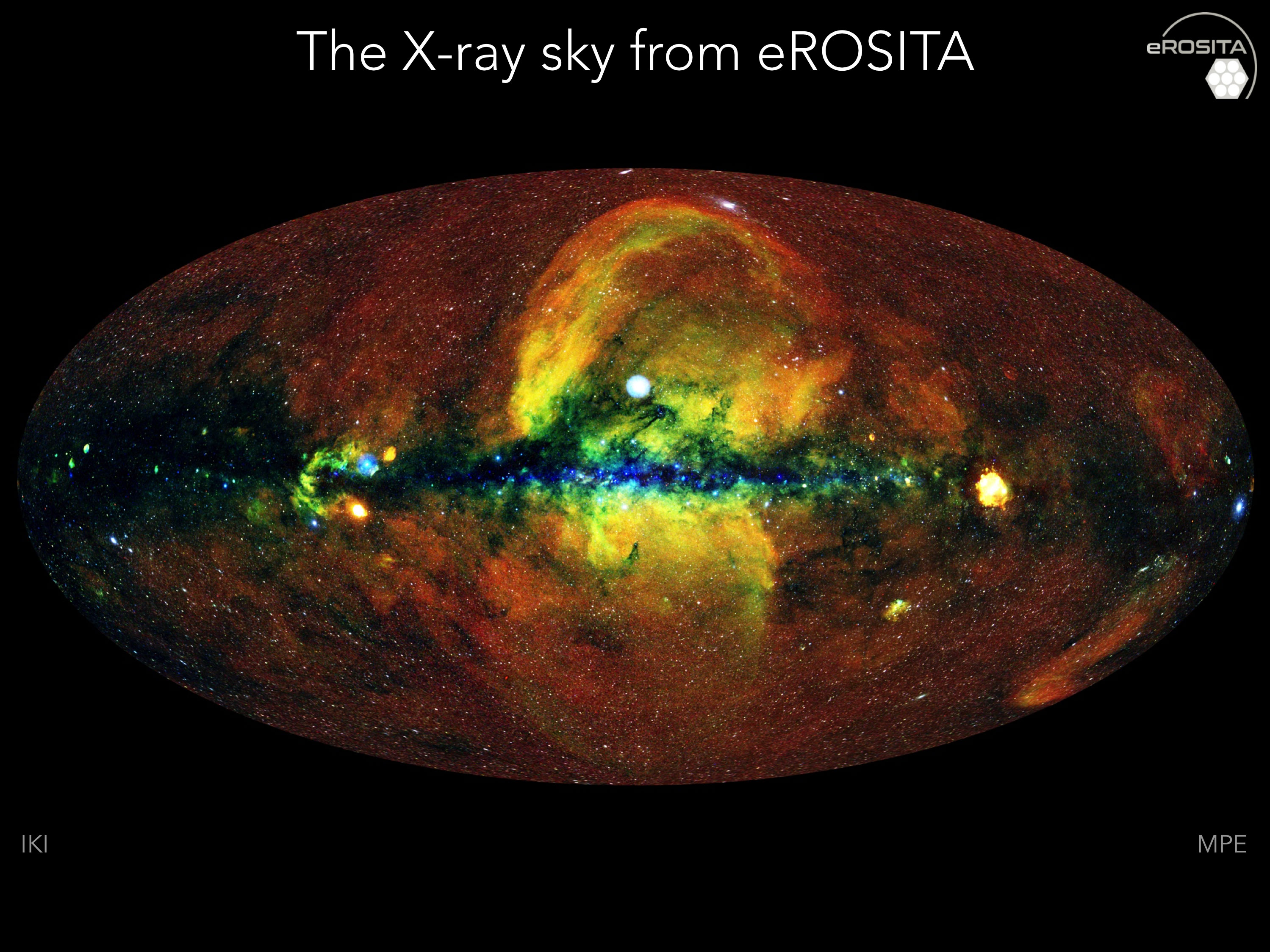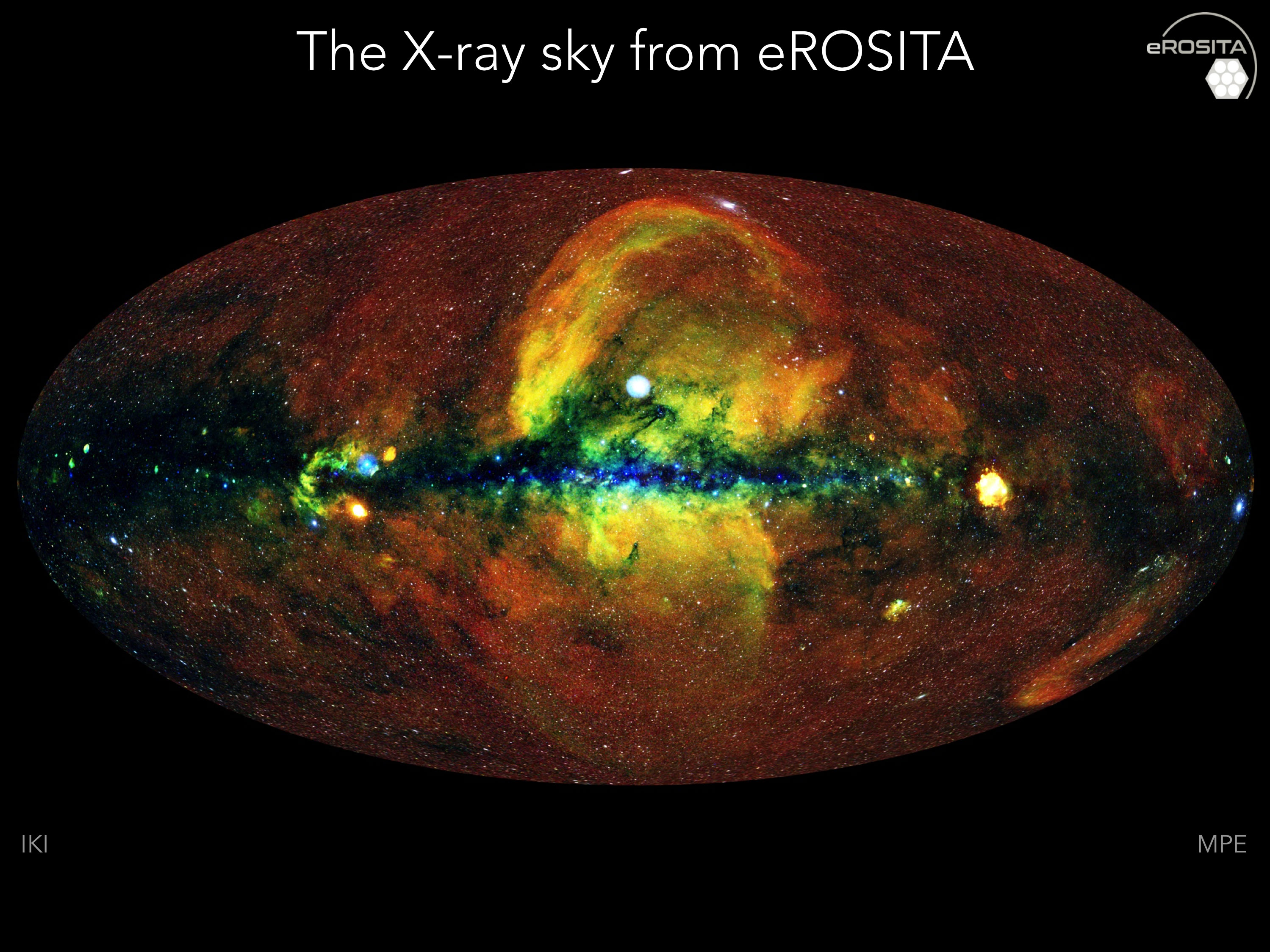
What if you could see X-rays? The night sky would seem a strange and unfamiliar place. X-rays are about 1,000 times more energetic than visible light photons and are produced by violent explosions and high temperature astronomical environments. Instead of the familiar steady stars, the sky would seem to be filled with exotic stars, active galaxies, and hot supernova remnants. The featured X-ray image captures in unprecedented detail the entire sky in X-rays as seen by the eROSITA telescope onboard Spektr-RG satellite, orbiting around the L2 point of the Sun-Earth system, launched last year. The image shows the plane of our Milky Way galaxy across the center, a diffuse and pervasive X-ray background, the hot interstellar bubble known as the North Polar Spur, sizzling supernova remnants such as Vela, the Cygnus Loop and Cas A, energetic binary stars including Cyg X-1 and Cyg X-2, the LMC galaxy, and the Coma, Virgo, and Fornax clusters of galaxies. This first sky scan by eROSITA located over one million X-ray sources, some of which are not understood and will surely be topics for future research.
¿Qué pasaría si pudieras ver los rayos X? El cielo nocturno se mostraría como un lugar extraño y desconocido. Los rayos X son aproximadamente 1000 veces más energéticos que los fotones de luz visible y son producidos por explosiones violentas y entornos astronómicos de alta temperatura. En lugar de las estrellas familiares y estables, el cielo parecería lleno de estrellas exóticas, galaxias activas y restos calientes de supernovas. La imagen en rayos X mostrada captura con un detalle sin precedentes todo el cielo en rayos X, tal como lo ve el telescopio eROSITA a bordo del satélite Spektr-RG, que orbita alrededor del punto L2 del sistema Tierra-Sol, lanzado el año pasado. La imagen muestra el plano de nuestra galaxia Vía Láctea a través del centro, un fondo difuso y omnipresente de rayos X, la burbuja interestelar caliente conocida como el Espiga Polar Norte, restos de supernovas ardientes como Vela, el Bucle de Cisne y Cas A, estrellas binarias energéticas incluyendo Cyg X-1 y Cyg X-2, la galaxia LMC, y los cúmulos de galaxias Coma, Virgo y Fornax. Esta primera exploración del cielo por parte de eROSITA identificó más de un millón de fuentes de rayos X, algunas de las cuales no se comprenden completamente y seguramente serán temas de investigación futura.