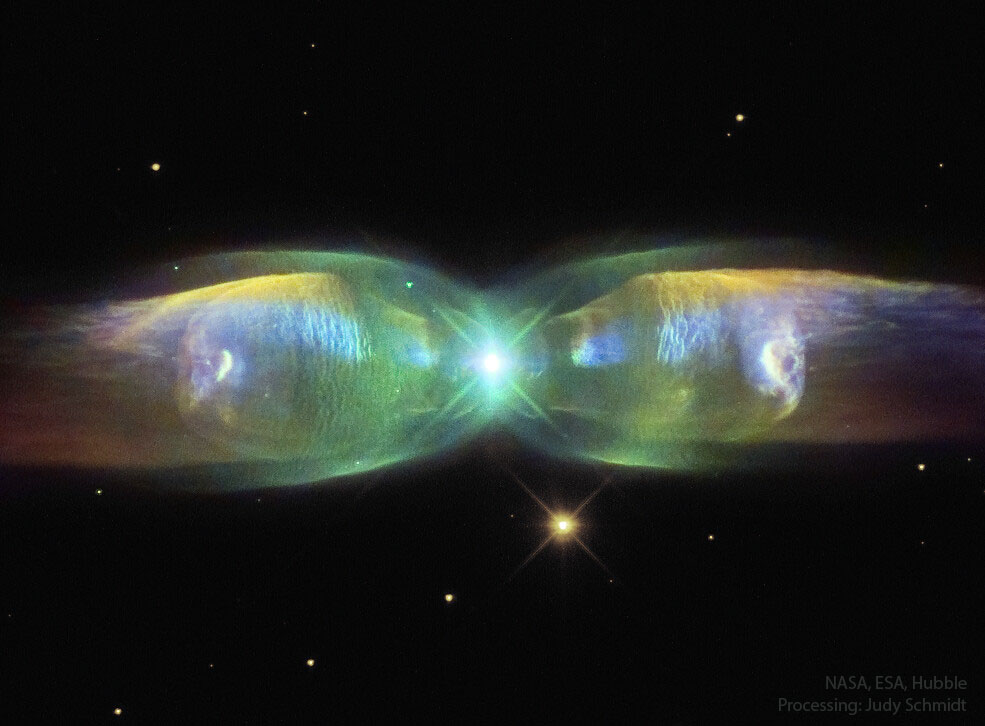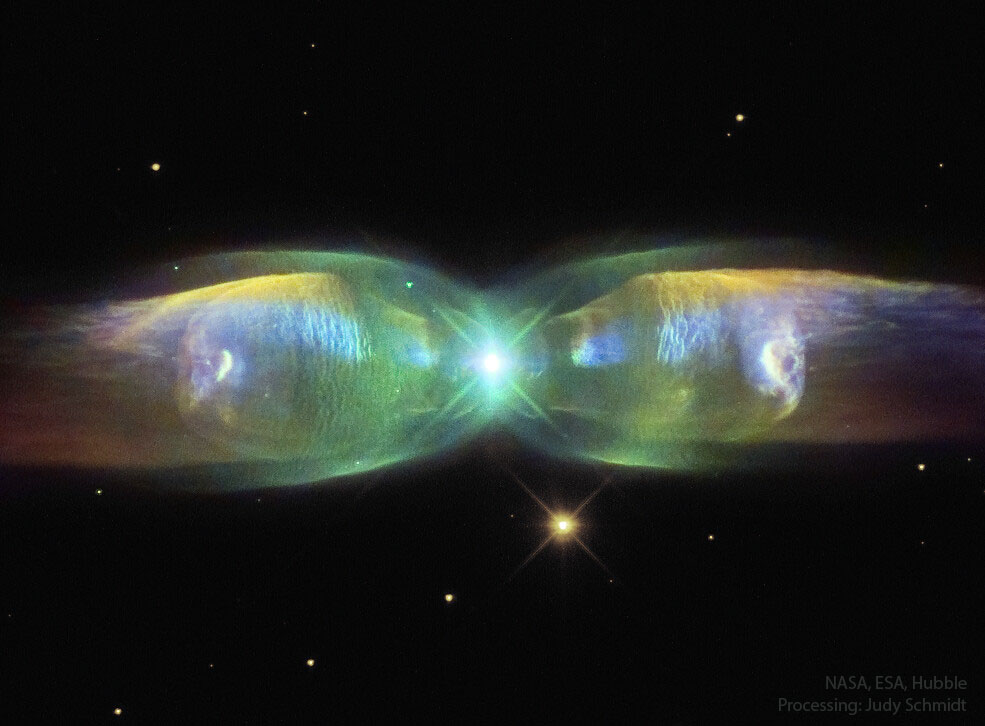
Are stars better appreciated for their art after they die? Actually, stars usually create their most artistic displays as they die. In the case of low-mass stars like our Sun and M2-9 pictured here, the stars transform themselves from normal stars to white dwarfs by casting off their outer gaseous envelopes. The expended gas frequently forms an impressive display called a planetary nebula that fades gradually over thousands of years. M2-9, a butterfly planetary nebula 2100 light-years away shown in representative colors, has wings that tell a strange but incomplete tale. In the center, two stars orbit inside a gaseous disk 10 times the orbit of Pluto. The expelled envelope of the dying star breaks out from the disk creating the bipolar appearance. Much remains unknown about the physical processes that cause and shape planetary nebulae. Almost Hyperspace: Random APOD Generator
¿Las estrellas se aprecian mejor por su arte después de morir? De hecho, las estrellas suelen crear sus despliegues más artísticos cuando mueren. En el caso de las estrellas de baja masa, como nuestro Sol y la M2-9 mostrada aquí, las estrellas se transforman de estrellas normales en enanas blancas expulsando sus envolturas gaseosas externas. El gas expulsado frecuentemente forma una impresionante exhibición llamada nebulosa planetaria, que se desvanece gradualmente a lo largo de miles de años. La M2-9, una nebulosa planetaria en forma de mariposa a 2100 años luz de distancia y mostrada en colores representativos, tiene alas que cuentan una historia extraña pero incompleta. En el centro, dos estrellas orbitan dentro de un disco gaseoso 10 veces más ancho que la órbita de Plutón. El envoltorio expulsado por la estrella moribunda se escapa del disco, creando la apariencia bipolar. Todavía queda mucho por descubrir sobre los procesos físicos que causan y moldean las nebulosas planetarias.