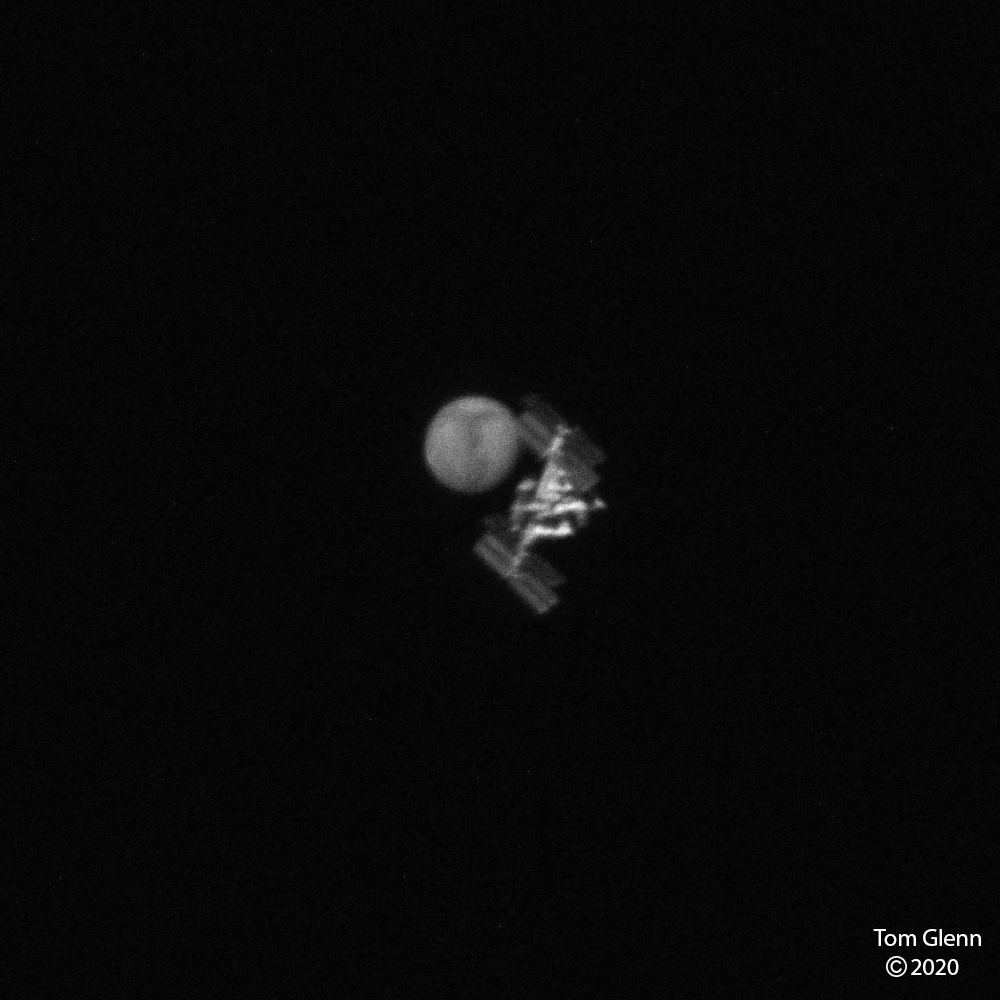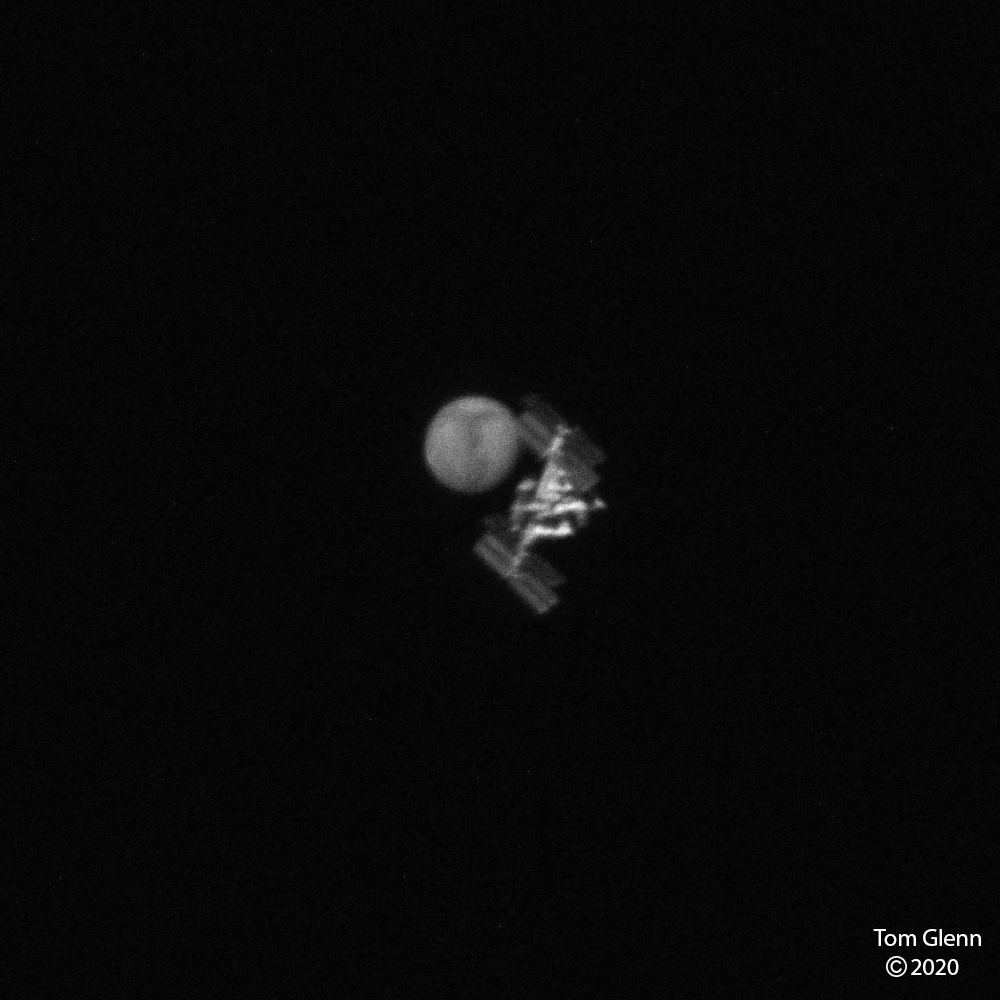
Yes, but have you ever seen the space station do this? If you know when and where to look, watching the bright International Space Station (ISS) drift across your night sky is a fascinating sight -- but not very unusual. Images of the ISS crossing in front of the half-degree Moon or Sun do exist, but are somewhat rare as they take planning, timing, and patience to acquire. Catching the ISS crossing in front of minuscule Mars, though, is on another level. Using online software, the featured photographer learned that the unusual transit would be visible only momentarily along a very narrow stretch of nearby land spanning just 90 meters. Within this stretch, the equivalent ground velocity of the passing ISS image would be a quick 7.4 kilometers per second. However, with a standard camera, a small telescope, an exact location to set up his equipment, an exact direction to point the telescope, and sub-millisecond timing -- he created a video from which the featured 0.00035 second exposure was extracted. In the resulting image capture, details on both Mars and the ISS are visible simultaneously. The featured image was acquired last Monday at 05:15:47 local time from just northeast of San Diego, California, USA. Although typically much smaller, angularly, than the ISS, Mars is approaching its maximum angular size in the next few weeks, because the blue planet (Earth) is set to pass its closest to the red planet (Mars) in their respective orbits around the Sun. Portal Universe: Random APOD Generator
Sí, pero ¿alguna vez has visto que la estación espacial haga esto? Si sabes cuándo y dónde mirar, ver brillar la Estación Espacial Internacional (ISS) al desplazarse por el cielo nocturno es un espectáculo fascinante, aunque no muy inusual. Existen imágenes de la ISS cruzando frente a la Luna o al Sol, pero son bastante raras, ya que requieren planificación, precisión en el tiempo y paciencia para obtenerse. Sin embargo, capturar a la ISS cruzando frente a Marte, que es minúsculo, es un desafío de otro nivel. Usando software en línea, el fotógrafo que tomó la imagen destacada aprendió que este tránsito inusual sería visible solo momentáneamente a lo largo de un estrecho tramo de tierra cercana que abarcaba apenas 90 metros. Dentro de este tramo, la velocidad equivalente en tierra de la imagen de la ISS en movimiento sería rápida: 7,4 kilómetros por segundo. Sin embargo, con una cámara estándar, un pequeño telescopio, una ubicación exacta para instalar su equipo, una dirección precisa hacia la que apuntar el telescopio y una temporización precisa a milisegundos, creó un video del cual se extrajo la exposición destacada de 0,00035 segundos. En la imagen resultante, se pueden ver detalles tanto de Marte como de la ISS simultáneamente. La imagen destacada fue capturada el lunes pasado a las 05:15:47 hora local, justo al noreste de San Diego, California, EE. UU. Aunque normalmente es mucho más pequeño en tamaño angular que la ISS, Marte se acerca a su tamaño angular máximo en las próximas semanas, ya que el planeta azul (Tierra) está a punto de pasar a su distancia más cercana del planeta rojo (Marte) en sus respectivas órbitas alrededor del Sol.