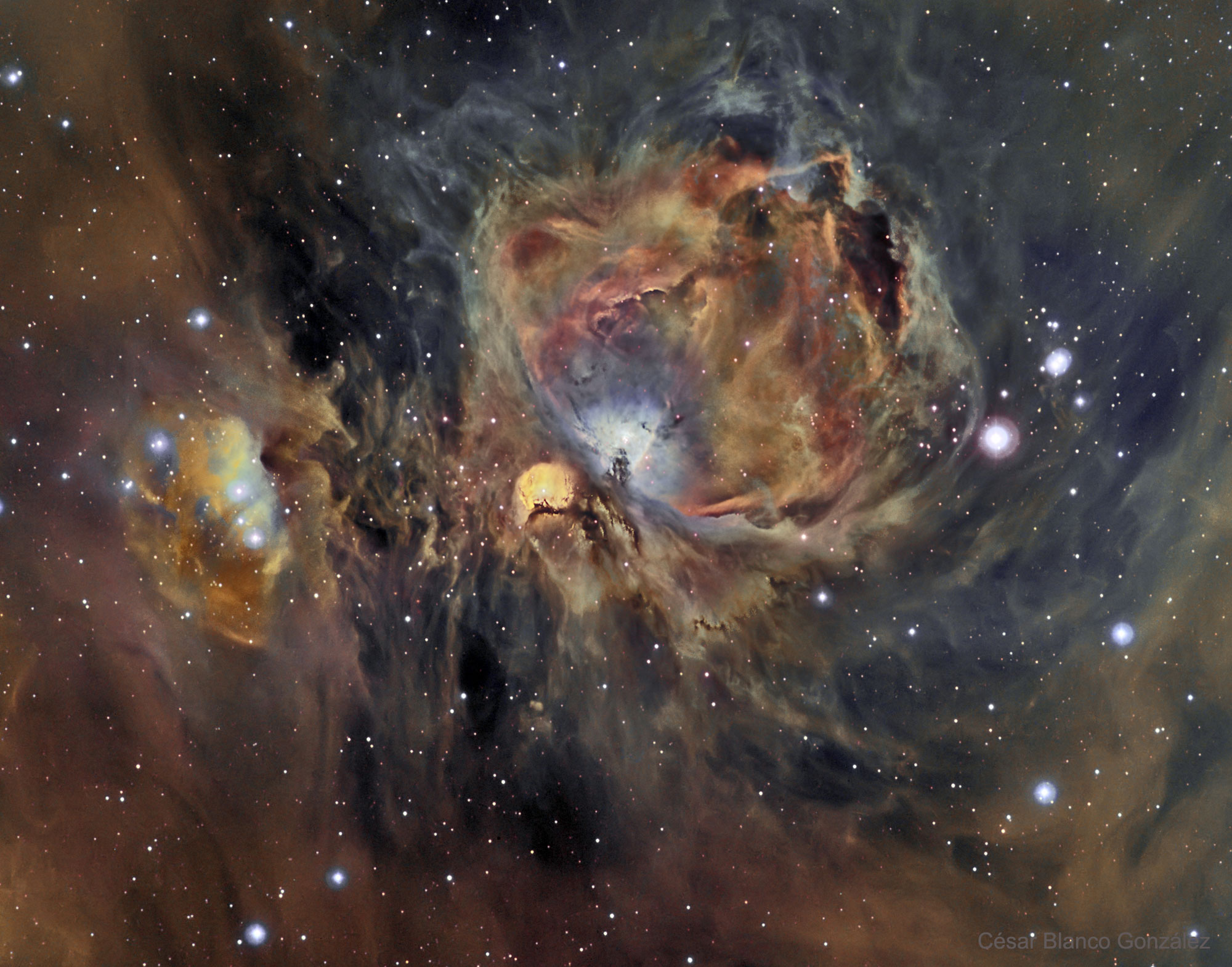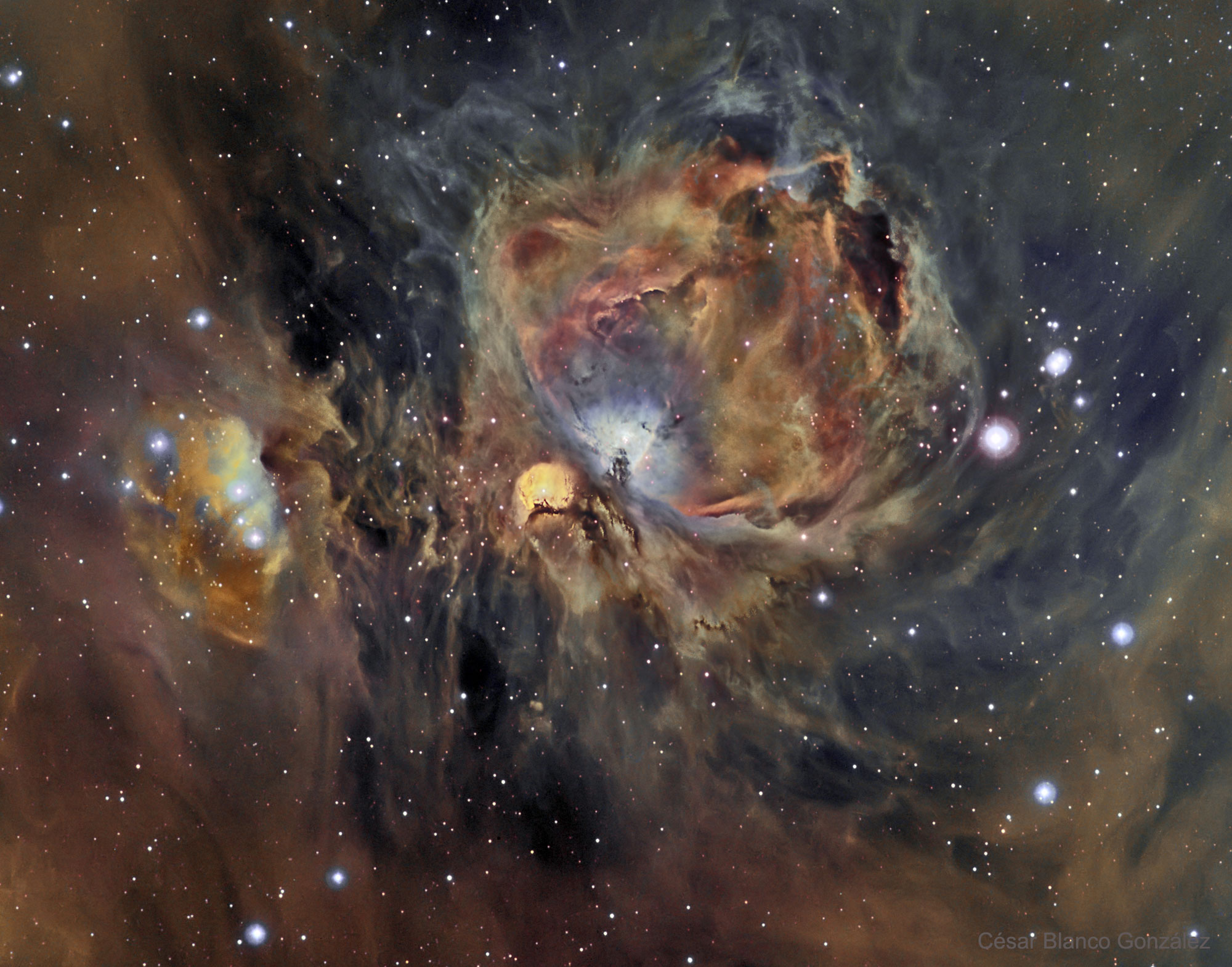
Few astronomical sights excite the imagination like the nearby stellar nursery known as the Orion Nebula. The Nebula's glowing gas surrounds hot young stars at the edge of an immense interstellar molecular cloud. Many of the filamentary structures visible in the featured image are actually shock waves - fronts where fast moving material encounters slow moving gas. The Orion Nebula spans about 40 light years and is located about 1500 light years away in the same spiral arm of our Galaxy as the Sun. The Great Nebula in Orion can be found with the unaided eye just below and to the left of the easily identifiable belt of three stars in the popular constellation Orion. The image shows the nebula in three colors specifically emitted by hydrogen, oxygen, and sulfur gas. The whole Orion Nebula cloud complex, which includes the Horsehead Nebula, will slowly disperse over the next 100,000 years.
Pocos paisajes astronómicos excitan la imaginación tanto como la vecina región de formación estelar conocida como la Nebulosa de Orión. El gas brillante de la nebulosa rodea estrellas jóvenes y calientes en el borde de una nube molecular interestelar de inmensas dimensiones. Muchas de las estructuras filamentosas visibles en la imagen destacada son en realidad ondas de choque - frentes donde el material en movimiento rápido choca con gas en movimiento lento. La Nebulosa de Orión abarca aproximadamente 40 años luz y se encuentra a unos 1500 años luz de distancia, en el mismo brazo espiral de nuestra Galaxia que el Sol. La Gran Nebulosa de Orión puede verse a simple vista, justo debajo y a la izquierda del cinturón de tres estrellas fácilmente identificable en la popular constelación de Orión. La imagen muestra la nebulosa en tres colores específicos emitidos por los gases de hidrógeno, oxígeno y azufre. La nube completa de la Nebulosa de Orión, que incluye la Nebulosa Caballo de Tarde, se dispersará lentamente durante los próximos 100 000 años.