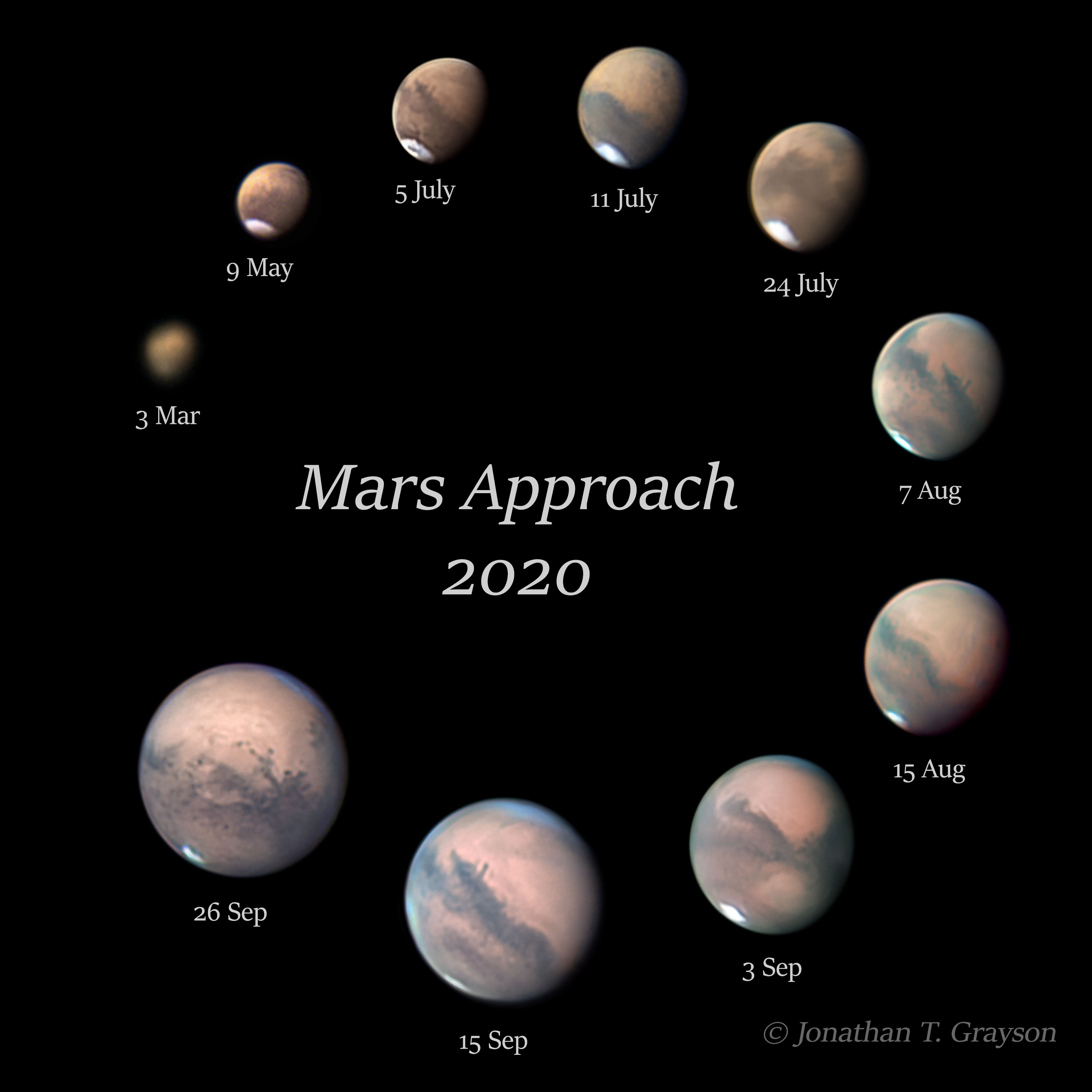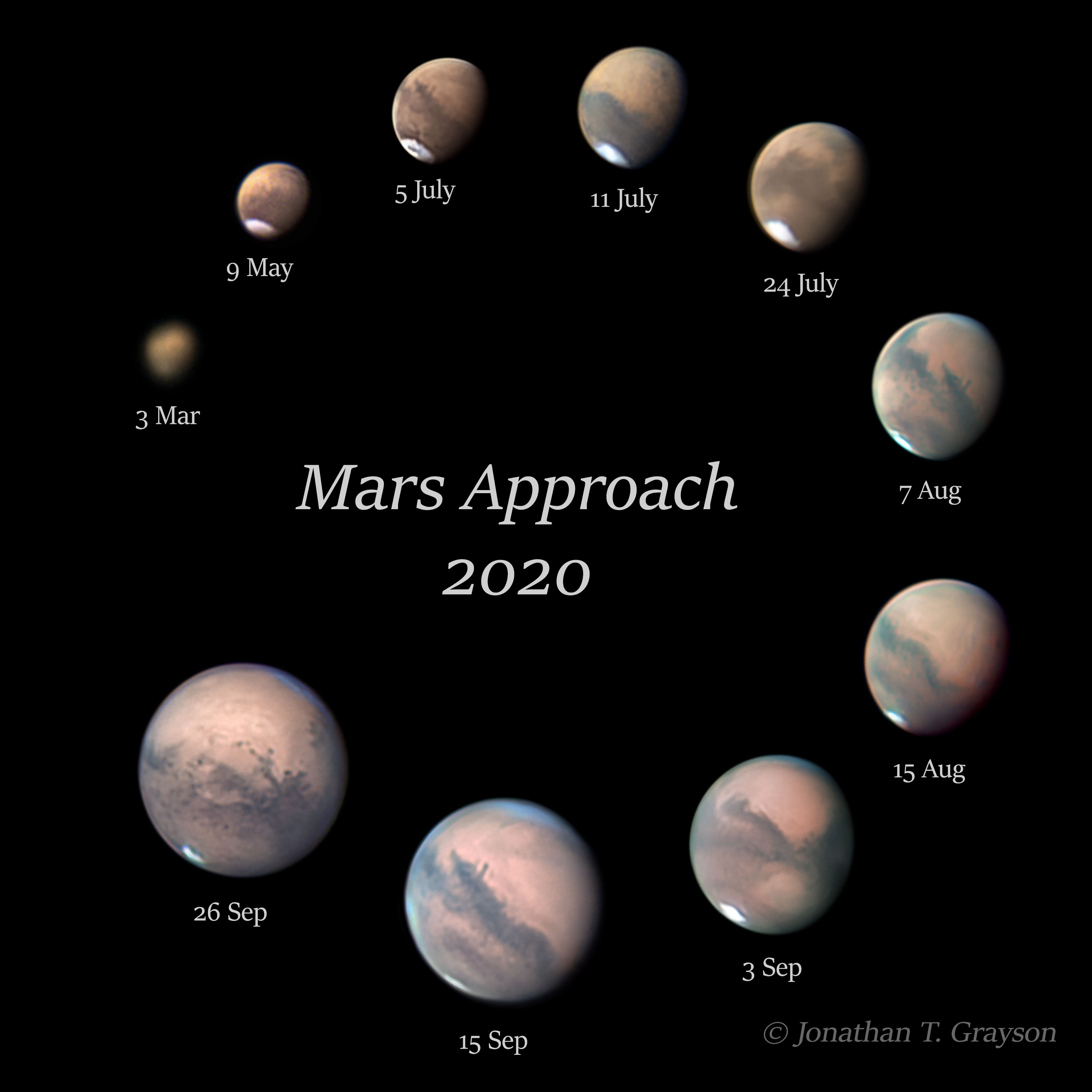
Look to the east just after sunset tonight and you'll see a most impressive Mars. Tonight, Mars will appear its biggest and brightest of the year, as Earth passes closer to the red planet than it has in over two years -- and will be again for another two years. In a week, Mars will be almost as bright -- but at opposition, meaning that it will be directly opposite the Sun. Due to the slightly oval shape of the orbits of Mars and Earth, closest approach and opposition occur on slightly different days. The featured image sequence shows how the angular size of Mars has grown during its approach over the past few months. Noticeably orange, Mars is now visible nearly all night long, reflecting more sunlight toward Earth than either Saturn or Jupiter. Even at its closest and largest, though, Mars will still appear about 100 times smaller, in diameter, than a full moon.
Mira hacia el este poco después de la puesta de Sol esta noche y verás un impresionante Marte. Esta noche, Marte aparecerá más grande y brillante del año, ya que la Tierra se acerca más al planeta rojo que en los últimos dos años — y no volverá a hacerlo en otros dos años. En una semana, Marte será casi tan brillante, pero estará en oposición, lo que significa que estará directamente opuesto al Sol. Debido a la forma ligeramente elíptica de las órbitas de Marte y la Tierra, el acercamiento más cercano y la oposición ocurren en días ligeramente diferentes. La secuencia de imágenes destacadas muestra cómo el tamaño angular de Marte ha crecido durante su aproximación en los últimos meses. De color notablemente naranja, Marte es ahora visible casi toda la noche, reflejando más luz solar hacia la Tierra que tanto Saturno como Júpiter. Aunque en su punto más cercano y grande, Marte aún aparecerá aproximadamente 100 veces más pequeño, en diámetro, que una luna llena.