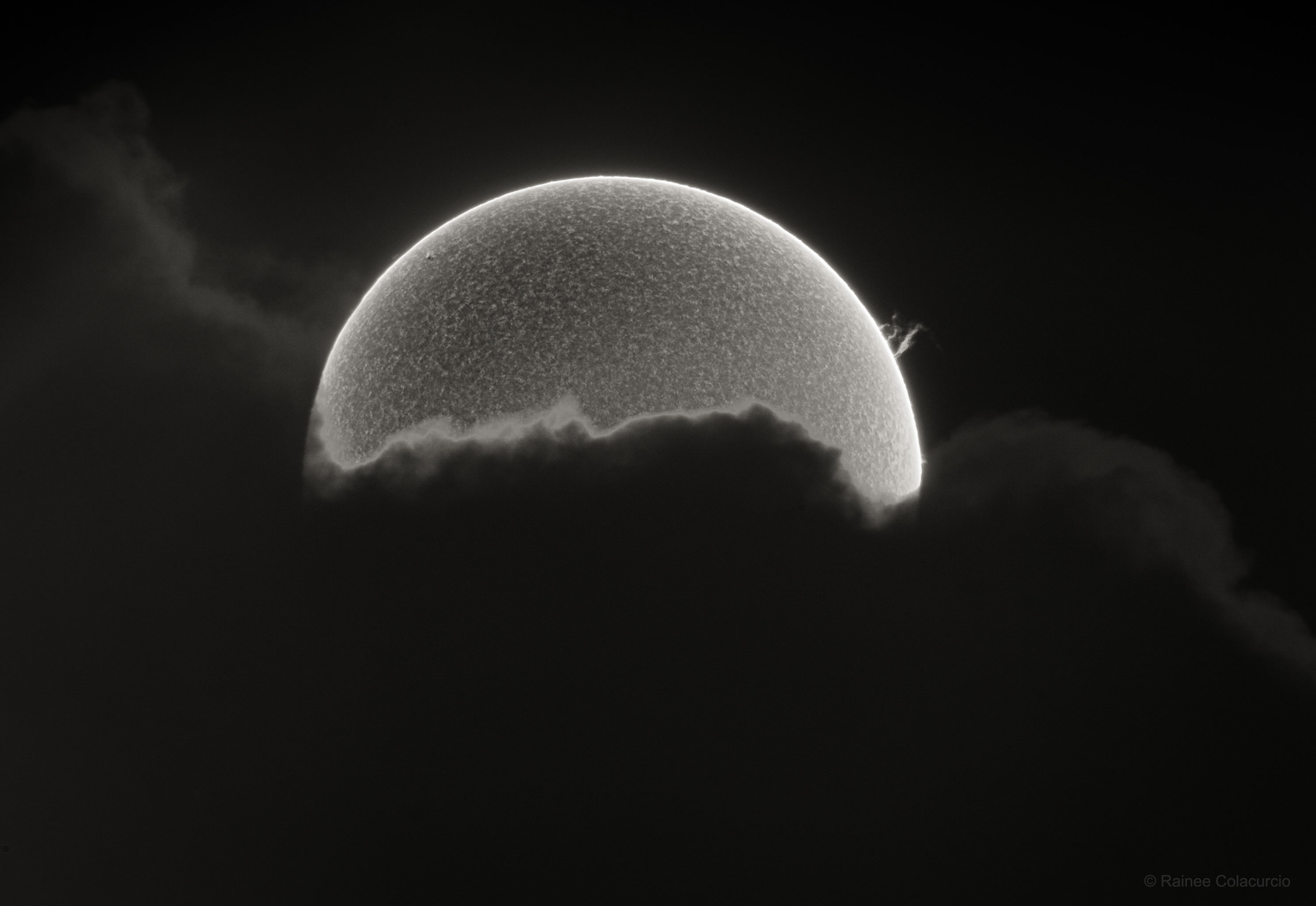
What's happening to the Sun? Clearly, the Sun's lower half is hidden behind a thick cloud. Averaging over the entire Earth, clouds block the Sun about 2/3rds of the time, although much less over many land locations. On the Sun's upper right is a prominence of magnetically levitating hot gas. The prominence might seem small but it could easily envelop our Earth and persist for over a month. The featured image is a combination of two exposures, one optimizing the cloud and prominence, and the other optimizing the Sun's texture. Both were taken about an hour apart with the same camera and from the same location in Lynnwood, Washington, USA. The shaggy texture derives from the Sun's chromosphere, an atmospheric layer that stands out in the specifically exposed color. The uniformity of the texture shows the surface to be relatively calm, indicative of a Sun just past the solar minimum in its 11-year cycle. In the years ahead, the Sun will progress toward a more active epoch where sunspots, prominences, and ultimately auroras on Earth will be more common: solar maximum. Gallery: Notable images of the Halloween Blue Moon of 2020 submitted to APOD
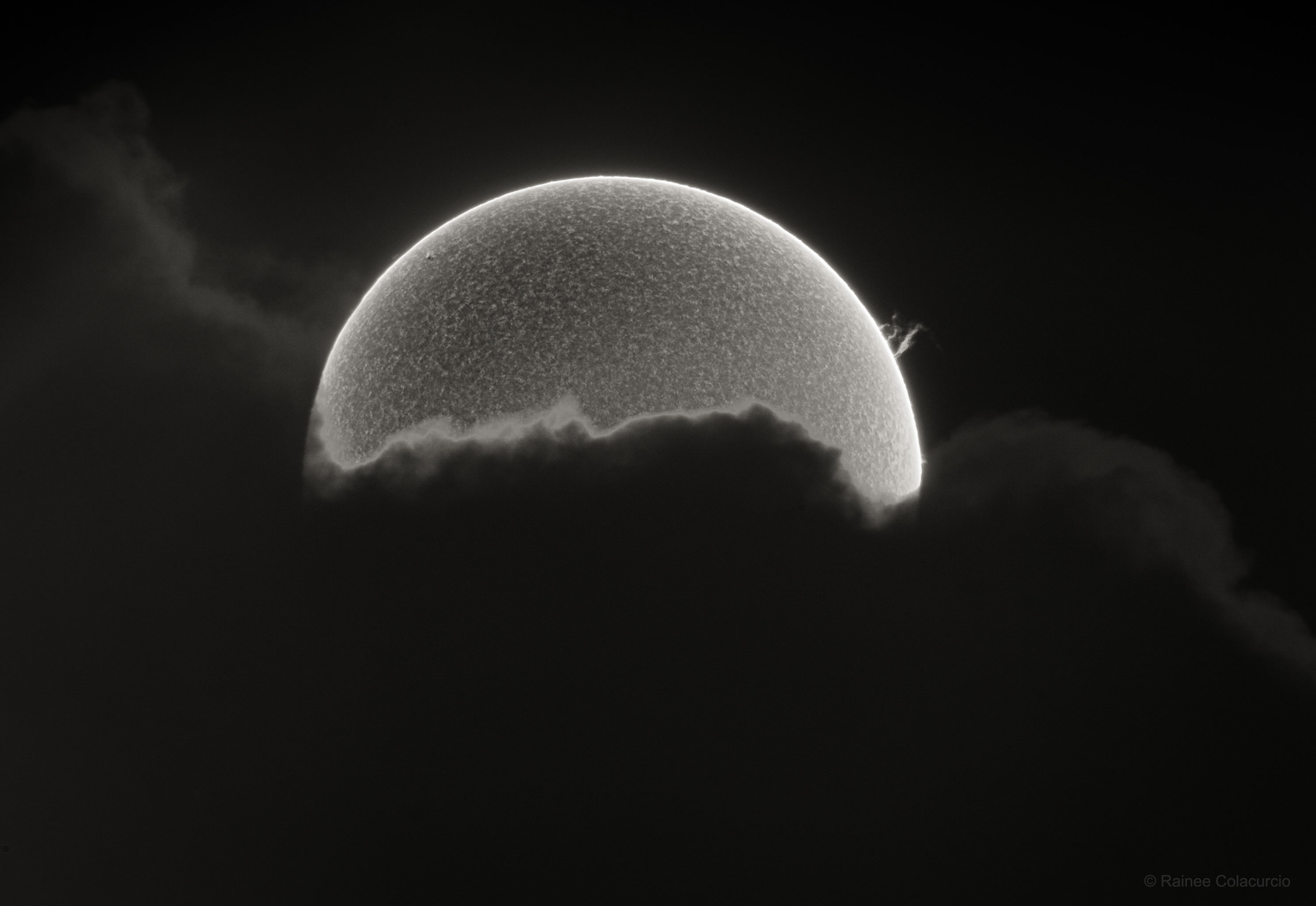
¿Qué está sucediendo con el Sol? Claramente, la mitad inferior del Sol está oculta detrás de una gruesa nube. En promedio sobre toda la Tierra, las nubes bloquean al Sol aproximadamente 2/3 del tiempo, aunque mucho menos en muchas ubicaciones terrestres. En la parte superior derecha del Sol hay una prominencia de gas caliente sostenido magnéticamente. La prominencia podría parecer pequeña, pero fácilmente podría envolver a nuestro planeta y persistir por más de un mes. La imagen destacada es una combinación de dos exposiciones, una optimizada para la nube y la prominencia, y la otra optimizada para la textura del Sol. Ambas fueron tomadas con una hora de diferencia aproximadamente, con la misma cámara y desde la misma ubicación en Lynnwood, Washington, EE.UU. La textura peluda proviene de la cromosfera del Sol, una capa atmosférica que destaca en el color específicamente expuesto. La uniformidad de la textura muestra que la superficie es relativamente tranquila, indicativa de un Sol que recientemente pasó por el mínimo solar en su ciclo de 11 años. En los años venideros, el Sol progresará hacia una época más activa donde las manchas solares, las prominencias y finalmente las auroras en la Tierra serán más comunes: el máximo solar.