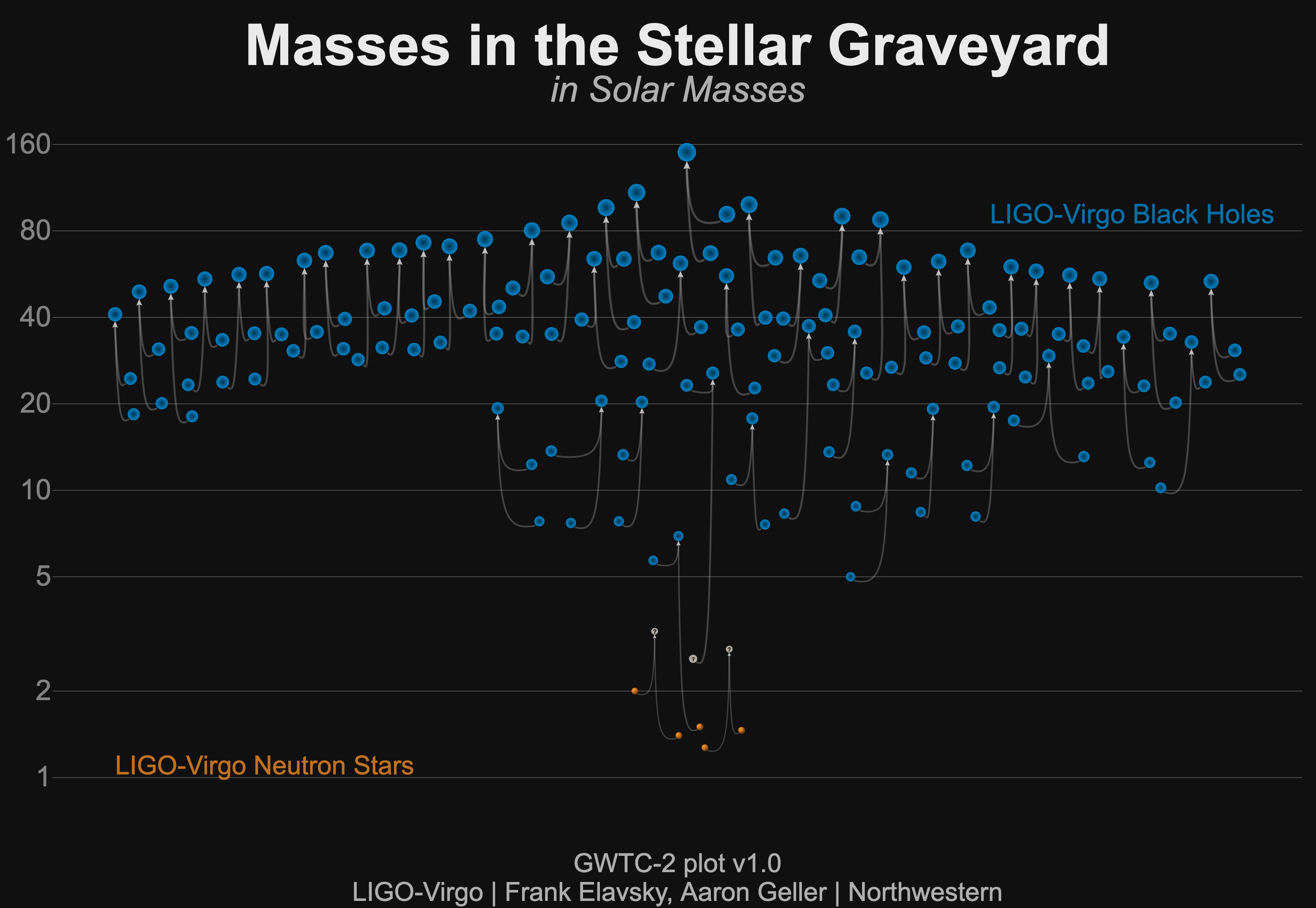
Over fifty gravitational wave events have now been detected. These events mark the distant, violent collisions of two black holes, a black hole and a neutron star, or two neutron stars. Most of the 50 events were detected in 2019 by the LIGO gravitational wave detectors in the USA and the VIRGO detector in Europe. In the featured illustration summarizing the masses of the first 50 events, blue dots indicate higher-mass black holes while orange dots denote lower-mass neutron stars. Astrophysicists are currently uncertain, though, about the nature of events marked in white involving masses that appear to be in the middle -- between two and five solar masses. The night sky in optical light is dominated by nearby and bright planets and stars that have been known since the dawn of humanity. In contrast, the sky in gravitational waves is dominated by distant and dark black holes that have only been known about for less than five years. This contrast is enlightening -- understanding the gravitational wave sky is already reshaping humanity's knowledge not only of star birth and death across the universe, but properties of the universe itself.
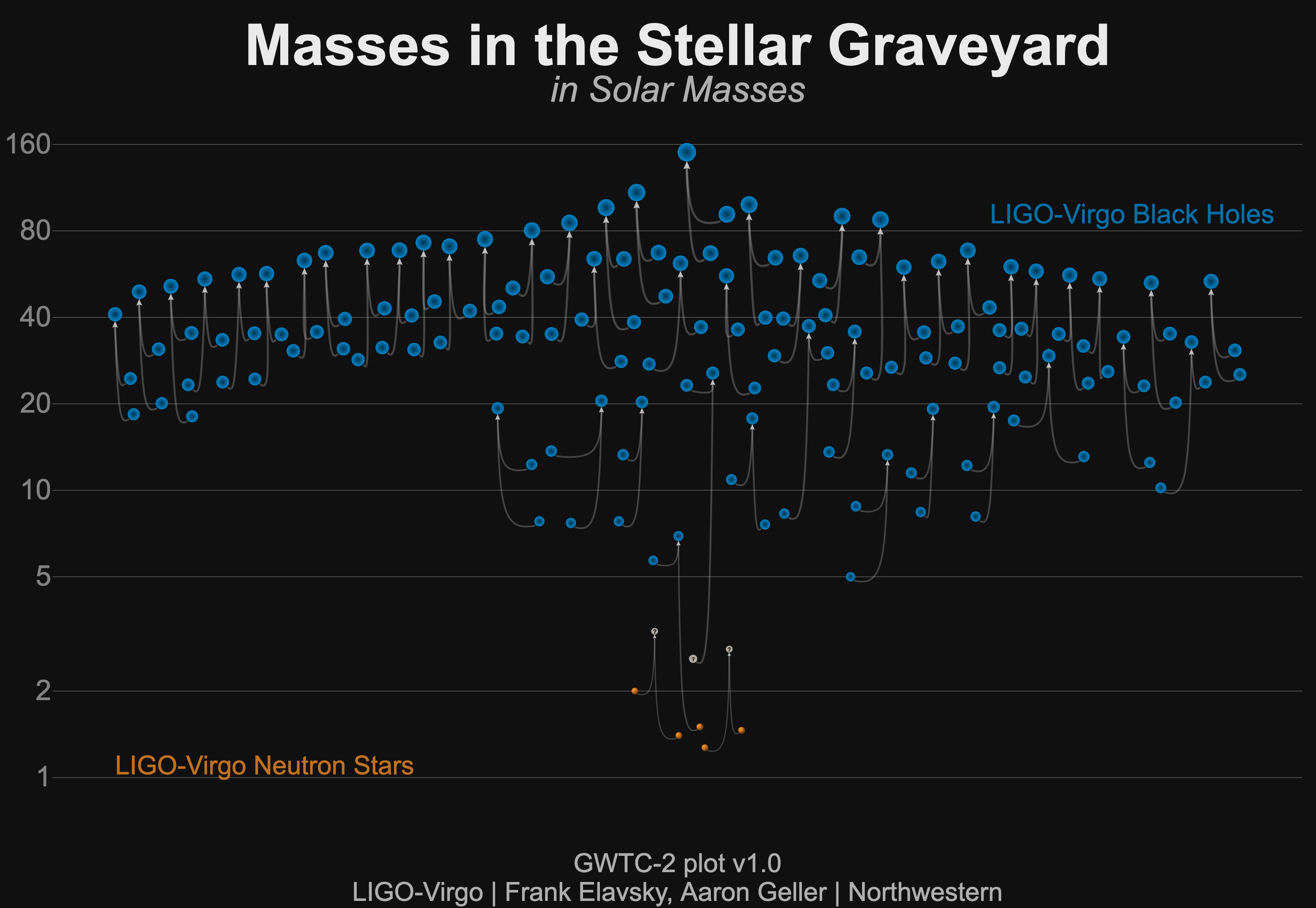
Se han detectado más de cincuenta eventos de ondas gravitacionales. Estos eventos marcan violentas colisiones distantes entre dos agujeros negros, un agujero negro y una estrella de neutrones, o dos estrellas de neutrones. La mayoría de los 50 eventos fueron detectados en 2019 por los detectores de ondas gravitacionales LIGO en Estados Unidos y el detector VIRGO en Europa. En la ilustración destacada que resume las masas de los primeros 50 eventos, los puntos azules indican agujeros negros de mayor masa, mientras que los puntos naranja denotan estrellas de neutrones de menor masa. Sin embargo, los astrofísicos aún no están seguros sobre la naturaleza de los eventos marcados en blanco, cuyas masas parecen estar en el medio — entre dos y cinco masas solares. El cielo nocturno en luz óptica está dominado por planetas y estrellas cercanas y brillantes que han sido conocidas desde los albores de la humanidad. En contraste, el cielo en ondas gravitacionales está dominado por agujeros negros distantes y oscuros que solo han sido conocidos durante menos de cinco años. Este contraste es iluminador: comprender el cielo de ondas gravitacionales ya está redefiniendo el conocimiento humano no solo sobre el nacimiento y la muerte de las estrellas en el universo, sino también sobre las propiedades del universo mismo.