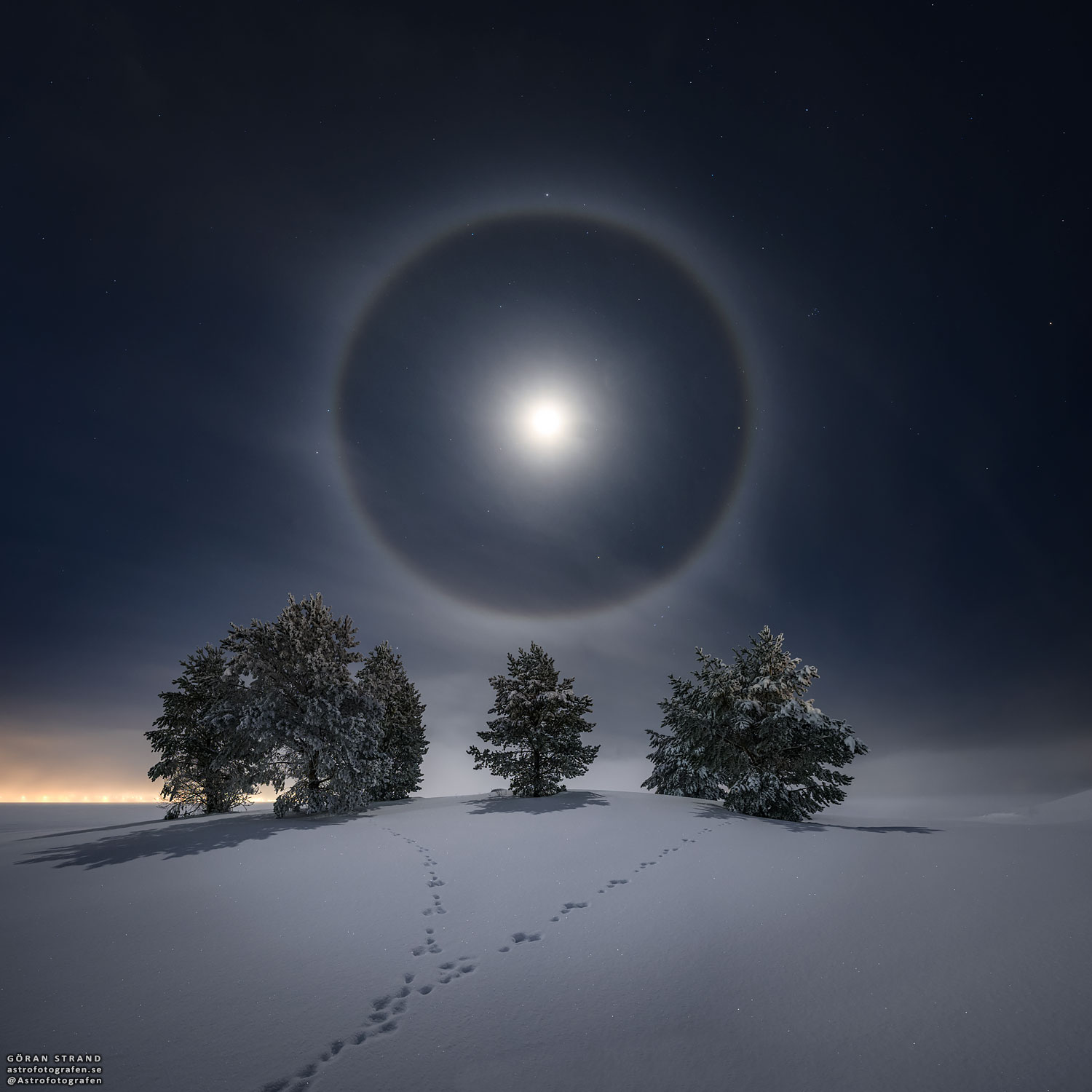
Have you ever seen a halo around the Moon? This fairly common sight occurs when high thin clouds containing millions of tiny ice crystals cover much of the sky. Each ice crystal acts like a miniature lens. Because most of the crystals have a similar elongated hexagonal shape, light entering one crystal face and exiting through the opposing face refracts 22 degrees, which corresponds to the radius of the Moon Halo. A similar Sun Halo may be visible during the day. Exactly how ice-crystals form in clouds remains a topic of research. In the featured image taken last week from Östersund, Sweden, a complete lunar halo was captured over snowy trees and rabbit tracks. APOD is available via Instagram: in English, Indonesian, Persian, and Portuguese
¿Alguna vez has visto un halo alrededor de la Luna? Esta visión bastante común ocurre cuando nubes altas y delgadas que contienen millones de diminutos cristales de hielo cubren gran parte del cielo. Cada cristal de hielo actúa como una lente diminuta. Debido a que la mayoría de los cristales tienen una forma similar de hexágono alargado, la luz que entra por una cara del cristal y sale por la cara opuesta se refracta 22 grados, lo que corresponde al radio del Halo Lunar. Un Halo Solar similar puede ser visible durante el día. Cómo exactamente se forman los cristales de hielo en las nubes sigue siendo un tema de investigación. En la imagen destacada tomada la semana pasada desde Östersund, Suecia, se capturó un halo lunar completo sobre árboles cubiertos de nieve y huellas de conejo.