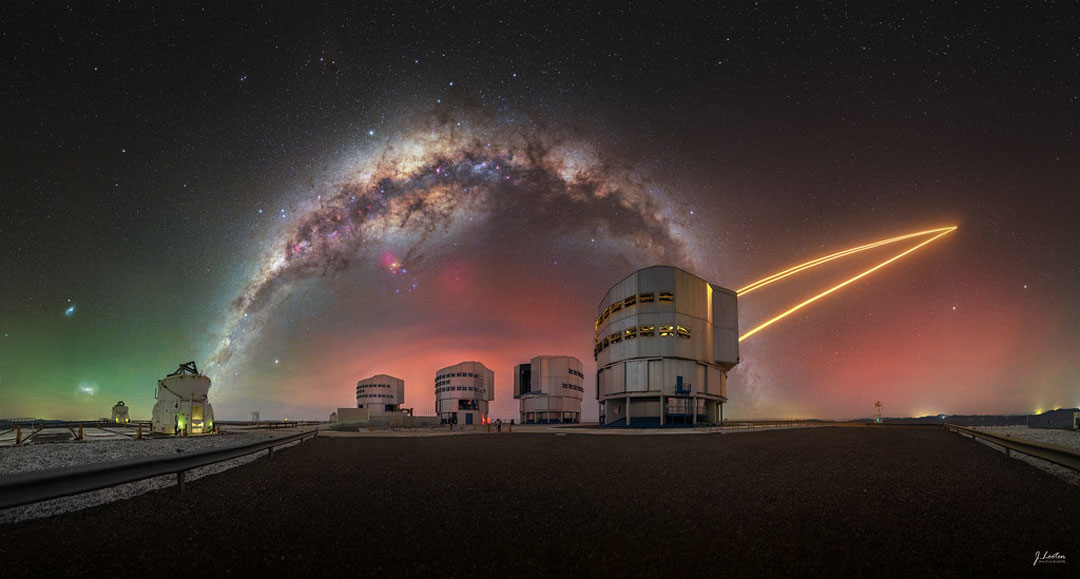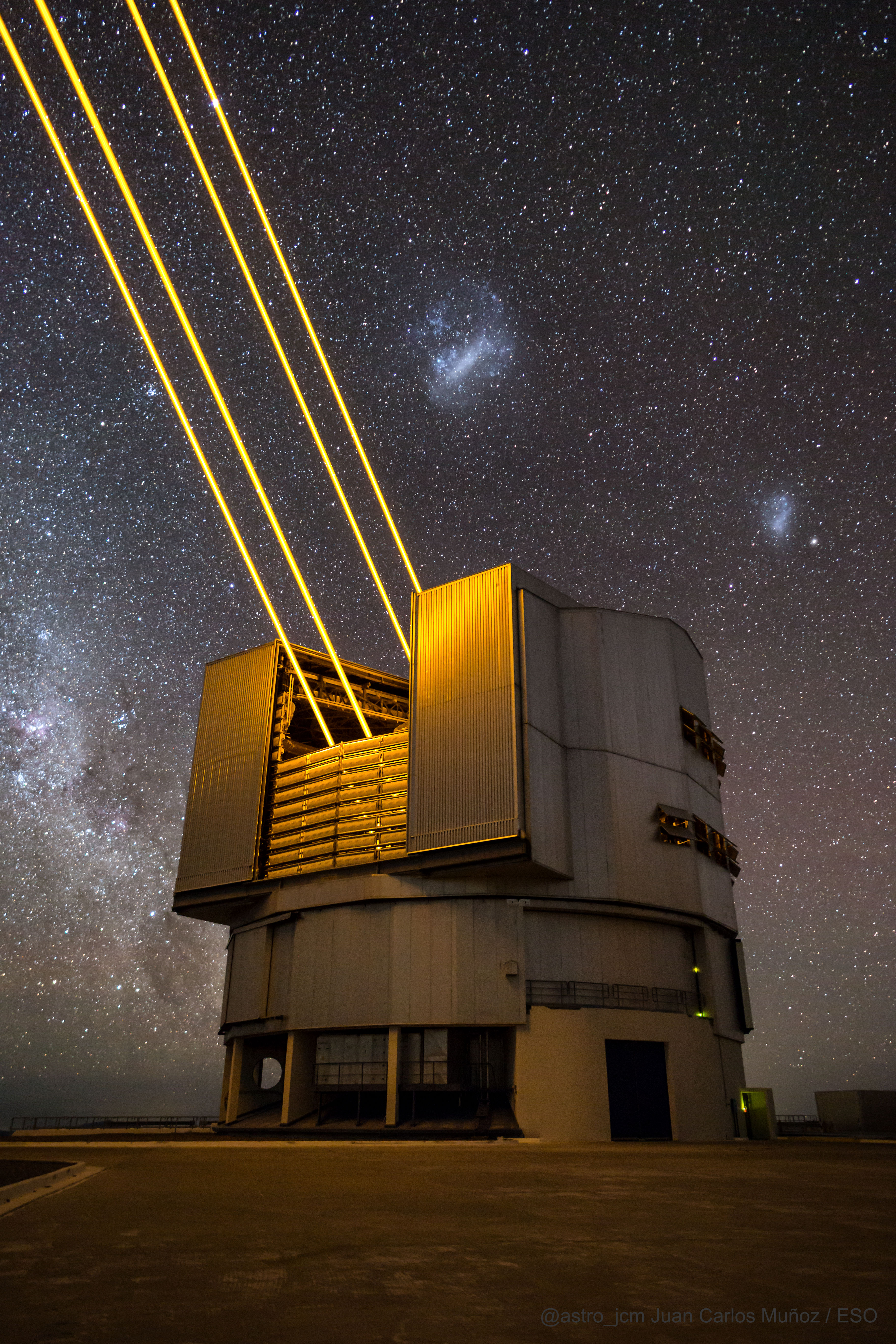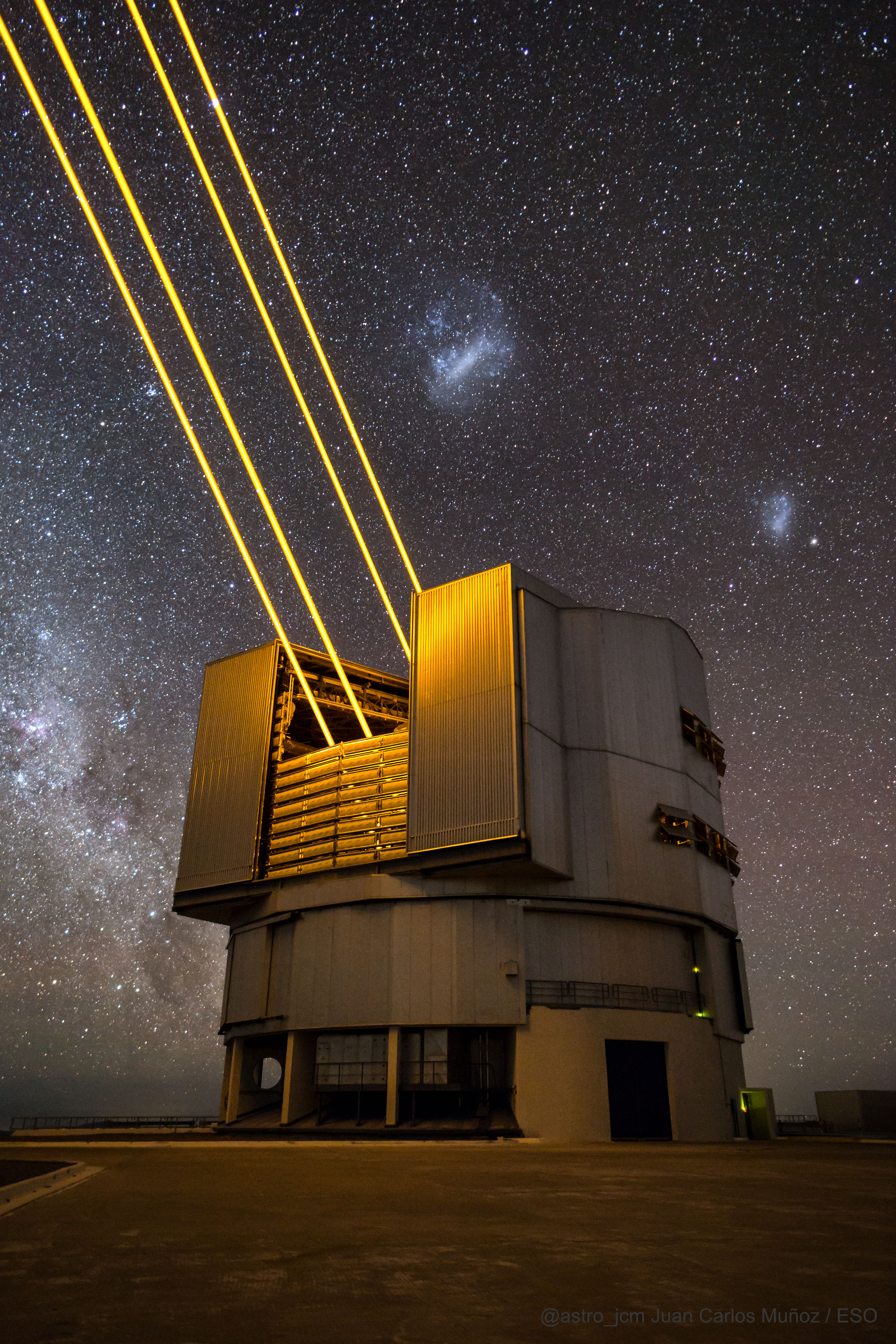
Why do stars twinkle? Our atmosphere is to blame as pockets of slightly off-temperature air, in constant motion, distort the light paths from distant astronomical objects. Atmospheric turbulence is a problem for astronomers because it blurs the images of the sources they want to study. The telescope featured in this image, located at ESO’s Paranal Observatory, is equipped with four lasers to combat this turbulence. The lasers are tuned to a color that excites atoms floating high in Earth's atmosphere -- sodium left by passing meteors. These glowing sodium spots act as artificial stars whose twinkling is immediately recorded and passed to a flexible mirror that deforms hundreds of times per second, counteracting atmospheric turbulence and resulting in crisper images. The de-twinkling of stars is a developing field of technology and allows, in some cases, Hubble-class images to be taken from the ground. This technique has also led to spin-off applications in human vision science, where it is used to obtain very sharp images of the retina.
¿Por qué titilan las estrellas? Nuestra atmósfera es la responsable, ya que bolsas de aire ligeramente diferentes en temperatura, en constante movimiento, distorsionan los caminos de la luz proveniente de objetos astronómicos distantes. La turbulencia atmosférica es un problema para los astrónomos porque desenfoca las imágenes de las fuentes que desean estudiar. El telescopio que aparece en esta imagen, ubicado en la Observación Paranal del ESO, está equipado con cuatro láseres para combatir esta turbulencia. Los láseres están sintonizados a un color que excita átomos que flotan alto en la atmósfera terrestre —sodio dejado por meteoritos que pasan. Estas manchas brillantes de sodio actúan como estrellas artificiales cuyo titileo se registra inmediatamente y se transmite a un espejo flexible que se deforma cientos de veces por segundo, contrarrestando la turbulencia atmosférica y resultando en imágenes más nítidas. El des-titileo de las estrellas es un campo en desarrollo tecnológico y permite, en algunos casos, obtener imágenes de clase Hubble desde el suelo. Esta técnica también ha llevado a aplicaciones derivadas en la ciencia de la visión humana, donde se utiliza para obtener imágenes muy nítidas de la retina.