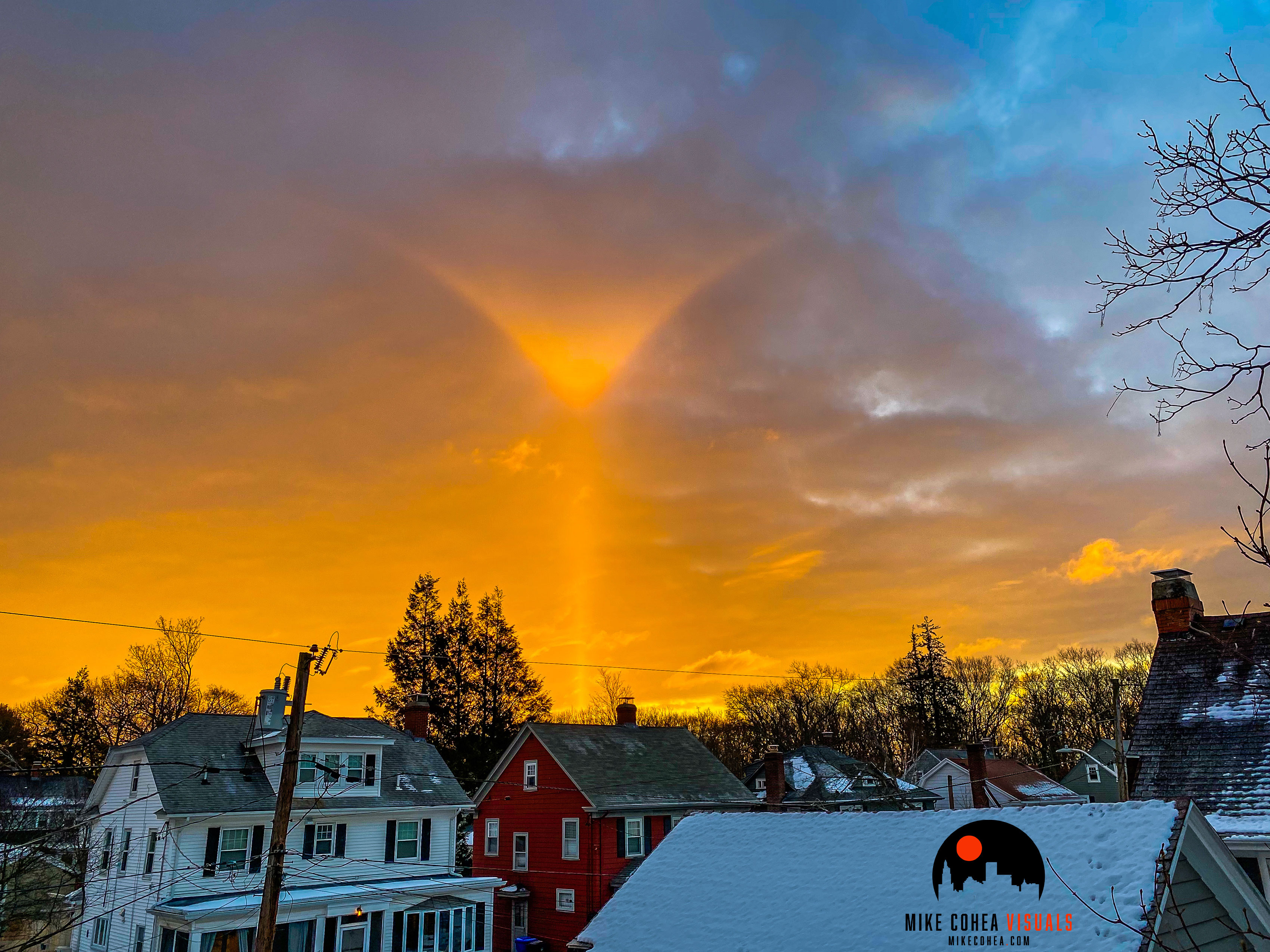
This was not a typical sun pillar. Just after sunrise two weeks ago in Providence, Rhode Island, USA, a photographer, looking out his window, was suddenly awestruck. The astonishment was caused by a sun pillar that fanned out at the top. Sun pillars, singular columns of light going up from the Sun, are themselves rare to see, and are known to be caused by sunlight reflecting from wobbling, hexagon-shaped ice-disks falling through Earth's atmosphere. Separately, upper tangent arcs are known to be caused by sunlight refracting through falling hexagon-shaped ice-tubes. Finding a sun pillar connected to an upper tangent arc is extraordinary, and, initially, took some analysis to figure out what was going on. A leading theory is that this sun pillar was also created, in a complex and unusual way, by falling ice tubes. Few might believe that such a rare phenomenon was seen again if it wasn't for the quick thinking of the photographer -- and the camera on his nearby smartphone. News from Mars: NASA Perseverance Coverage
Este no fue un pilar solar típico. Justo después del amanecer, hace dos semanas en Providence, Rhode Island, EE. UU., un fotógrafo, mirando por la ventana de su casa, quedó repentinamente asombrado. La sorpresa fue causada por un pilar solar que se extendía en forma de abanico en la parte superior. Los pilares solares, columnas únicas de luz que se elevan desde el Sol, son en sí mismos raros de observar, y se conocen como fenómenos causados por la reflexión de la luz solar en discos hexagonales de hielo que caen y se balancean a través de la atmósfera terrestre. Por otro lado, los arcos tangentes superiores se conocen como fenómenos causados por la refracción de la luz solar a través de tubos hexagonales de hielo que caen. Encontrar un pilar solar conectado a un arco tangente superior es extraordinario, y, inicialmente, tomó algún análisis para comprender qué estaba sucediendo. Una teoría principal sugiere que este pilar solar también fue creado, de una manera compleja y poco común, por tubos de hielo en caída. Pocos podrían creer que se hubiera observado nuevamente un fenómeno tan raro si no fuera por el rápido pensamiento del fotógrafo — y la cámara de su smartphone cercano.