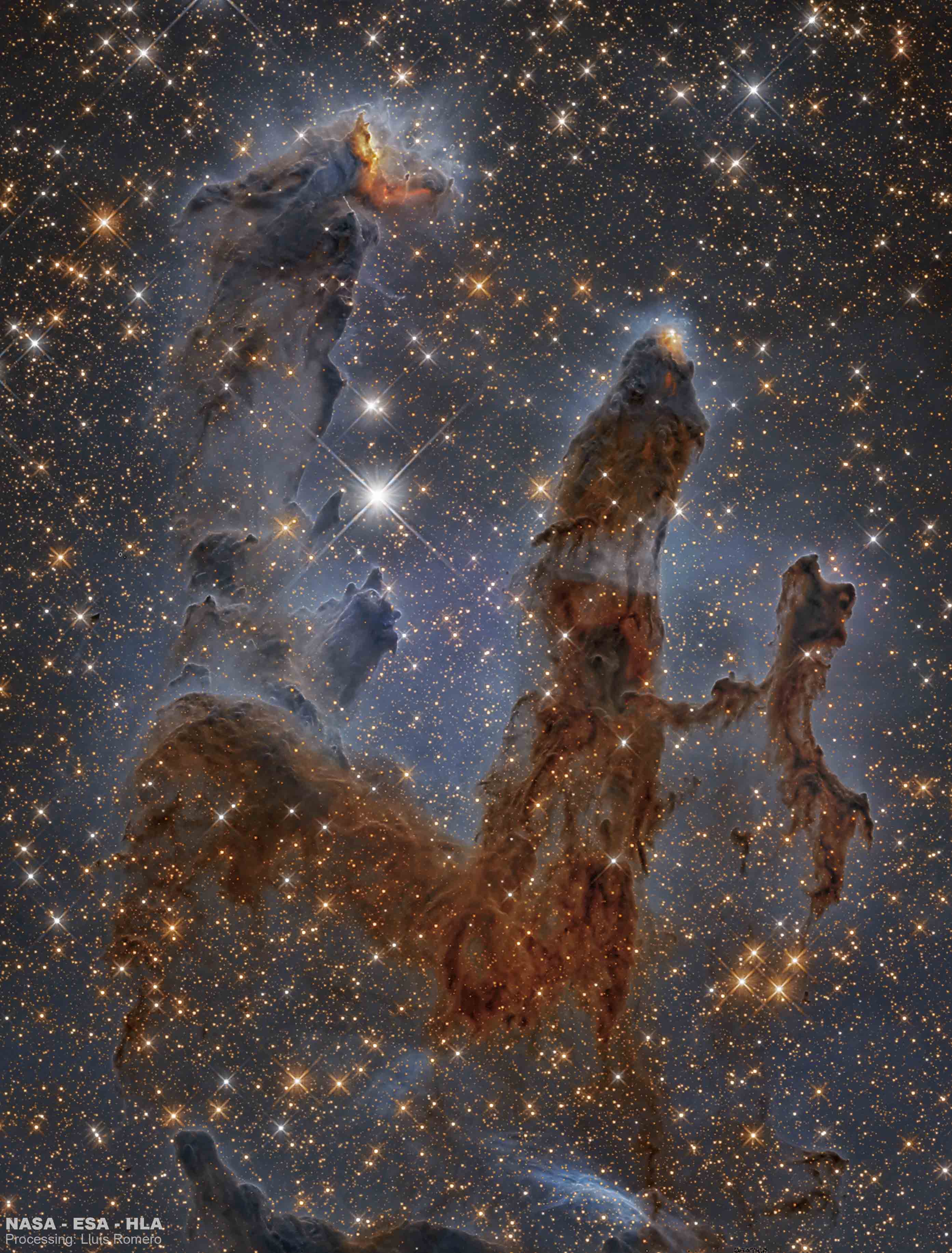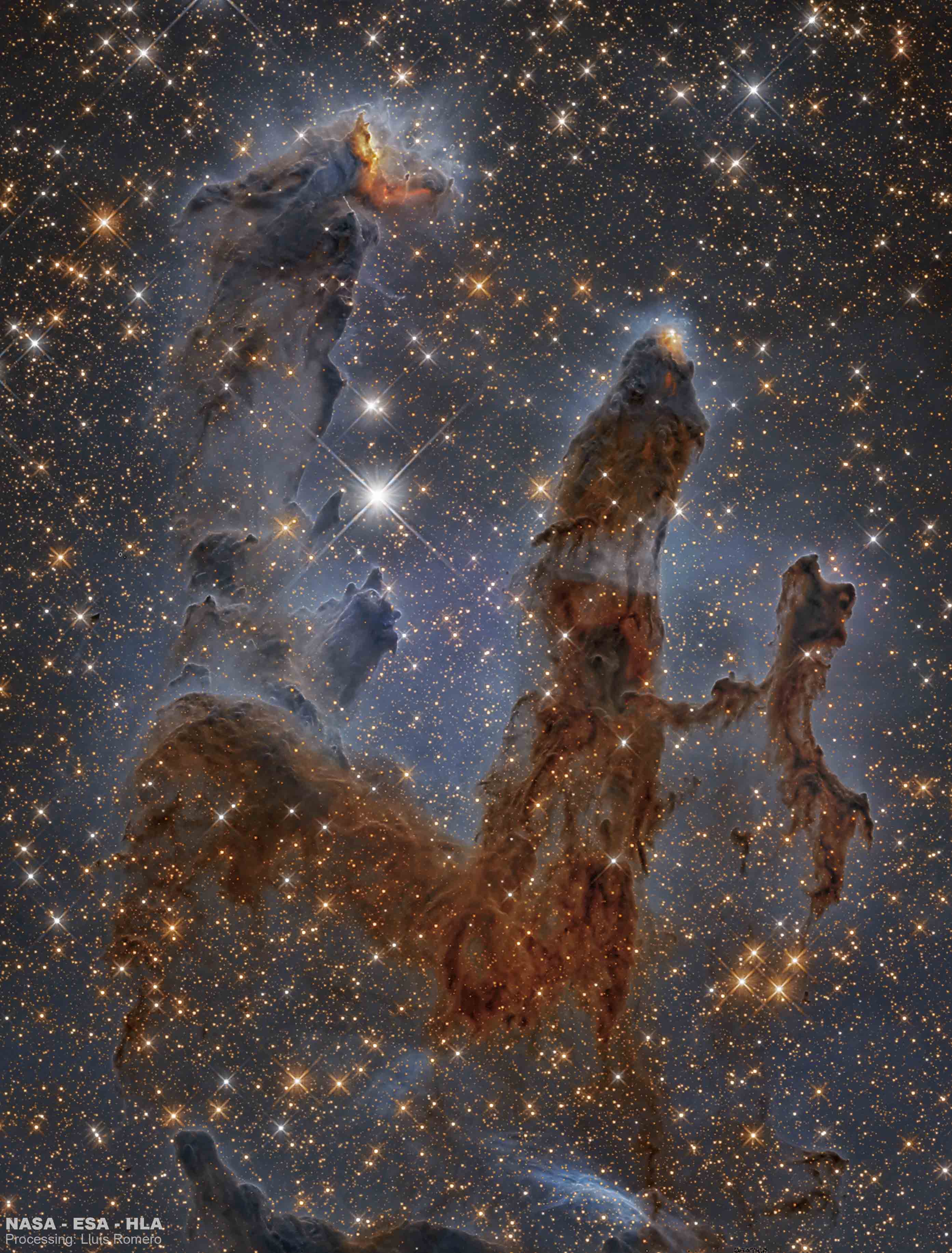
Newborn stars are forming in the Eagle Nebula. Gravitationally contracting in pillars of dense gas and dust, the intense radiation of these newly-formed bright stars is causing surrounding material to boil away. This image, taken with the Hubble Space Telescope in near infrared light, allows the viewer to see through much of the thick dust that makes the pillars opaque in visible light. The giant structures are light years in length and dubbed informally the Pillars of Creation. Associated with the open star cluster M16, the Eagle Nebula lies about 6,500 light years away. The Eagle Nebula is an easy target for small telescopes in a nebula-rich part of the sky toward the split constellation Serpens Cauda (the tail of the snake).
Estrellas recién nacidas se están formando en la Nebulosa del Águila. Contrayéndose gravitacionalmente en columnas de gas y polvo denso, la intensa radiación de estas estrellas brillantes recién formadas está haciendo que el material circundante se evapore. Esta imagen, tomada con el Telescopio Espacial Hubble en luz infrarroja cercana, permite al observador ver a través de gran parte del polvo denso que hace que las columnas sean opacas en luz visible. Las estructuras gigantes tienen kiloparsecs de longitud y se llaman informalmente las Columnas de la Creación. Asociada al cúmulo estelar abierto M16, la Nebulosa del Águila se encuentra a unos 6500 años luz de distancia. La Nebulosa del Águila es un objetivo fácil para telescopios pequeños en una región rica en nebulosas del cielo hacia la constelación dividida Serpens Cauda (la cola de la serpiente).