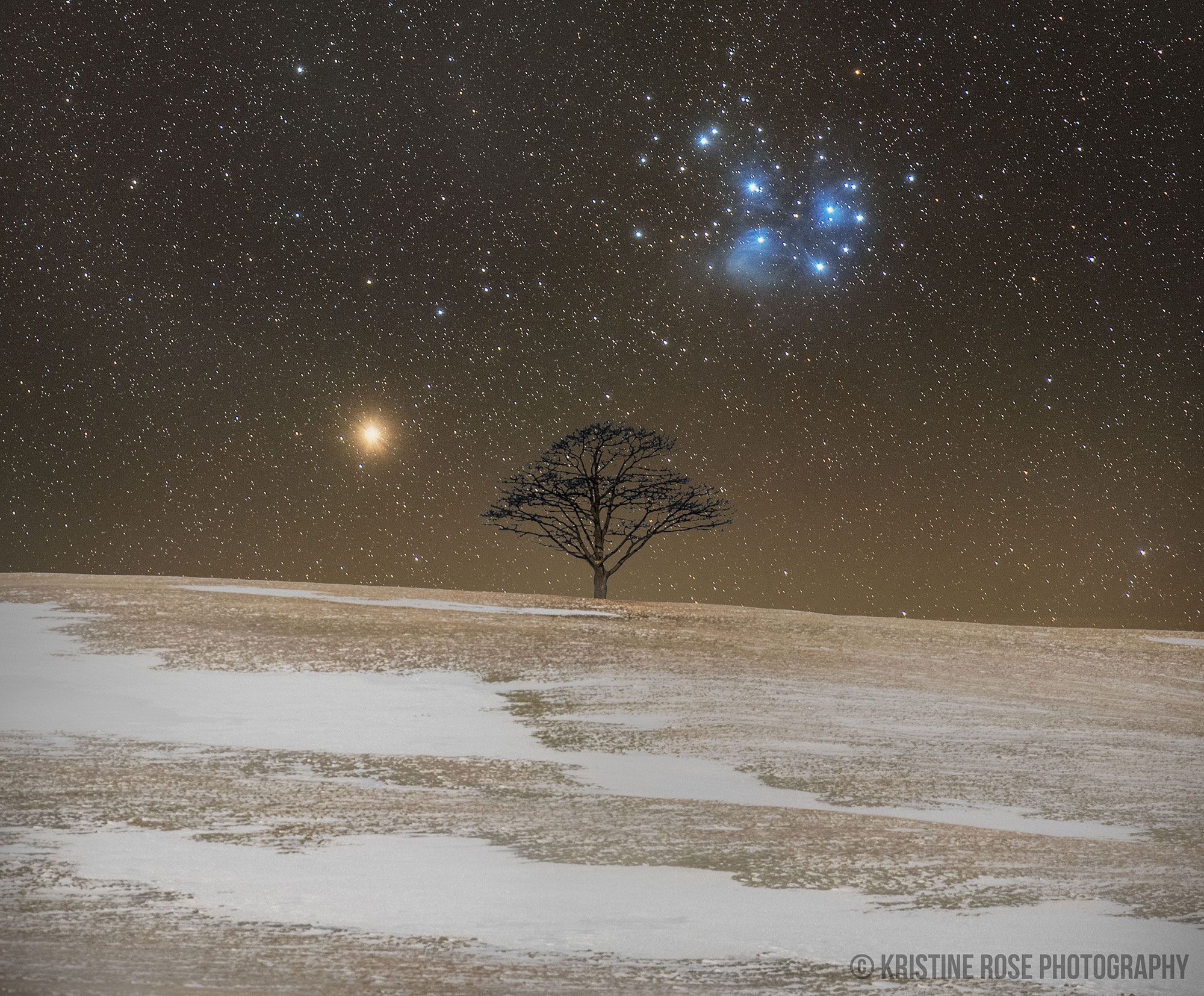
Is this just a lonely tree on an empty hill? To start, perhaps, but look beyond. There, a busy universe may wait to be discovered. First, physically, to the left of the tree, is the planet Mars. The red planet, which is the new home to NASA's Perseverance rover, remains visible this month at sunset above the western horizon. To the tree's right is the Pleiades, a bright cluster of stars dominated by several bright blue stars. The featured picture is a composite of several separate foreground and background images taken within a few hours of each other, early last month, from the same location on Vinegar Hill in Milford, Nova Scotia, Canada. At that time, Mars was passing slowly, night after night, nearly in front of the distant Seven Sisters star cluster. The next time Mars will pass angularly as close to the Pleiades as it did in March will be in 2038.
¿Es solo un árbol solitario en una colina desierta? Quizás al principio, pero mire más allá. Allí, un universo activo espera ser descubierto. En primer lugar, físicamente, a la izquierda del árbol, se encuentra el planeta Marte. El planeta rojo, que es el nuevo hogar del rover Perseverance de la NASA, sigue siendo visible este mes al atardecer sobre el horizonte occidental. A la derecha del árbol se encuentran las Pléyades, un brillante cúmulo de estrellas dominado por varias estrellas azules brillantes. La imagen destacada es una composición de varias imágenes separadas del primer plano y del fondo tomadas dentro de un par de horas entre sí, a principios del mes pasado, desde el mismo lugar en Vinegar Hill en Milford, Nueva Escocia, Canadá. En ese momento, Marte pasaba lentamente, noche tras noche, casi frente al distante cúmulo estelar de las Siete Hermanas. La próxima vez que Marte pase angularmente tan cerca de las Pléyades como lo hizo en marzo será en 2038.