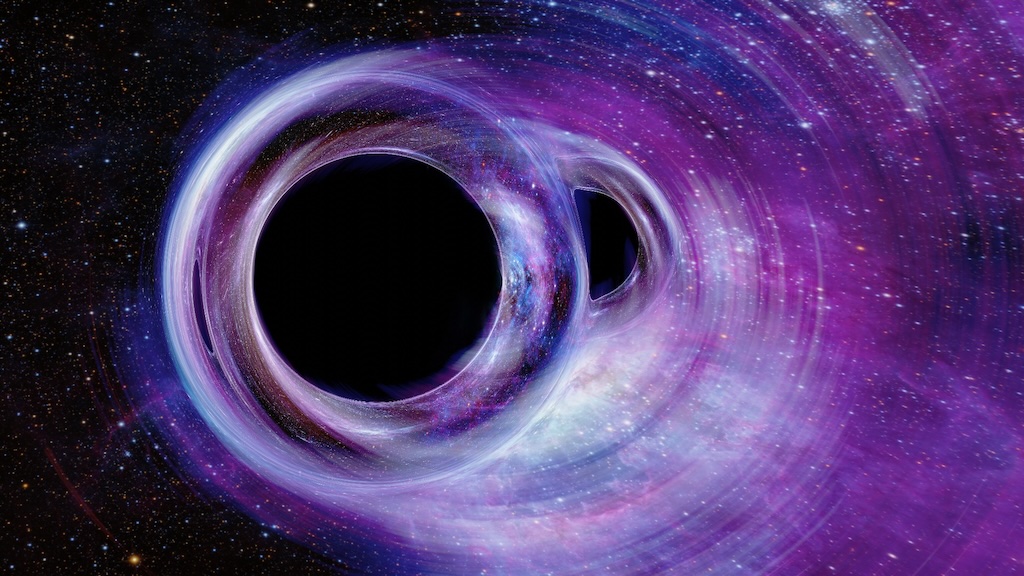
Light rays from accretion disks around a pair of orbiting supermassive black holes make their way through the warped space-time produced by extreme gravity in this stunning computer visualization. The simulated accretion disks have been given different false color schemes, red for the disk surrounding a 200-million-solar-mass black hole, and blue for the disk surrounding a 100-million-solar-mass black hole. That makes it easier to track the light sources, but the choice also reflects reality. Hotter gas gives off light closer to the blue end of the spectrum and material orbiting smaller black holes experiences stronger gravitational effects that produce higher temperatures. For these masses, both accretion disks would actually emit most of their light in the ultraviolet though. In the video, distorted secondary images of the blue black hole, which show the red black hole's view of its partner, can be found within the tangled skein of the red disk warped by the gravity of the blue black hole in the foreground. Because we're seeing red's view of blue while also seeing blue directly, the images allow us to see both sides of blue at the same time. Red and blue light originating from both black holes can be seen in the innermost ring of light, called the photon ring, near their event horizons. Astronomers expect that in the not-too-distant future they’ll be able to detect gravitational waves, ripples in space-time, produced when two supermassive black holes in a system much like the one simulated here spiral together and merge.
Crédito: NASA, CGRO SSC Los rayos de luz provenientes de discos de acreción alrededor de un par de agujeros negros supermasivos en órbita se desplazan a través del espacio-tiempo curvado producido por la gravedad extrema en esta asombrosa visualización por computadora. Los discos de acreción simulados se les ha asignado diferentes esquemas de color falso, rojo para el disco que rodea un agujero negro de 200 millones de masas solares, y azul para el disco que rodea un agujero negro de 100 millones de masas solares. Eso facilita seguir la fuente de la luz, pero la elección también refleja la realidad. El gas más caliente emite luz más cercana al extremo azul del espectro y el material que orbita agujeros negros más pequeños experimenta efectos gravitacionales más fuertes que producen temperaturas más altas. Para estas masas, ambos discos de acreción emitirían en realidad la mayor parte de su luz en el ultravioleta. En el video, imágenes secundarias distorsionadas del agujero negro azul, que muestran la visión del agujero negro rojo de su compañero, se encuentran dentro del entrelazado hilo del disco rojo, curvado por la gravedad del agujero negro azul en primer plano. Debido a que estamos viendo la visión del rojo del azul mientras también vemos directamente el azul, las imágenes nos permiten ver ambos lados del azul al mismo tiempo. La luz roja y azul que proviene de ambos agujeros negros se puede ver en el anillo de luz más interno, llamado anillo de fotones, cerca de sus horizontes de sucesos. Los astrónomos esperan que en el futuro no muy lejano puedan detectar ondas gravitacionales, ondulaciones en el espacio-tiempo, producidas cuando dos agujeros negros supermasivos en un sistema muy similar al simulado aquí se enroscan y fusionan.