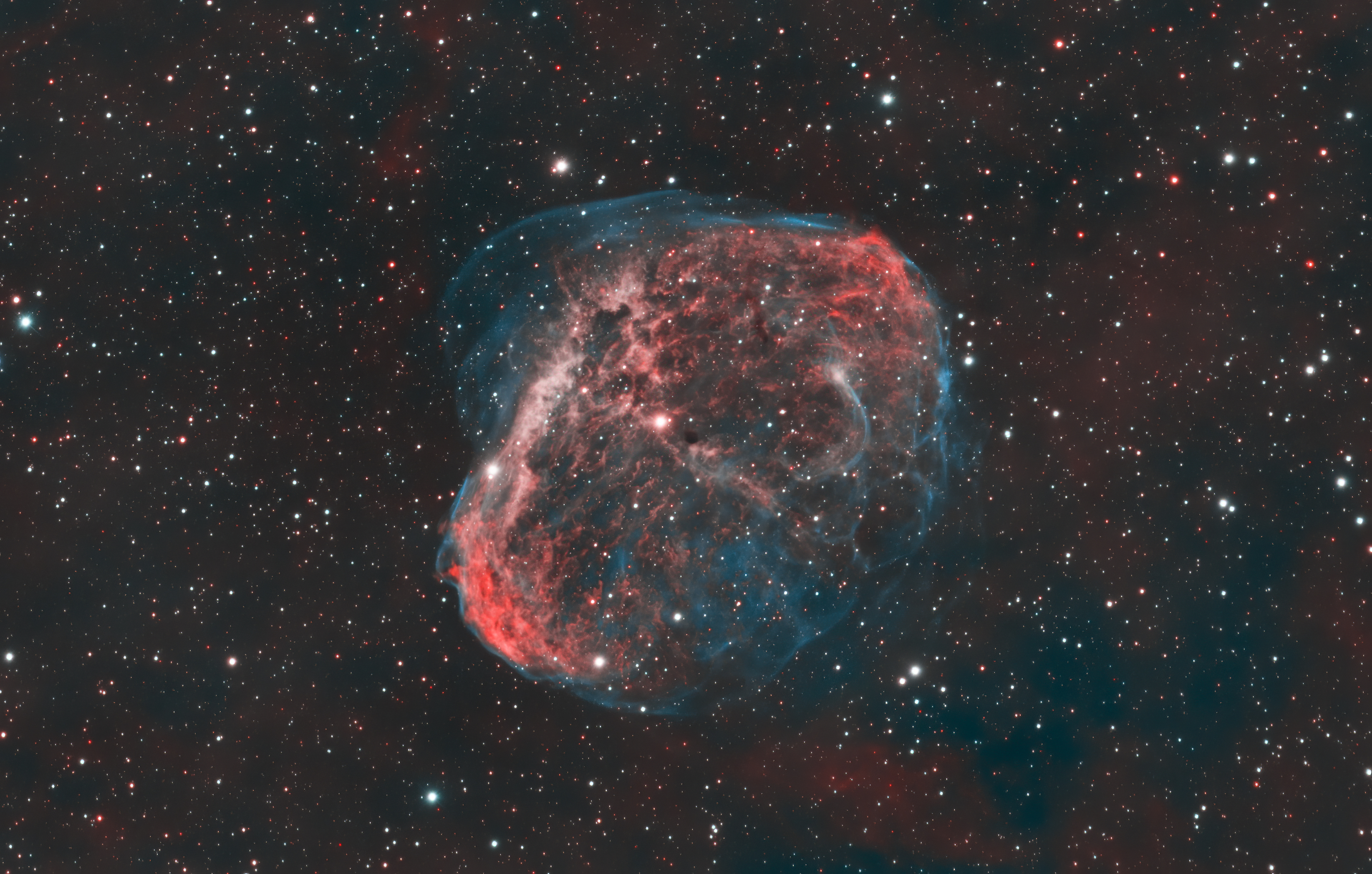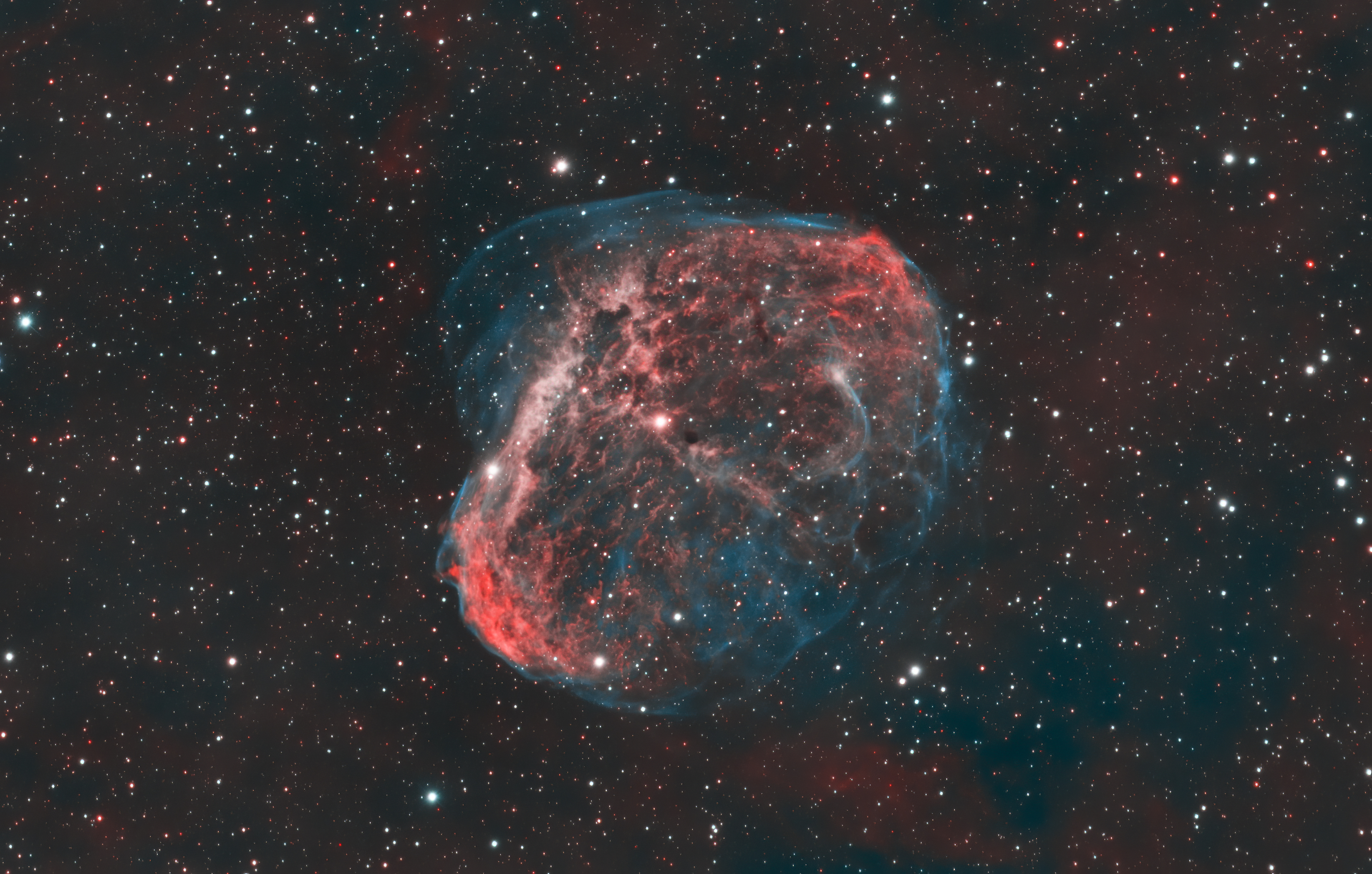
NGC 6888, also known as the Crescent Nebula, is a about 25 light-years across blown by winds from its central, bright, massive star. A triumvirate of astroimagers ( Joe, Glenn, Russell) created this sharp portrait of the cosmic bubble. Their telescopic collaboration collected over 30 hours of narrow band image data isolating light from hydrogen and oxygen atoms. The oxygen atoms produce the blue-green hue that seems to enshroud the detailed folds and filaments. Visible within the nebula, NGC 6888's central star is classified as a Wolf-Rayet star (WR 136). The star is shedding its outer envelope in a strong stellar wind, ejecting the equivalent of the Sun's mass every 10,000 years. The nebula's complex structures are likely the result of this strong wind interacting with material ejected in an earlier phase. Burning fuel at a prodigious rate and near the end of its stellar life this star should ultimately go out with a bang in a spectacular supernova explosion. Found in the nebula rich constellation Cygnus, NGC 6888 is about 5,000 light-years away.
NGC 6888, también conocida como la Nebulosa Creciente, tiene aproximadamente 25 años luz de diámetro y fue formada por vientos provenientes de su estrella central, brillante y masiva. Un trío de astrofotógrafos (Joe, Glenn, Russell) creó esta precisa imagen de la burbuja cósmica. Su colaboración telescópica recopiló más de 30 horas de datos de imágenes en banda estrecha, aislando la luz emitida por átomos de hidrógeno y oxígeno. Los átomos de oxígeno producen el tono azul-verdoso que parece envolver los detalles de las capas y filamentos. Dentro de la nebulosa, la estrella central de NGC 6888 se clasifica como una estrella Wolf-Rayet (WR 136). Esta estrella está perdiendo su envoltura exterior mediante un fuerte viento estelar, expulsando una masa equivalente a la del Sol cada 10 000 años. Las estructuras complejas de la nebulosa probablemente sean el resultado de este fuerte viento interactuando con material eyectado en una fase anterior. Al quemar combustible a un ritmo prodigioso y estar cerca del final de su vida estelar, esta estrella finalmente terminará con un estallido en una explosión de supernova espectacular. Ubicada en la constelación rica en nebulosas de Cisne, NGC 6888 se encuentra a unos 5 000 años luz de distancia.