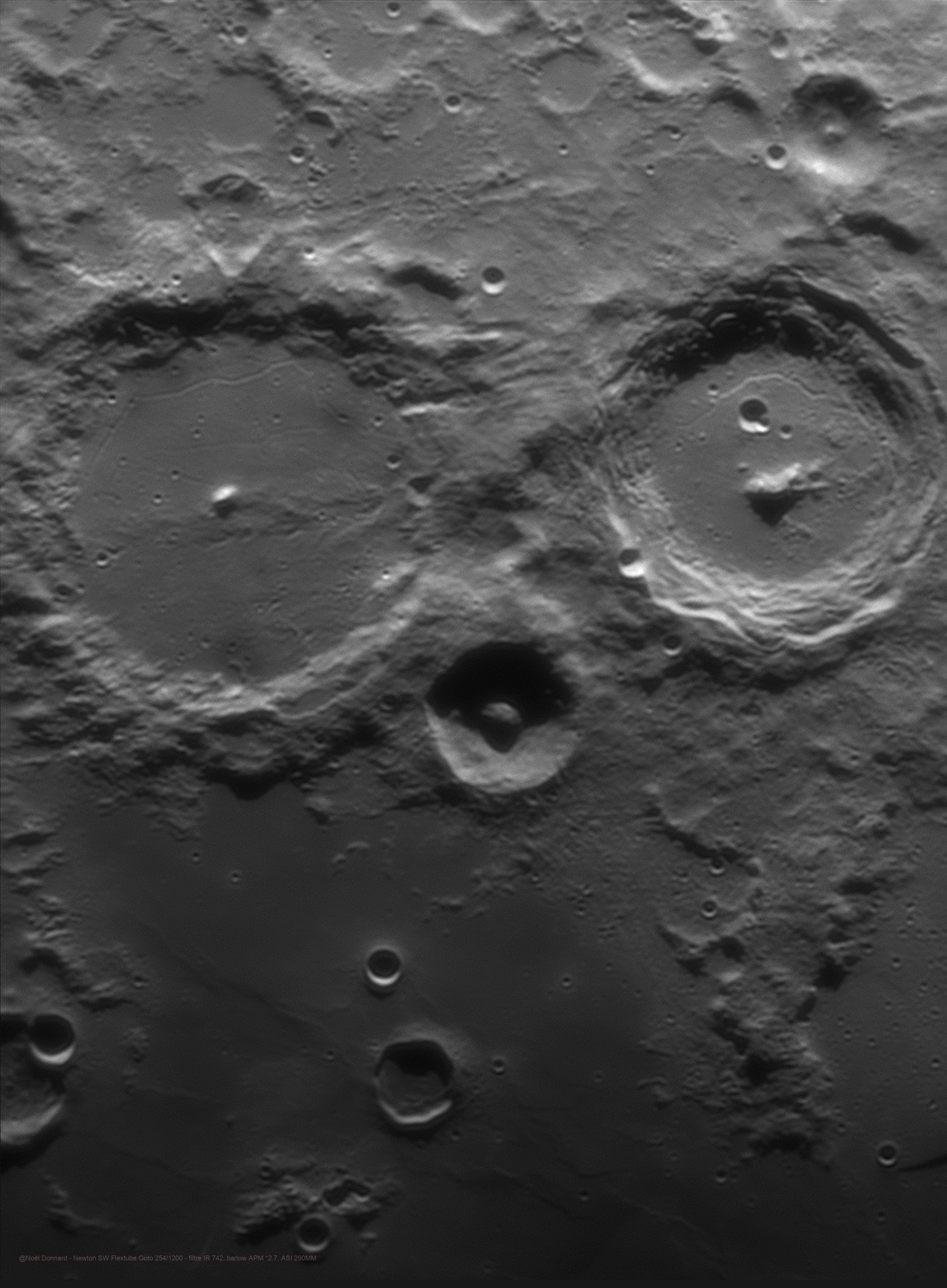
Point your telescope at tonight's first quarter Moon. Along the terminator, the shadow line between night and day, you might find these two large craters staring back at you with an owlish gaze. Alphonsus (left) and Arzachel are ancient impact craters on the north eastern shores of Mare Nubium, the lunar Sea of Clouds. The larger Alphonsus is over 100 kilometers in diameter. A low sun angle highlights the crater's sharp 1.5 kilometer high central peak in bright sunlight and dark shadow. Scouting for potential Apollo moon landing sites, the Ranger 9 spacecraft returned closeup pictures of Alphonsus before crashing in the crater just northeast (toward the upper left) of its central mountain in 1965. Alpetragius, between Alphonsus and Arzachel, is the small crater with the deeply shadowed floor and overly large central beak.
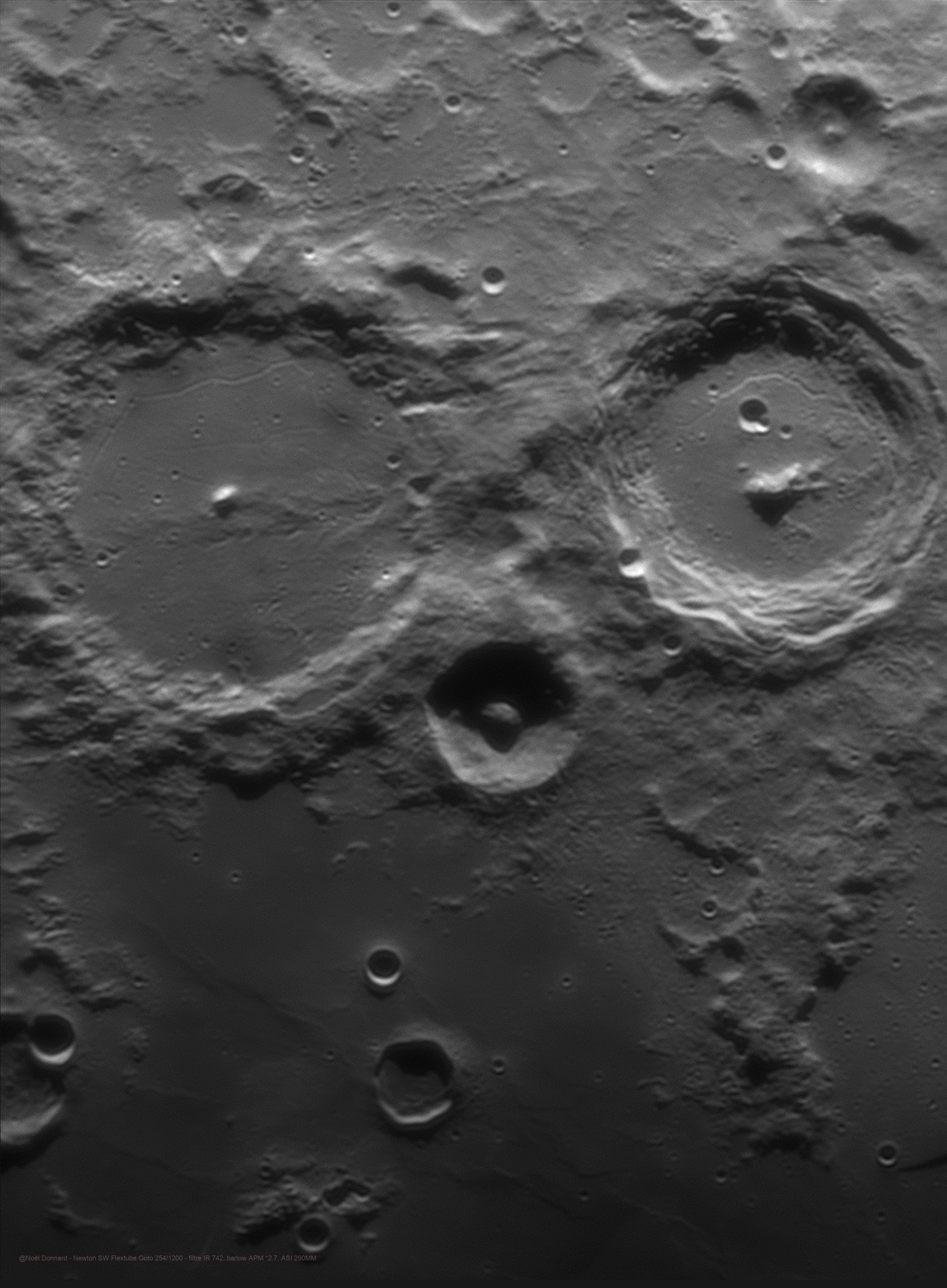
Dirija su telescopio hacia la Luna en cuarto creciente de esta noche. A lo largo del terminador, la línea de sombra entre la noche y el día, podría encontrar estos dos grandes cráteres que le devuelven la mirada con una expresión similar a la de un búho. Alphonsus (a la izquierda) y Arzachel son antiguos cráteres de impacto ubicados en las costas noreste del Mare Nubium, el Mar de las Nubes lunar. El más grande, Alphonsus, tiene un diámetro superior a los 100 kilómetros. Un ángulo bajo del Sol resalta el agudo pico central del cráter, de 1.5 kilómetros de altura, iluminado por la luz brillante y la sombra oscura. Durante la búsqueda de posibles sitios de aterrizaje para la misión Apolo, la nave espacial Ranger 9 devolvió imágenes detalladas de Alphonsus antes de estrellarse en el cráter, justo al noreste (hacia la parte superior izquierda) de su montaña central, en 1965. Alpetragius, ubicado entre Alphonsus y Arzachel, es el pequeño cráter con un fondo profundamente sombreado y un pico central exageradamente grande.