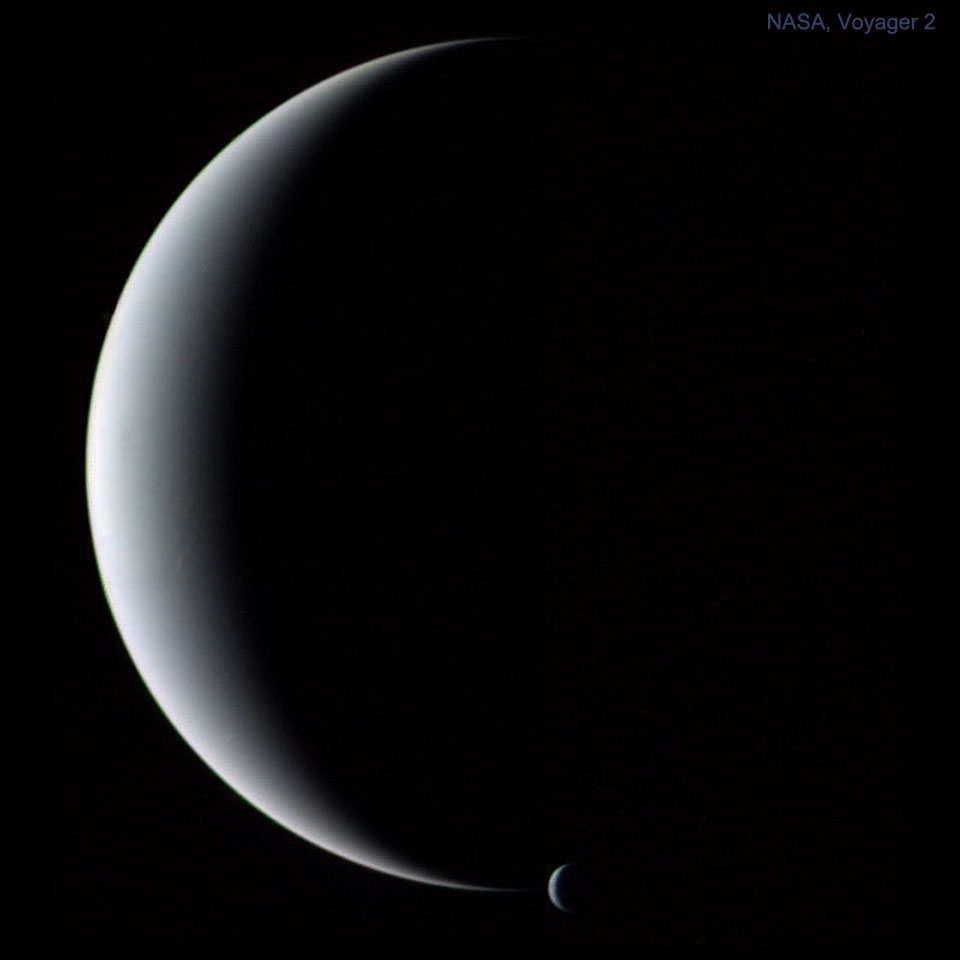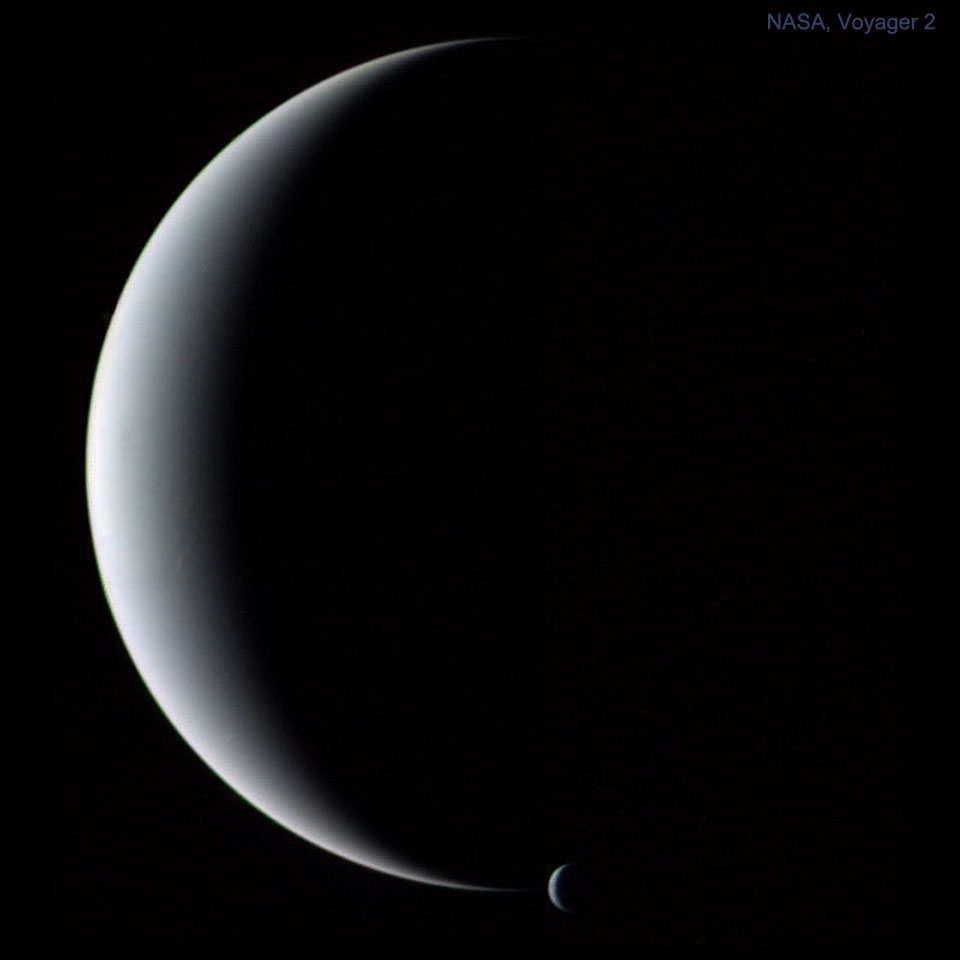
Gliding silently through the outer Solar System, the Voyager 2 spacecraft camera captured Neptune and Triton together in crescent phase. The elegant picture of the ice-giant planet and its cloudy moon was taken from behind just after closest approach in 1989. It could not have been taken from Earth because Neptune never shows a crescent phase to sunward Earth. The unusual vantage point also robs Neptune of its familiar blue hue, as sunlight seen from here is scattered forward, and so is reddened like the setting Sun. Neptune is smaller but more massive than Uranus, has several dark rings, and emits more light than it receives from the Sun.
Mientras se desplazaba silenciosamente por el sistema solar exterior, la cámara de la nave espacial Voyager 2 capturó a Neptuno y Tritón juntos en fase creciente. La elegante imagen del planeta gigante de hielo y su luna nublada fue tomada desde atrás, poco después del acercamiento más cercano en 1989. No podría haber sido tomada desde la Tierra, ya que Neptuno nunca muestra una fase creciente desde la Tierra, que mira hacia el Sol. El punto de observación inusual también priva a Neptuno de su tono azul familiar, ya que la luz solar vista desde aquí se dispersa hacia adelante y, por lo tanto, se enrojece como el Sol al ponerse. Neptuno es más pequeño pero más masivo que Urano, tiene varios anillos oscuros y emite más luz de la que recibe del Sol.