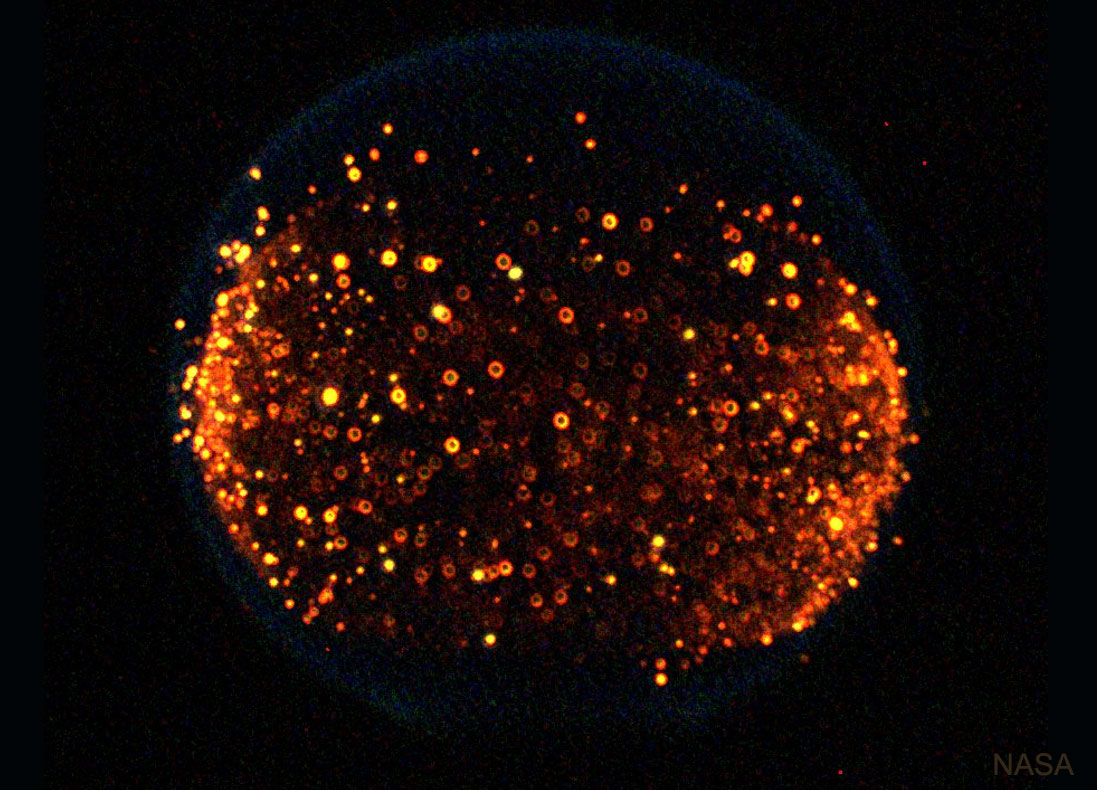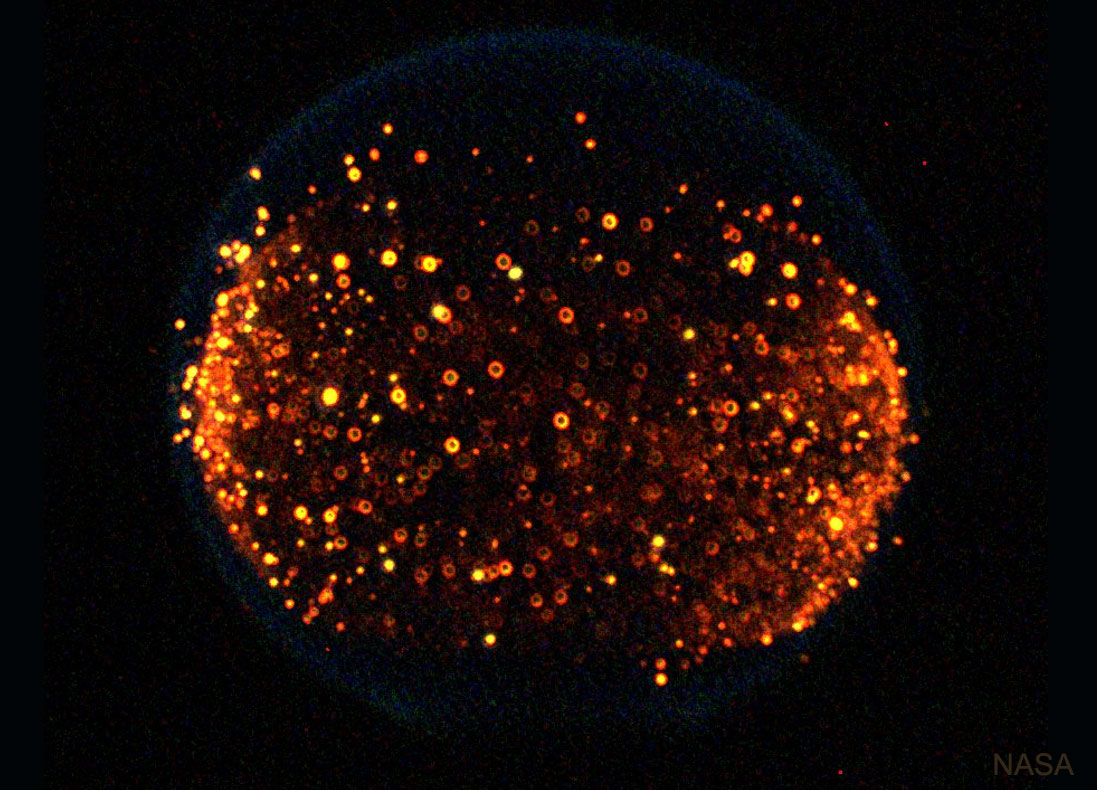
What does fire look like in space? In the gravity on Earth, heated air rises and expands, causing flames to be teardrop shaped. In the microgravity of the air-filled International Space Station (ISS), however, flames are spheres. Fire is the rapid acquisition of oxygen, and space flames meet new oxygen molecules when they float by randomly from all directions -- creating the enveloping sphere. In the featured image taken in the ISS's Combustion Integration Rack, a spherical flame envelopes clusters of hot glowing soot. Without oxygen, say in the vacuum of empty space, a fire would go out immediately. The many chemical reactions involved with fire are complex, and testing them in microgravity is helping humanity not only to better understand fire -- but how to put out fire, too.
¿Cómo se ve el fuego en el espacio? En la gravedad terrestre, el aire caliente sube y se expande, causando que las llamas tengan forma de lágrima. Sin embargo, en la microgravedad de la Estación Espacial Internacional (ISS) llena de aire, las llamas son esféricas. El fuego es la rápida adquisición de oxígeno, y las llamas en el espacio encuentran nuevas moléculas de oxígeno cuando flotan aleatoriamente desde todas direcciones, creando la esfera envolvente. En la imagen destacada tomada en el Rack de Integración de Combustión de la ISS, una llama esférica envuelve agrupaciones de hollín brillante y caliente. Sin oxígeno, como en el vacío del espacio vacío, el fuego se apagaría inmediatamente. Las muchas reacciones químicas involucradas en el fuego son complejas, y probarlas en microgravedad está ayudando a la humanidad no solo a comprender mejor el fuego, sino también a apagarlo.