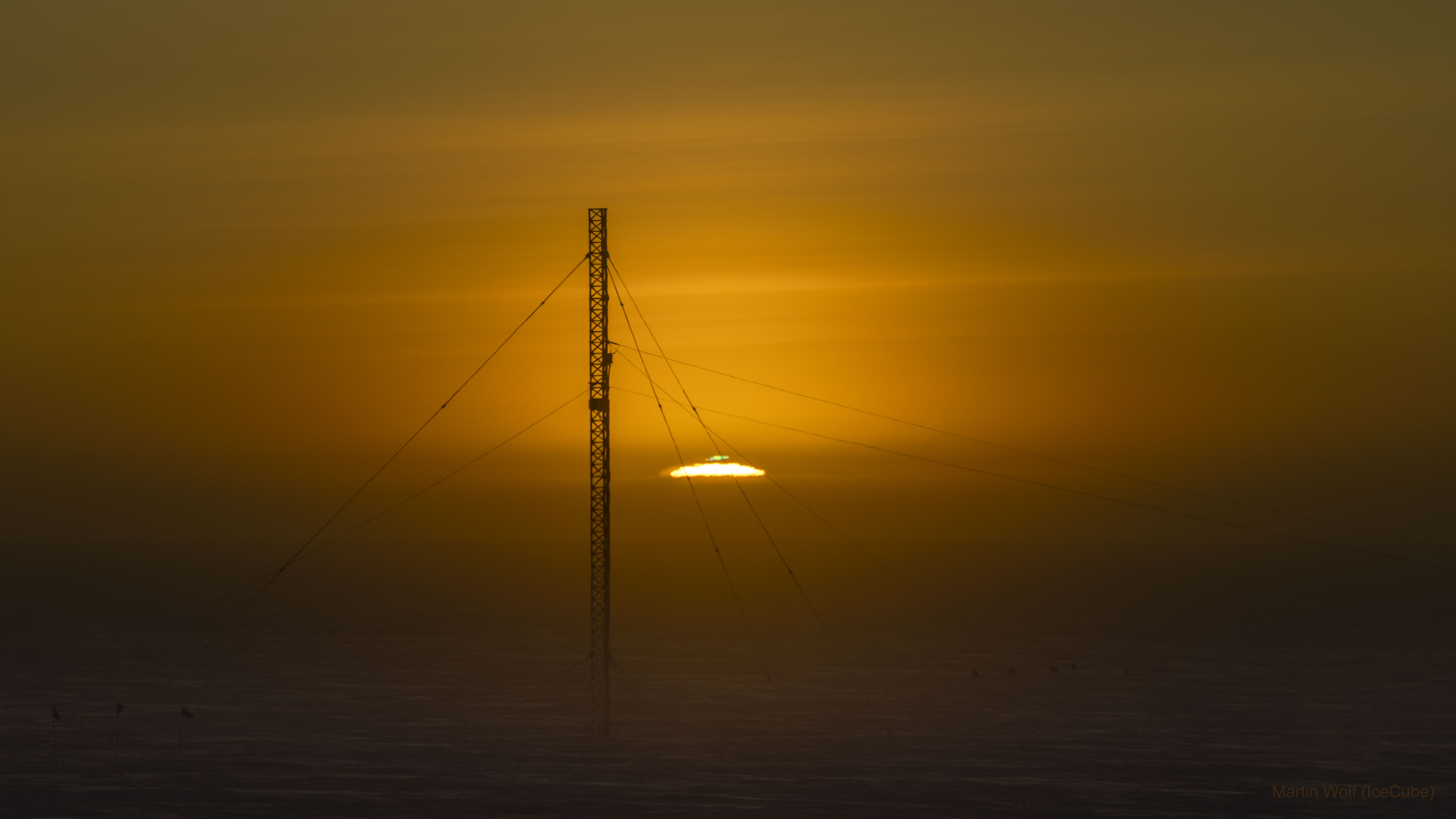
Sunrise at the South Pole is different. Usually a welcome sight, it follows months of darkness -- and begins months of sunshine. At Earth's poles, it can take weeks for the Sun to rise, in contrast with hours at any mid-latitude location. Sunrise at a pole is caused by the tilt of the Earth as it orbits the Sun, not by the rotation of the Earth. Although at a pole, an airless Earth would first see first Sun at an equinox, the lensing effect of the Earth's atmosphere and the size of the solar disk causes the top of the Sun to appear about two-weeks early. Pictured two weeks ago, the Sun peeks above the horizon of a vast frozen landscape at Earth's South Pole. The true South Pole is just a few meters to the left of the communications tower. This polar sunrise capture was particularly photogenic as the Sun appeared capped by a green flash.
El amanecer en el Polo Sur es diferente. Generalmente una visión bienvenida, sigue a meses de oscuridad y comienza meses de luz solar. En los polos terrestres, puede tomar semanas para que el Sol se eleve, en contraste con horas en cualquier ubicación de latitud media. El amanecer en un polo es causado por la inclinación de la Tierra mientras orbita alrededor del Sol, no por la rotación de la Tierra. Aunque en un polo, una Tierra sin atmósfera vería por primera vez al Sol en un equinoccio, el efecto de lente de la atmósfera terrestre y el tamaño del disco solar hacen que la parte superior del Sol aparezca aproximadamente dos semanas antes. Hace dos semanas, el Sol asomó por encima del horizonte de un vasto paisaje helado en el Polo Sur terrestre. El verdadero Polo Sur está a solo unos metros a la izquierda de la torre de comunicaciones. Esta captura del amanecer polar fue particularmente fotogénica ya que el Sol aparecía coronado por un destello verde.