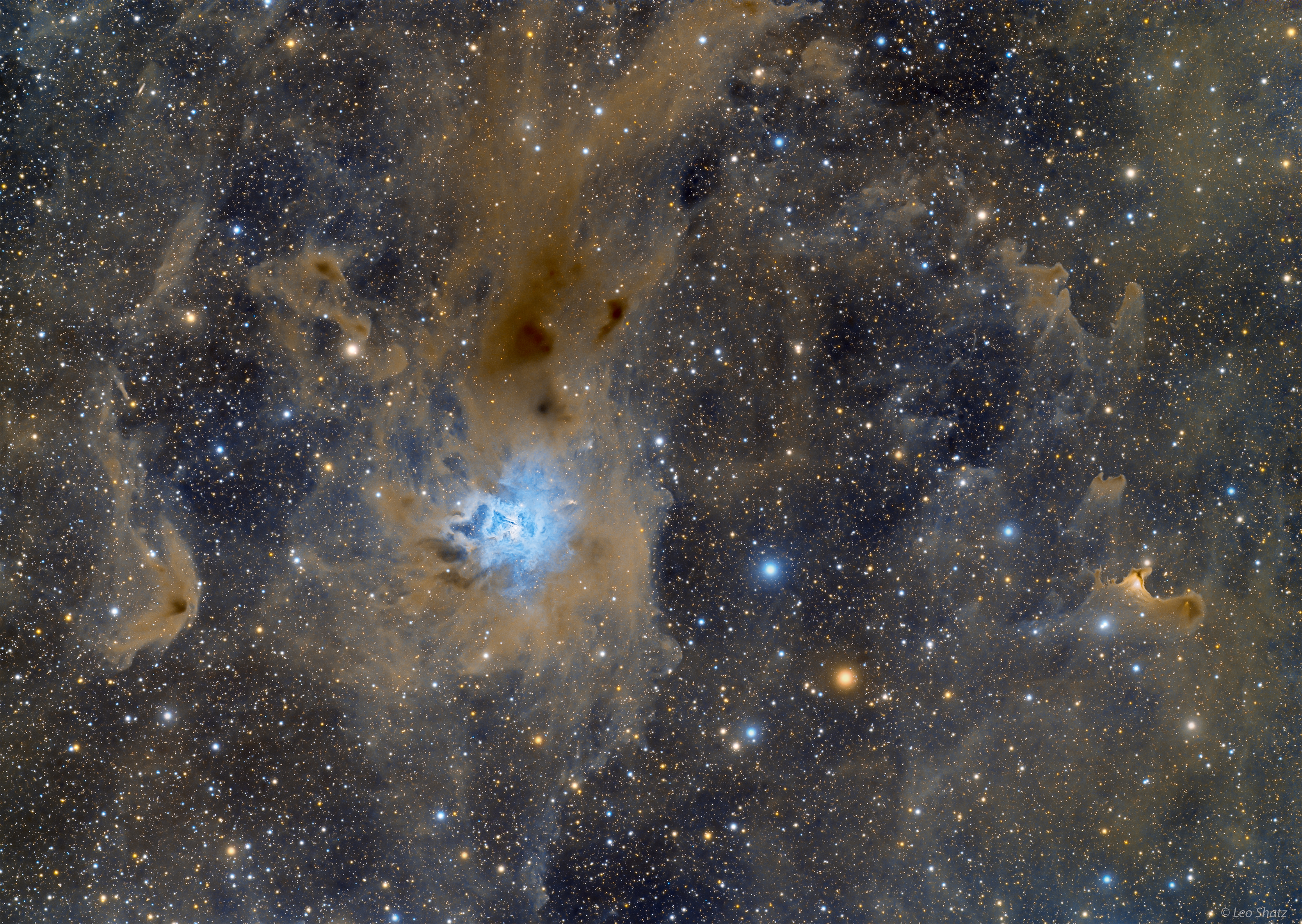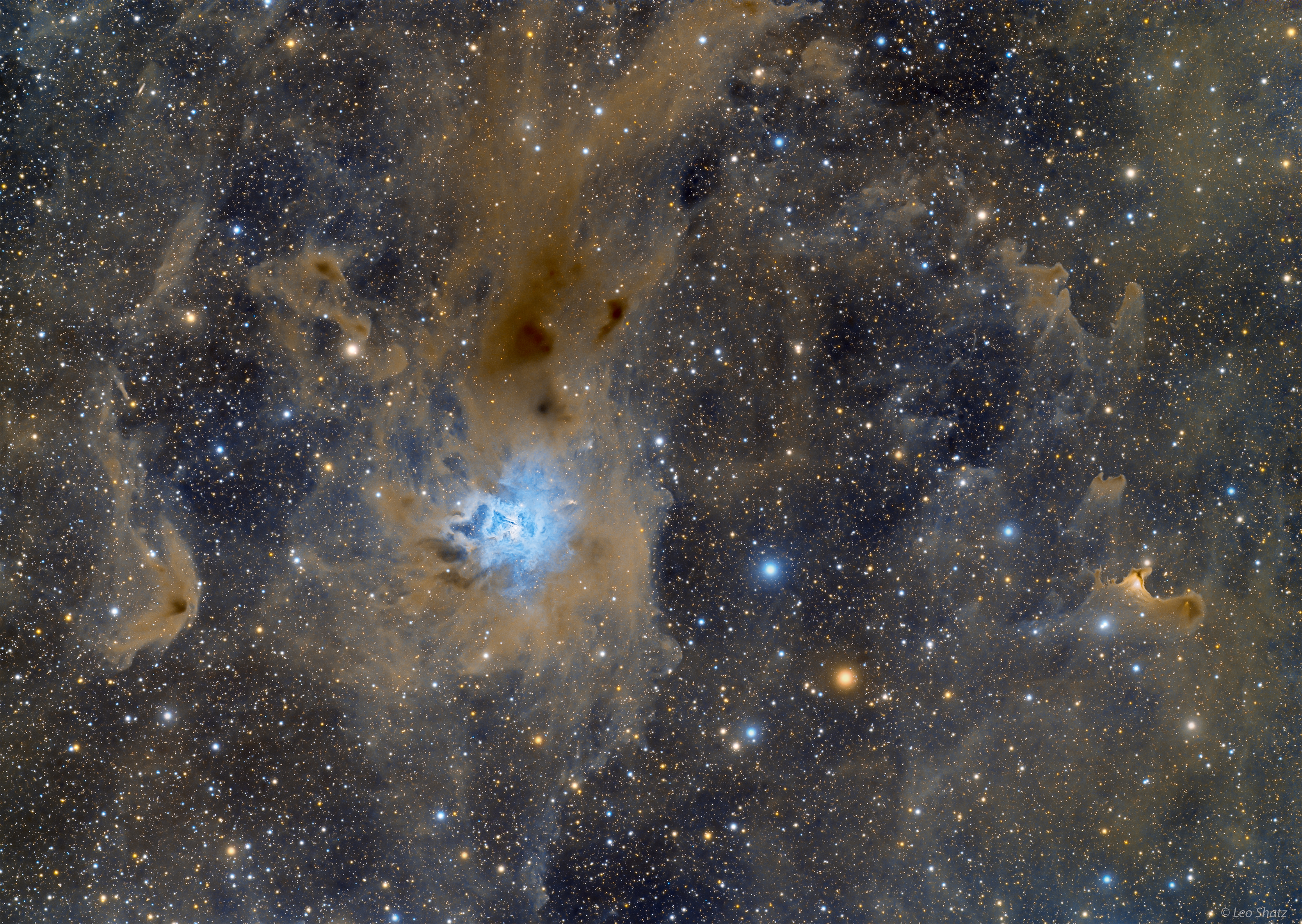
Spooky shapes seem to haunt this dusty expanse, drifting through the night in the royal constellation Cepheus. Of course, the shapes are cosmic dust clouds visible in dimly reflected starlight. Far from your own neighborhood, they lurk above the plane of the Milky Way at the edge of the Cepheus Flare molecular cloud complex some 1,200 light-years away. Over 2 light-years across and brighter than most of the other ghostly apparitions, vdB 141 or Sh2-136 is also known as the Ghost Nebula, seen at the right of the starry field of view. Inside the nebula are the telltale signs of dense cores collapsing in the early stages of star formation. With the eerie hue of dust reflecting bluish light from hot young stars of NGC 7023, the Iris Nebula stands out against the dark just left of center. In the broad telescopic frame, these fertile interstellar dust fields stretch almost seven full moons across the sky.
Formas espeluznantes parecen aterrorizar esta extensión polvorienta, flotando a través de la noche en la constelación real de Cefeo. Por supuesto, las formas son nubes de polvo cósmico visibles en la débil luz reflejada de las estrellas. Lejos de tu propio vecindario, se esconden por encima del plano de la Vía Láctea en el borde del complejo de nubes moleculares de la Flama de Cefeo, a unos 1200 años luz de distancia. Con más de 2 años luz de ancho y más brillante que la mayoría de otras apariciones fantasmales, vdB 141 o Sh2-136 también se conoce como la Nebulosa Fantasma, visible a la derecha del campo estrellado. Dentro de la nebulosa se encuentran las señales características de núcleos densos colapsando en las primeras etapas de la formación estelar. Con el tono siniestro del polvo reflejando luz azulada de estrellas jóvenes y calientes de NGC 7023, la Nebulosa Iris destaca contra el oscuro fondo justo a la izquierda del centro. En el amplio marco telescópico, estos fértiles campos interplanetarios de polvo se extienden casi siete lunas llenas a través del cielo.